Hello there furiends, Happy Wednesday! Finally, things are getting organized in our neck of the woods and the home office is working for our Purrsonal Assistant so that we can actually get some decent work out of her. There are still a few things to organize and rearrange but we are making progress.
The Human likes old stuff and purrticularily likes to collect old tool boxes, especially the painted ones. She brought one home from her business and I’m trying to decide if this is something I need.
“Human, what is this, is it for me and how should I use it?”
And since The Human is spending most days working in the home office, we like to hang out with her too. In this photo, I tried a new sleeping spot and position. Methinks I won’t be using that one too much.
Good view but not so comfy.”
We’re just happy to be getting back to our work schedule so, without further ado, here’s this week’s newsworthy feline stories from around the web.
An Engineer’s Guide to Cat Technology of the Future
Professional engineers Paul and TJ have done some of the most hilarious cat videos from an engineer’s point of view. This is there latest video which is a summary of cat technology and they discuss what cat technology will look like in the future. This video took them ten years to make! If you haven’t watched their previous videos, I highly recommend them!
I don’t know about your humans but The Human at our house isn’t happy until she locates all three of us when she gets home. Even though she tells herself that we have a lot of hiding places and chances are, if one of us doesn’t come out when she shakes the treat can, it doesn’t mean we’re not in the house. If your humans act the same way then tell them to get you a Tile -tracking bundle that includes one of the company’s Sticker trackers and a new collar attachment to truly secure it to the feline.
This tracker is more comfortable for us to wear and can be detected from 250 feet away which is why it’s a better in-house tracker than an outside tracker. It also has a battery that lasts for three years.
You can get the tracker in either black or white and it’s affordable at $40.00. And some of us, if we do make an escape, hang out very close to home. When Lily did a Houdini on us this winter, she was hiding under the wicker furniture on the front porch (and meowing like crazy!)
Now here’s something new and different, some scientists have gotten together and studied how we cats respond to you humans when you point. This kind of study has been done with dogs but, as usual, we cats were left out of the scientific loop.
“This study came about because a student, Margaret Mäses, approached me and said she would like to test cats,” says Wascher. “I was absolutely up for it because cats are an interesting and understudied species.”
Wascher and Mäses set out to replicate and expand on a study from nearly 20 years ago showing that cats may be able to follow human pointing gestures.
To find subjects, Mäses meticulously evaluated the suitability of approximately 200 rescue cats housed together in a shelter in Lithuania. Out of these cats, she worked to identify those who were open to being isolated in the testing room with a stranger.
“I do have to credit Margaret, who was absolutely brilliant in being able to identify individuals who were not fearful or anxious and were interested in taking part in the study,” says Wascher.
Out of the 200 cats at the shelter, Wascher and Mäses ended up with a sample of nine cats who completed testing. Now you might be wondering, why so few? She explained, “One of the problems was that so many of the cats were not interested in the test or in being isolated in the room or in whatever this strange human wanted from them,” says Wascher. “In cognitive tests like these, it is important that the subject know what question is being asked of them and they are motivated to take part in the experiment.”
Mäses presented the cats with two cups, each containing a small amount of food. She tested the cats in two conditions: one in which she pointed directly at one of the cups and one in which she pointed across her body at one of the cups.
Overall, the results showed that cats are able to follow human pointing gestures. As a group, the cats’ success rate was about 75 percent, and they performed significantly above chance whether the pointing gesture was direct or across the body.
While this replicates and expands on the previous study, Wascher said further research is needed to understand this behavior’s underlying mechanisms.
Wascher said this study also adds to the growing body of literature suggesting that species not typically thought of as highly social may still be able to master social-cognitive tasks. Even though cats usually do not live in huge, socially sophisticated groups, socialization with humans may give them a chance to exhibit their social-cognitive abilities.
Finally, Wascher hopes research like this will help cat owners better understand the behavior and cognition of the animals in their care.
“For a long time in science, the cognitive abilities of other species were underestimated,” she says. “I think a better understanding of how other animals think and feel creates an environment where humans tend to be more careful with them.”
“Now don’t forget your lines and please, meow as though you mean it.”
I think all cats should be famous and, if you’re a Boston feline, you may have a chance to be in a commercial, and get paid $1200.00 (that’s a lot of kibble and catnip my furiends!)
The cats, according to the casting call by Boston casting need to be comfortable being outside and in a harness. The cats and their owners also need to be available to film the commercial either the week of May 8 or May 15.
To be considered, email a photo of your cat, their comfort level with a harness, a photo of the cat’s owner, where you’re based and contact information to pets@bostoncasting.com. The subject line should be “CAT CASTING // [your name].”
The Human is bummed that we don’t have an opportunity to contribute to our lavish lifestyle so she’s on the computer looking for cat casting companies in our area.
Furiends, we kitties can suffer from terrible sun damage and the story of Dora the cat is a cautionary tale. Dora was an outdoor kitty who lived in an industrial area with her kittens. When wharehouse workers saw the state she was in they took her to the local shelter and were shocked to find that the problem with her ears could be cancer.
After a thorough vet check, the decision was made to operate and remove the tips of her ears in the hopes that the damage wouldn’t spread.
It isn’t just the ears of pale colored cats that can be sun damaged but also our noses (if they are unpigmented and white or pink). Sun damage and skin cancer will often appear as a pink, thickened or scabbed area on the ears or nose and also may cause hair loss and itching. As it progresses it can become ulcerated and bleed or cause black crusts to form.
Dora made a full recovery and has been adopted into a loving home. Her new human said, “I spotted Dora on the website and she looked so sad and frightened that I instantly knew I wanted to give her a forever home,” Dora was timid when she got to her new home but within a week she was moving through the house (which is how she got her name because she’s always exploring).
Hello Furiends! I hope your week went well. It’s been nice here in our neck of the woods. The snow is finally starting to melt and we are enjoying finding sun puddles in the house to “recharge”. The Human did have an exciting surprise this week. She came home to find a package from Chewy and lo and behold, there was a painting of Lily, from one of Chewy’s talented artists.
“I think this painting captures me beautifully.”
Now I say “one of the Chewy artists” because The Human did receive a lovely portrait of my brother Oliver and the signature on the painting is different than the one on Lily’s portrait but also beautiful!
“I am a handsome fellow!”
Now it’s not that I begrudge Lily and Oliver their fame but I am wondering when it will be my turn, I think I’m a pretty handsome man cat.
“Dear Chewy, when will I be immortalized in a painting?”
Oh, and if you’re wondering how being captured for posterity in oil has affected Lily……….
“You may now approach me peasants.”
As I mentioned, we’ve been having sun!! While The Human mumbles about how the sun shows how dirty the living room windows are, Ollie and Lily took advantage of the soft sofa and the sun puddles.
Oh well, purrhaps it’s time for me to stop sulking about the painting …but then again….
“Here’s the deal Human, get a painting done of me and I’ll get off your paperwork, capiche?
Well, enough about us, let’s see what’s new in the feline news world.
A cat named Teddy was found in a pile of rubble six days after a gas explosion in a house in south Wales. The March 13 blast killed one person. Teddy’s human and her son were taken to the hospital and both recovered from their injuries. Another family feline and their puppy had been rescued but for a week there was no sign of Teddy. Thank goodness rescue workers never gave up and, when Teddy’’s human showed up after she was released from the hospital and whistled for him, Teddy the Ragdoll emerged from the wreckage. I love stories with happy endings!
A street performing cat in Taiwan has won over the internet and the locals with his vocal purrformances. The song he and his humans sing is a love song that has a hook that plays on the onomatopoeia of the sound a cat makes. Onomatopoeia is a word that imitates a sound like “buzz” or “sizzle”.
Roughly translated, the first line is, “We can learn to meow like cats, we go meow meow meow meow meow.” Needless to say, this is a purrfect line for a cat to sing. As he’s brought to the microphone to sing the cat delights the crowd and his fellow human singers. You can watch the wonderful purrformance in a clip posted to TikTok.
I quite fancy a singing career however The Human can’t sing at all so I’d have to find my own human band. Anyone out there want to go on the road?
Newsweek has a weekly pet winner and this week’s winner is Murray, adopted by Lisa Russel in 2021. Lisa, like The Human, took Murray to foster and of course, became a foster failure (a badge of honor).
Murray, was adopted in the fall of 2021, his owner told Newsweek: “I was just supposed to foster him for a week or two…but we all know how that can go.”
Murray had been living in downtown San Diego until his owner was no longer able to care for him. A call for help with fostering was sent out to the community and Russell answered the call. As soon as she she saw Murray he was her forever cat.
Murray loves to travel in the stroller in the big park near his house. Russel says, “He hangs his little arm over the edge of the stroller like he’s driving a sorts car. On nippy days, he dons a scarf made by a neighbor-it’s blue to match his eyes, of course.”
“When Murray hears me tell the dogs that it’s time to go to the park, he runs to the bottom of the stairs along with them. He’s rarin’ to go,” said Russell. “I do put a collar and leash on him so that he is secure in the stroller. He is a very good boy, but I want to be safe and not worry about his reflexively hopping out to chase a lizard or bird.”
I’m thinking about all those lucky folks in the San Diego park who meet Murray when he’s out and about and get a “Murray paw shake”.
From then Instagram account of Anthony Klein and Sammy
Anthony Klein and his ginger feline companion Sammy are best buds. They do a lot together including singing duets. Klein shared a video on Instagram showing his drowsy cat as he serenades him with the song “Twinkle, Twinkle Little Star”. In the video, Sammy joins in the singing.
As you may have guessed, the video has gone viral. These two are a purrfect match, in life and in singing. Don’t forget to check out their Instagram account.
Happy Wednesday Furiends! We hope things in your neck of the woods are going well, although we know some of you are really suffering through a crazy winter. Still, it’s all about your purrspective. We are getting spring fever with these high temperatures and The Human even ran out of the house without a coat this morning. Weather Kitty understands our purrspective here in the Inland Northwest as evidence by the photo today. You may call it chilly, we call it spring!
What a difference a week makes. This video was taken last Friday. It was, in the words of Winnie the Pooh, a rather blustery day.
And when the weather’s like that, this is how you’ll find us.
We found some great holidays to celebrate this week, we invite you to enjoy them too!
On March 17th we’re all Irish!Oliver invites you to join him for one of his favorite holidays on March 17.This may not be Lily’s favorite holiday on March 18th but she bets you can all relate?
Well, that’s it for our neck of the woods. We hope you enjoy your week and whatever holiday you wish to celebrate (except maybe Awkward Moments Day!)
“I’d rather go to the vet in my harness than a carrier.” – Oliver
The heading of this article made The Human but after we read it, it made a lot of sense. The sense of self control in situations is strong in humans and dogs and MUCH stronger in cats because, to put it bluntly, we felines like to have control
We felines, this shouldn’t be viewed as a negative trait; control gives us a sense of safety. With cats, the idea is to reward and reinforce good behavior and that constitutes allowing the cat to give consent or to participate.
In the example of carrier training, if the only time a cat sees or is shoved into a carrier is to go to the vet; the cat will be less than enthusiastic about the carrier.
The following cat carrier trips are from Marc Bekoff, Ph.D., and Steve Dale:
Leave the carrier out 24/7. If the cat was previously afraid of a carrier because of the negative association made with the veterinary visit, purchase a new carrier that looks different.
Randomly drop treats into the carrier so it becomes an automatic treat dispenser.
Once comfortable inside the carrier, begin to feed the cat in the carrier. Most cats may now hop inside, expecting a treat for doing so. Cats do train people—and now you comply.
Now, ask your cat to hop into the carrier on cue—and always offer high-value award for doing so.
Ask your cat to leap into the carrier, close it, and walk to another part of the house. Once there, open the carrier and feed. Good things happen after being inside the carrier.
Finally, teach the cat that car rides aren’t bad—before going to the vet, just drive around the block, and when returning home give them a meal. And when you do go to the veterinarian, go for a happy visit—no exam, only treats.
These steps are much better than force and working with your feline to make him see the carrier as something other than an item of fear will be beneficial.
Marc Bekoff, Ph.D., and Steve Dale address the issue of petting and over-stimulation as well, saying that “petting is okay as long as the cat consents.”
They say, “For cats who typically allow only a minute or two of petting, stop petting after around 30 seconds. Quit while you’re ahead, leaving the cat to decide, “I want more.” If so the cat asks to be petted more, offer only a few seconds, continuing to leave the cat wanting still more. At some point, the cat will likely say, “Okay, that’s enough.” You can increase the time you spend petting your cat while still allowing the cat to maintain control.
Likewise, if you want to play with your cat, be sure your cat tells you it’s okay. Cats, dogs, and other animals clearly express their intentions and have to consent for fair play to continue; it’s best to be sure they want to play with you.
The article notes that “giving cats control by granting them agency and asking for their consent supports their need for safety, security, and trust, makes them happier, and enhances the social bonds you form with each other.” This feline agrees wholeheartedly.
When Barbara Thorpe passed away in 2002 she put most of her money in a charitable trust. A trust is a legal arrangement where the money set aside must be spent according to the wishes of the person who sets up the trust.
Barbara wanted her fortune to benefit the cats of Dixfield, Maine but for many years her money sat in the trust, unused which was contrary to the law. Eventually, Brenda Jarvis along with four other cat ladies in town joined together to sue to liberate the money on behalf of the cats of Dixfield. The cat ladies lost their lawsuit but their efforts attracted the attention of Christina Moylan, who is an attorney working for the Attorney General of Maine. Christina’s job is to ensure trusts are handled properly.
In the matter of trusts, Christina says that the law must follow the instructions of the dead forever, even if the world changes, even if the instructions seem vague.
It took a few years but Christina did find a way to honor Barbara’s wishes and she found an animal shelter that was willing to manage the money and now, the shelter is taking in stray cats from Dixfield.
We say two paws up for Christina Moylan and for following the law and finding a way to honor Barbara Thorpe’s wishes to care for the feral cats of Dixfield, Maine.
People, people, people…how many times will I have to report on a cat going through an airport scanner before this madness stops?!
A cat was discovered inside a passenger’s carry-on baggage when it went through the security checkpoint in a Virginia airport.
Good grief, if you remember to take your computer out of your bag before it goes through the scanner how can you forget your cat in his travel case?????
This feline can’t wrap his mind around this and all I can do is reiterate, TAKE YOUR CAT OUT OF THE CARRY-ON BEFORE IT GOES THROUGH THE SCANNER!!!
On its website, TSA provides travelers information about guidelines on traveling with pets stating they should never be put through an airport’s X-ray tunnel.
Dogs and cats, for example, can either be screened privately in a separate room or walk with a traveler through the metal detector on a leash and then the empty carrier can be sent through the X-ray machine.
He likes to be carried around in a paper bag in the house so I thought I’d try it outside. He didn’t try to jump out and just relaxed.
We love the folks at Bored Panda because they find some of the funniest cat photos. They found some of these on the Reddit community thread called “This Is My Life Meow” and when you’re done checking the Bored Panda photos you can always find new ones on the Reddit thread.
This one was the Tribe’s favorite. Let us know which one is your favorite.
The felines in residence at the home of two Redditch, England humans are living La Vida Loca. They have their own bedroom (that cost over 300 UKL ($361.00) to furnish) with a full sized double bed, crown shaped cat beds, lots of toys and a budget up to 100 UKL ($120.32 at today’s rate of exchange) a month for treats.
Hannah Whitmore, 24, a service adviser for a car dealership, loves cats, so when she moved in with her boyfriend, 25-year-old bricklayer Tommy Taylor, the couple adopted two felines – Simba, 10, and Nimbus, one. Kudos to them for adopting an older cat!
Tommy refers to himself as a “cat dad” and always speaks to the cats when he gets home. Hannah changes the cats’ bedsheets in their room every week.
“I would say the cats own us rather than the other way around!” Hannah laughed.
She continued, “They are here for a short time, and they should be our priority. They very much come first in our house, but I think that’s the way it should be. I definitely spoil them in a materialistic way. But Tommy is very affectionate with them. When he gets home, he’ll talk to the cat before he talks to me!
Tommy, the self-proclaimed cat dad had to be convinced to adopt the cats but during COVID when he and Hanna stayed with is grandparents and their cat, the cat won him over. When the couple moved into their three-story townhouse they went to Cats Protection in Birmingham and adopted Simba.
Nimbus joined the family about a year later.
The casts are inseparable, sleeping together, washing each other and loving each other.
And what if the couple has children and move into a bigger house? According to Hannah, the cat’s new bedroom will have to be twice as big.
These cats are living the high life and I’m thinking The Human needs to step up her game.
Happy Windy, Wintery, Wednesday furiends! We were sailing along in our neck of the woods, convinced that spring was just around the corner when all of a sudden it turned into Siberia! The Human was outside with the snow blower this morning and as we watched from our warm window perches we couldn’t help but laugh because the wind was so strong it blew most of the driveway snow back on her. She was quite a sight when she came in. Right now it’s a balmy 19 degrees and the wind has died down to 9mph and the town streets are like skating rinks. We felines are happy to burrow under a pillow and stay safe and warm.
“Human, why are you covered in ice and snow? Please keep your distance, I am nice and warm in this chair.”“Good grief Human! Why are you all wet? find yourself a nice spot on the bed and cuddle up with me and my pillow.”“I know I’m squishing the chair cushion, what’s your point?”
There are all kind of cat daddy’s out there, even cowboys. Andrew, a true Texas cowboy has turned his home into a cat sanctuary. Today he as seven cats in residence. Andrew has caught attention of the web for posting videos of his relationship with all his cats. His video about his favorite orange cat, Sebby is a real hit. Andrew carries his feline with him wherever he goes, in his hat and in his heart. He also wants to make clear that he loves ALL his cats. You can watch his TikTok video here.
When The Human read this she nearly fainted. This converts to $481.87 per month. Meowza! But, William Powers, a physician from Farmington Hills, Michigan, owns six cats – including the world’s tallest and one with the longest tail ever measured. Our Human is no slouch and spares no expense for our healthy meals but we usually cost her about $145.00 a month for the three of us.
His cat, Fenrir, the worlds tallest cat is a Savannah cat and measures an impressive 18.83 inches and weighs 36lbs. I can see where his food consumption might be a bit more than ours!
William also has the Guinness World Record holder feline in his house, a Maine Coon called Altair who holds the world record for the longest tail (40.83 cm or 16.07 inches)The other four feline siblings are, two Bengal’s and two other Savannah cats. Fenrir has a custom diet made out of mostly raw meat, primarily chicken but sometimes other meat. Then the cats get a special blend of supplements such as amino acids, long chain fatty acids, porcine bone meal, and other additives like nutritional yeast for flavor.
Sometimes he’ll use some regular domestic wet cat food as a topper or mixed into their raw diet to improve the flavor.
William’s home is “designed with the cats in mind”. They have an outdoor enclosure, their own master bedroom with huge glass windows, and tons of towers and wall mounts for their enrichment.
Fenrir is quite the local celebrity with over 8,900 followers on Instagram, and often goes to William’s office to visit patients and do the work of a true therapy cat.
Fenir is a bit of a fraidy cat and will often hide if he’s in close proximity to other cats and dogs.
William and Fenir also make appearances at local shelter events.
The contest is for both photography and videography. You don’t have to use professional gear to take your photo or video but you do have to edit your submission using some form of Adobe Creative Cloud software, including but not limited to Photoshop, Lightroom, Premiere Rush, Premier Pro and Adobe Express. Any image with a cat as the subject is allowed.
Despite being launched by Adobe Japan, the competition terms and conditions do not state anywhere that entrants must be from a certain area or region to enter the contest – but the prizes up for grabs are all in Japanese yen.
To enter, you must be following the official Adobe Japan Creative Cloud Twitter or Instagram accounts, and post your image with the hashtag #アドビにゃん (Adobe cat) which must also be accompanied by one of the following hashtags: #写真部門 (photo), #動画部門 (video) or #猫大喜利部門 (cat ogiri) depending on which you enter.
divisions are the ones that have the highest award, also including what the competition refers to as an Excellence Award.
The grand prize for the photo division is an Amazon gift card worth ¥100,000 (equivalent to $745 / £614 / AU$1,088 approximately), and two people will also be selected for the Excellence Award and receive an Amazon gift card worth ¥50,000 (equivalent to $371 / £307 / AU$545 approximately). These will be exactly the same prizes and amounts for the Video division winners.
Just remember that, while the T&Cs don’t explicitly prohibit foreign entries, it’s unlikely that prizes (including Amazon vouchers) will be redeemable outside Japan but still, you could have some fun entering.
As a former shelter cat, this feline loves stories about creative ways shelters use to find forever homes for their cats. An adoption center and cat sanctuary in Los Angeles has gone viral after launching its “nice and naughty” cat of the week series.
Toni Barrett, development manager for Heaven on Earth Perry’s Place, said she and her staff were inspired by a popular cat influencer on TikTok who goes by the name “Pot Roast’s Mom,” who would label her own cats as “good or bad” cat of the week.
Barrett thought the idea was funny and decided to apply it to her work at the sanctuary, she told Fox News Digital.
“We should do that at Perry’s Place because we have so many cats, and we always have someone doing something naughty or volunteers telling us how much they loved [how] this cat was well-behaved this week,” Barrett said.
The series was launched on the shelter’s Instagram page in March of 2022, but did not take off until the fall, according to Barrett.
“It was slow [at first], people were enjoying it, and then all of a sudden we had this one [post] that kind of went viral,” Barrett commented.
Two felines named Elijah and Popsicle were awarded nice and naughty cat of the week, respectively.
“Elijah has opened up and shown the staff how much he loves belly rubs,” the post read in reference to the “nice cat” of the week.
“Popsicle stole treats from Daniel, his BLIND roommate,”the post also said, regarding its “naughty cat”.
Barrett quickly noticed a massive increase in Instagram followers as well as likes. Since then, thousands of users have been reacting to the posts.
Heaven on Earth’s Perry’s Place is the current residence for roughly 111 cats and 91 foster cats.
Volunteers and staff members are the ones to nominate a cat to be selected for the “nice and naughty” cat of the week award.
“Our adoption team has done such a great job that sometimes I’ll have a cat ready on Tuesday, and then on Friday that cat will be adopted, so then I have to scramble and find a new cat,” she commented. Now that’s the kind of problem every shelter would like to have!
I hope all is good in your neck of the woods. It’s been C-O-L-D in our neck of the woods! Today the temperature climbed up to a balmy 15 degrees Fahrenheit!
Since it’s a new month, Oliver, Lily and I decided to celebrate some of the occasions that are celebrated in the month of February. Enjoy andn don’t forget to celebrate!
Date night has been made so much better for folks in San Diego. Whiskers and Wine may be the only full restaurant, bar and cat rescue in the country. For a $30.00 fee you can have the attendance of some meowvelous felines while you enjoy a delicious dinner and some cocktails like a Whisky Meower. Whiskers and Wine is a hit and, since it’s opening in August 2022, has helped 80 cats get adopted. And, if you visit them on Saturday or Sunday mornings, you can purrticipate in yoga with cats. .Be sure and watch the video of this great place!
The Human often gets frustrated with my brofur Oliver and I when we suddenly go after each oither. She can’t tell if we’re really fighting or play fighting. Evedintely sh e’s not the only human who wonders about this. A new study published in Scientific Reports has investigated play and fighting in cats.
The scientists used observation to see if they could figure out this conundrum. The study, led by Noema Gajdoš-Kmecová from the University of Veterinary Medicine and Pharmacy in Slovakia and from the University of Lincoln, UK, analyzed 105 videos of interactions between 210 cats to find the answer.
After they purrused the videos, the research team then developed an ethogram – a list of specific behaviors and those were put into six groups:
Inactive: head and body motionless and in specific position, for example crouching
Wrestling: cats in physical contact with wrestling movements
Chasing: one cat runs in pursuit or another cat runs away
Other interactive activities: for example grooming, approaching, raised fur on back
Non-interactive: activity directed towards themselves or an inanimate object, for example drinking, self-licking
Vocalization: for example growl, hiss, meow
They went back and watched the videos again to identify which of their discovered behaviors were shown in the cats. Each interaction was then analyzed statistically to work out which behaviors appeared together in clusters.
They then separated the videos into three categories of interactions.
1-Playful: included 40% of cats from the videos and included wrestling and a lack of vocalizing.
2-Agonistic: agonistic behaviors (any social behaviors that include threatening, aggression, and submission). Cats in this group vocalized and had recurring bouts of inactivity; 32% of cats from the sample landed in this group.
3-Intermediate: this group included 28% of cats and was more closely associated with the playful group than the agonistic group. Cats in this group interacted for prolonged periods with pauses in between.
The scientists also had cat behaviorists review the videos and their conclusions. From their observations, the professionals provided some tips.
If your cats are wrestling, they’re probably playing. Normally, when there is friction between cats in a multi-cat household, they tend to avoid physical contact. Instead, they’ll use offensive or defensive maneuvers that don’t involve extended direct contact, such as slapping. This is true with our Lily. She’ll walk by Oliver or I and give us a big whacky paw for no reason, and then she strolls off.
If your cats are vocalizing, and chasing between periods of inactivity (such as crouching), they are most likely fighting. Vocalization is an especially important clue here to an aggressive rather than playful interaction. Chasing is OK if it’s mutual, but if one cat is chasing or one cat is running away, that’s not so positive.
The intermediate group is the tricky one. It contains elements of both playful and agonistic behaviors, though but more closely related to the playful than the agonistic group. This suggests play could become agonistic, depending on what happens during the interaction.
In particular, the authors observed frequent breaks within the interaction, which may allow cats to reassess their partner’s interest in playing and avoid escalation from play to aggression.
This study is the first to apply a scientific approach to cat behaviors anybody can identify, describing three types of interactions to help identify between play and fighting in cats.
It’s pretty easy for humans to figure out when cats are really fighting but this study helps in working out what’s happening when it doesn’t appear to be a real cat fight.
It’s also important to understand the relationship between cats. If they are buddies, share food and for the most part friendly with each other, you can let them have a little antagonistic play without worrying.
Everyone has that one coworker…
After watching this video, I can’t believe that anyone would complain about this wonderful employee!
This feline loves to learn about the history of my ancestors. This article is about how . Vikings prized cats for two reasons: their rodent-hunting abilities and their coats. In other words, when felines started slacking on the mousing, they faced transformation into a cape or a coat. (Note, this was NOT part of the history I enjoyed!)
As felines traveled on the conquering Viking ships as they pillaged and murdered their way through the British Isles, Iceland, Europe, Greenland and North America many found homes in these new places. (Perhaps if they knew they were in danger of becoming a coat, some of them jumped ship!)
It’s a bit hard to picture these violent people with pets but it’s true, they purrfered cats!
And how did the fabulous feline get to Scandinavia you ask? Recent examination of feline DNA from archaeological sites dating to 15,000 to 2,700 years ago suggests the ancestors of today’s cats expanded across the world during two distinct periods, separated by millennia. The first migration event saw them move from the Middle East into the Mediterranean. There, local farmers welcomed our ancestors, pleased to have effective rodent-control services in their fields and crop storehouses.
Still, even this cat knows that the Mediterranean is a long way off from Northern Europe, Archaeologists say that happened thousands of years later and began in Egypt. At this point, seafarers knew the value of felines in keeping from setting up shop on their ships. Some of these sailors were Vikings This was discovered in a Nordic site in Germany where scientists discovered cat DNA resembling that of ancient Egyptian felines.
That second wave of cat migration began around 1700 B.C. and picked up significant speed by the A.D. 400s. This conclusion was reached after reseearchers worked with animal bones from the Bronze age to the 1600’s.
Perhaps the most fascinating insight discovered by the researchers was the physiological transformation felines underwent over the centuries. Typically, when animals get domesticated, they shrink in size. For example, the average dog is about one-quarter smaller than its wolf ancestors.
When it comes to felines, however, DNA shows something altogether surprising. Instead of getting smaller, “domestication” caused cats to balloon. (I resemble that remark!) We know that the Egyptians treated us as gods and that the Vikings fed us very well! Thankfully that tradition continues today!
Instead of talking about life in our neck of the woods this week, I want to talk about an amazing place we just learned about in a very far away neck of the woods. We received an email from Peter, a volunteer at Velvet Paws Sanctuary, a small regional cat shelter in Hajdúszoboszló which is close to the second largest Hungarian city Debrecen.
Peter wrote that Velvet Paws isn’t a shelter but a refuge in the home of a woman named Ilona. She was active in shelter volunteer work until she moved to Hajdúszoboszló. She found that people there weren’t interested in the fate of stray cats so she decided to create a foundation to help wounded and ill cats from the streets and provide medical assistance, shelter and food and find forever homes for the cats. Peter wrote that there are cats everywhere in the house (at present there are 50) and the cats aren’t allowed in the garden in the winter as it is too cold. All of the cats are all socialized and given free access. An old white cat lives in the bathroom because he needs extra care and feeding. There is only one cage in the house and that is used to keep the new small kittens separate from the older cats in the house.
Peter does the web and social media work and is the only one who speaks English and who reached out to us. He explained that Hungarian taxpayers can send 1% of their tax to any listed foundation but as they are new, the sanctuary does not qualify yet. Peter also noted that he had registered the non-profit with TechSoup (a Google organization for non-profits) but they haven’t qualified yet for free Google advertising. We sent The Human over to Google to find out more about TechSoup and it doesn’t sound like they are interested in small non-profits like this one.
Everything done for Velvet Paws is done by volunteers and they rely on the kindness of the community to provide cat food and other supplies as well as help with veterinary costs. They are taking advantage of free social media accounts and use a free Wix website as well and don’t have the funds to hire professionals. I say they’re doing a good job with the volunteers they have but things could always be better.
Their website,Twitter account and YouTube channel tell the stories of cats they’ve rescued. This story about Bársonyka, found when she was three months old, especially touched my heart. Her name means Velvet Kitty and when she was found two of her legs were broken and she had a traumatic diaphragm hernia. After her fractures were fixed and her hernia surgery completed, she was fine. She’s now waiting for someone to adopt her. Her surgeries cost the sanctuary $400.00. You can find this story and others on their website. They also have a program where you can virtually “adopt” one of their cats.
I hope you will check out this very deserving sanctuary and, if you are so moved, to help them in whatever way you can. Spreading the word about them is a big help so please share the story of the good people in Hungary who donate their time, treasure and home to help cats in need. And I know many of my furiends are well versed in the cat saving biz so if you have any ideas that could help them, please let them know. If your Hungarian isn’t up to snuff, you can send an email in English to Peter at hungarianvelvetpaws@gmail.com.
I love these amazing felines! They are traveling the country and if you have the chance to see them take it. I would caution you not to expect any of their feats from your felines in residence, even if all the Acro-Cats are formal strays.
The current show is called “Meowy Catmas” and will be in various venues in the New Orleans area until Dec. 18th.
There will also be a special appearance by The Rock-Cats, the only cat band in the world, playing seasonal carol selections such as “A Cat in a Manger,” “Catnip Roasting on an Open Fire” and “God Rest Ye Merry Kittens.”
In addition to being on “Cat People,” the Amazing Acro-Cats have been featured on national TV shows including “The Late Show with Stephen Colbert,” Animal Planet’s “Puppy Bowl,” “CBS News Sunday Morning” and PBS Nova’s “Cat Tales.”
Tickets range in price from $35 to $50. The first week of shows offers a $5 discount when purchased online. For show dates and times, and to purchase tickets, visit www.rockcatsrescue.org.
Tickets are also available at the door. This two-hour performance has limited seating, so advanced ticket purchases are suggested as it is always a sellout.
Volunteer opportunities are available during the show that will earn you a free ticket. Learn more here.
The Acro-Cats tour supports the Rock Cats Rescue, a 501(c)(3) nonprofit organization. Rock Cats Rescue is focused on saving cats “one click at a time” through cat welfare, rescue and adoption. Acro-Cats performances promote the importance of bonding and training cats with positive reinforcement, while also finding homes for rescued cats. Rock Cats Rescue has found homes for 310 cats and kittens since 2009.
Have you been seeing the word ‘dabloons’, or doubloons, a lot lately, and are confused as to what is going on? Well evidently this feline isn’t the only one confused.
I did some research and will hopefully answer your questions about the dabloon movement.
When I asked The Human what dabloons were she thought I was talking about doubloons which are gold coins dating back to 16th century Spain and used as currency for hundreds of years. Those aren’t the ones I’m talking about. The ones on TikTok came from a meme (said to have been on Instagram) from 2021 with a cat holding out a paw and the words, “four dabloons”. Each toe was worth one dabloon.
The meme quickly became popular on Tik tok and has evolved into “Dabloons” andnow refers to an imaginary currency. This doesn’t surprise me. Humans have been involved in quite a bit of imaginary currency these days. It is a fictional currency used to trade fictional items and only for fun and not to be taken seriously.
The meme quickly became popular on Tik tok and has evolved into “Dabloons” andnow refers to an imaginary currency. This doesn’t surprise me. Humans have been involved in quite a bit of imaginary currency these days.
It is a fictional currency used to trade fictional items and only for fun and not to be taken seriously.
The meme quickly became popular on Tik tok and has evolved into “Dabloons” and now refers to an imaginary currency. This doesn’t surprise me. Humans have been involved in quite a bit of imaginary currency these days. It is a fictional currency used to trade fictional items and only for fun and not to be taken seriously.
How it works
Humans collect ‘dabloons’ by just counting up how many times they have seen dabloons online. In other words, if you see dabloons, you get dabloons, and each meme is worth four dabloons.
Humans are going to great effort toe create this dabloon economy in extreme detail. You can get into dabloon debt, dabloon theft, some are tracing dabloon inflation, and there are even claims of a dabloon IRS (the American Inland Revenue Service).
Dabloon shops have popped up, such as @dabloongrocerystore, offering items as innocuous as eggs and flour. You may come across videos featuring cats declaring “hello traveller” as though you are a weary adventurer making your way around the internet. They will then offer you a variety of items with prices in dabloons, which you can choose at your leisure. Hmm, maybe I should check this out for Oliver, he could use a job.
You have to keep track of your own dabloon spending, which some people are doing using excel spreadsheets.
Some people started to give away infinite dabloons, but this has started to play havoc with the economy. The hashtag dabloons has been viewed 520 million times on TikTok.
This feline has concluded that some of you humans have waaaaay too much time on your hands!
How do cats always land on their feet? Far from being some human urban myth, the majority of felines dropped from a height manage to land on all fours; from your domestic feline to the king of the beasts, feline agility is at work.
The falling cat question has been under scrutiny by scientists for many years.. (There’s even a book about the phenomenon.) Back in 1894, Étienne-Jules Marey captured the arc of a cat falling on film, creating a slow-motion series of frames that showed what was happening. As Ars Technica describes, when it was first presented, Marey’s slo-mo cat fall led esteemed physicists to declare that cats were acting “against the known laws of physics.”
Regardless of feline agility defying physics, Marey’s film captured a cat showing the “bend and twist” necessary in mid-flight to bring its legs underneath its body for a safe landing. Each frame showed how the cat flexed its spine and rotated its legs to land “butter-side” up, so to speak.
In a BBC video, the wild cat, native to Africa, the Middle East, Central Asia, Pakistan and northwestern India, falls gracefully to the ground. Following the slow-motion frames, the narrator describes the sequence of events.
As the feline orientates itself in space to determine which way up it is facing, it starts a two-direction rotation. The forelimbs go clockwise while the rear spins counter to that. The cat holds its front legs close into its body similar to the way ice skaters do to increase speed of spin. This is key as it allows the animal to exert a force against the rest of its body, with the flexible spine allowing the rotations to continue. As the cat rights itself it brings all four feet underneath and arches its back to prepare to absorb the landing. Muscular and flexible limbs held perpendicular to the main body mass absorb the compression and impact forces for a successful landing.
Feet landings have helped cats survive in the wild and they have another advantage that makes them more likely to survive a fall: Their terminal velocity is low. Terminal velocity is the limiting uniform velocity attained by a falling body when the resistance of the air has become equal to the force of gravity. (I had to copy this as science is not this feline’s strong suit!) In other words, it’s the fastest speed a falling body gets to in free flight since resistance to the air limits the acceleration attained. To put it in non-sciency terms, we cats deploy a fluffy parachute by stretching ourselves out, a little like a flying squirrel. (I’m not so sure how I feel about being compared to a rodent but I digress).The scientists say this makes our terminal velocity around 60 miles per hour. You humans hit terminal velocity at 120 mph.
Fascination for feline agility extends to robotics, where building machines that are capable of self-righting, landing correctly or surviving falls offers a lot more versatile. This curiosity also extends to space, where NASA studied how cats fell in order to coach their astronauts on how to move around in zero gravity.
Once again, science proves what amazing creatures we felines are.
Over the years, we’ve seen unusual feline faces become instant social media sensations. Cats like Lil Bub, Cinderblock, Grumpy Cat, Perdita, and Jorts became overnight stars.. And now it’s time for everyone to hear about Fishtopher, a cat that’s become famous for looking really depressed.
Fortunately, only a couple of days after the internet discovered Fishtopher, there were plenty of people interested in adopting him. In a Facebook post from last weekend, New Jersey’s Homeward Bound Pet Adoption Center said that the cat’s “sad, fat face” had led to “hundreds of inquiries” and a line of people waiting outside its building for a chance to take home a rising star.
Among them were Laura Folts and Tanner Callahan, a couple from Baltimore who, NBC News states, took a two-hour drive to wait outside for the shelter to open on the weekend. They ended up being the first in line and adopted Fishtopher.
Now, as was probably inevitable, Fishtopher has an Instagram and a Twitter account. He no longer looks sad and his accounts are used to both document this fact and share links to other cats in need of homes. I would say this was the best result possible from Fishtopher’s fame..
Happy Wednesday Furiends, It’s been a pretty routine week in our neck of the woods. We’ve been up to our usual shenanigans. Oliver is still deaf to The Human’s pleas to stop burrowing UNDER the sofa cover.
“Yes Human, I see the cat hair on the sofa. What’s your point?”
Lily heard that a friend of ours was feeling under the weather so she dressed up like a nurse. Lilly is a nice kitty but trust me, she is no medical purrfesional!
“I’m here to lend my purrfesional services.”
And Oliver thinks he’s some kind of comedian. Please don’t laugh as you’ll only encourage him.,
“Hey Al, what’s a cat’s favorite kitchen tool?”“I don’t know Ollie, what is a cat’s favorite kitchen tool?”“A whisker” MOL“Oh PULLEEZE”
Well, that was our week….oh wait, there was one other thing. The Human was contacted by the good folks at Chicken Soup and told her story “Miss P and the Turkey” will be in the February release, “Lessons I learned From My Cat”. We are happy for her but would have purferred that the story was about us. Oh well, maybe she’ll get her book finished and published because Oliver and I are in it!
Well, that’s it for news from The Tribe. Now here’s some feline news from the web.
First, let me say that it was a bit disappointing that it took a bunch of scientists to research the meaning of the “slow blink”. Sheesh, anyone who knows cats knows that’s our way of showing affection.
Scientists published a study in 2020 where they observed cat-human interactions and, as the article says, “… were able to confirm that this act of blinking slowly makes cats – both familiar and unfamiliar animals – approach and be receptive to humans.”
They do give humans a nod by saying that this is something many cat owners “suspected”. Many humans know this to be a fact.
The scientists say that our partially closed eyes, accompanied by slow blinking is similar to how human eyes narrow when they smile. In other words, the slow blink is a feline version of a smile.
The researchers then tested to see if humans copied this expression would they communicate friendliness and openness to their feline.
They did two experiments. In the first one, owners slow-blinked at 21 cats from 14 different households. The cats were settled and comfy and the owners were told to sit about a meter away and slow blink when the cat was looking at them. Cameras recorded both the owner’s face and the cat’s face, and the results were compared to how cats blink with no human interaction.
The results showed that cats are more likely to slow-blink at their humans after their humans have slow-blinked at them.
The second experiment included 24 cats from eight different households. This time, it wasn’t the owners doing the blinking but the researchers, who’d had no prior contact with the cat. The researchers performed the same slow-blink process as the first experiment, adding an extended hand towards the cat. And they found that not only were the cats more likely to blink back, but that they were more likely to approach the human’s hand after the human had blinked.
“This study is the first to experimentally investigate the role of slow blinking in cat-human communication,” McComb said.
Folks, you can try this at home and see how your felines respond. Narrow your eyes at your feline as you would in a relaxed smile, followed by closing your eyes for a couple of seconds. You’ll find they respond in the same way themselves and you can start a sort of conversation.”
I’m always happy to hear positive things about our connections with humans. The scientists stated the following:
This article contains important information and the facts are far beyond this feline brain so I am including this article in it’s entirety.
As veterinary professionals in 2022, few of us would have imagined that we would be diagnosing a fatal disease in young cats and telling our clients we know of a treatment but that we can’t administer, sell, or prescribe it—then suggesting they visit a Facebook page to purchase unmarked vials of a drug from China for thousands of dollars. But that is precisely the scenario in which we find ourselves in the diagnosis and treatment of feline infectious peritonitis (FIP) in the United States.
How did we get to a point where our only option is to suggest that our clients meet up with strangers from the internet with no veterinary training in parking lots to buy an unapproved medication to inject into their dying cats?
A brief history on the seemingly miraculous, unapproved treatment for FIP
Gilead Sciences, a US-based global pharmaceutical company, had been studying various anti-viral drugs for years with the goal of finding a treatment for the deadly Ebola virus in humans. Among the drugs they created and patented were GS-441524 and GS-5734—neither of which proved to be successful in treating Ebola.
Meanwhile, Davis Niels Pedersen, DVM, PhD, a professor emeritus of medicine and epidemiology at the University of California Davis, was fervently studying and trying to find a cure for FIP. He reached out to a friend, who was chief medical officer of Gilead Sciences at the time, to inquire about antiviral drugs that might help.
He received about 25 different drugs from their library to try, and two of them showed very promising results: GS-5734, now known as remdesivir, and GS-441524, which is metabolized to remdesivir in the body.
The results were incredible. They saw unheard-of cure rates in both artificially infected and naturally infected cats (between 80% and 100%). It seemed like the problem had been solved. Unfortunately, Gilead Sciences reportedly refused to license GS-441524, the simpler of the two molecules, for use in cats, and they later pursued remdesivir as a treatment for severely ill COVID-19 patients.
The fear was that performing the studies to secure FDA approval for GS-441524 in cats might hamper efforts to approve GS-5734 (now remdesivir) in humans because if studies using GS-441524 to treat cats had any adverse effects or undesirable results, this could influence the analysis of remdesivir for human use.
Remdesivir is now conditionally approved for emergency use in humans to treat severe COVID-19 infections, but without full FDA approval, it can’t legally be used off-label by veterinarians. GS-441524 is not approved at all, so it cannot legally be used either.
As a result, desperate cat owners are left with no choice but to reach out to FIP Warriors, a global network made up of cat lovers, breeders, and rescuers—many of whom have been through treatment with their own cats. They help owners of sick cats get vials quickly, share notes on the best “brands” to purchase, and teach owners how to give daily subcutaneous injections to their cats.
These are all tasks that would normally be performed by veterinary professionals. The other missing part to the current scenario is the drug safety, efficacy, and oversight piece. There are reportedly significant variations in the safety and success rates of products from different manufacturers, with one version even being blamed for killing cats in January 2021.
Promising new research
Researchers at the University of California Davis, where Pederson first discovered the success of those two molecules in treating FIP in cats, are taking up the charge.
Krystle Reagan, PhD, DVM, Dip. ACVIM, assistant professor of medicine and epidemiology, is leading several studies to find a treatment that is “readily accessible to treat cats diagnosed with FIP.”
In collaboration with a team at the University of California San Diego, she is using CRISPR technology to develop a rapid test that detects viral genetic material. This study is still ongoing, but researchers hope it will yield a more definitive and rapid test that could replace the diagnosis by circumstantial evidence and exclusion that is currently the norm.
Reagan is also the principal investigator on a clinical trial evaluating the use of GS-441524 and remdesivir in oral formulations to treat FIP. She reports that the efficacy of the oral formulations of both drugs appears to be good, and that this can provide an alternative to the daily GS-441524 injections, which are known to be painful to cats.
Reagan’s colleague, Amir Kol, DVM, PhD, Dip ACVP (Clinical Pathology), associate professor of pathology, microbiology, and immunology, is leading a clinical trial of his own involving the use of mesenchymal stem cells (MSCs) along with GS-441524 in the treatment of FIP.
Regarding the mechanism of action of MSCs in the treatment of FIP, Kol stated, “We still do not know if MSC treatment is effective in FIP. … Nonetheless, based on previous data, we expected MSC treatment to benefit cats with FIP by promoting three critical pathways that: 1) Decrease inflammation; 2) Rejuvenate exhausted T cells; and 3) Regenerate lymphoid tissue post infection.”
This trial may add to our treatment arsenal for a rare, but serious, complication in human children as well. Kol draws parallels between FIP, with its “massive inflammatory response in conjunction … with an exhausted antiviral specific immune response” and MIS-C, multisystem inflammatory syndrome in children, which can be a severe complication of COVID-19 infection.
MIS-C, he notes, is characterized by “1) Coronavirus-induced systemic hyperinflammatory disease; 2) Young age; and 3) T cell exhaustion.” He hopes that FIP in cats will serve as a good model for MIS-C in children, and that the findings from this study will benefit the treatment of both species. If success is seen in cats, MSCs are easily sourced for clinical trials in humans in the future, marking an “immediate translatable impact on children’s health.”
Seeking FDA approval for cats and humans
While none of these studies guarantee that a drug will be approved for veterinary use, we can hope that, with the preponderance of evidence for the efficacy and safety of GS-441524 and remdesivir in cats, one or both drugs can become licensed and FDA-approved for use in cats.
Even full approval for use in humans would open doors to legal extra-label use in veterinary medicine. The more we learn about these disease models in cats and humans, the better we can refine the treatment and enhance the response rates in both species.
While this story started with treatment needs in animals taking a back seat to treatment needs in humans, the next chapter can include cats, cat owners, and veterinarians finally getting access to lifesaving options for FIP, and better treatments for severe disease in both species.
Angela Eaton was fostering four kittens and when they reached that, “We want to play and we like your keyboard and computer stage” Angela tried to distract them with one of her computer screens. She would put on videos that felines like to watch (my favorites are birds and squirrels). When she saw how much the kittens enjoyed the videos she was inspired to create a videogame for felines.
Eaton’s video game that uses visual stimulation to engage the playful participation of cats and kittens have been branded Cattywhompus. It’s a multi-level game that displays moving targets like frogs, flying saucers, fish-that cats “catch” with a touch. And the cool thing is the game keeps score and your humans can brag about who well you did against the felines in other homes (those humans love to brag about us!) And if your human is a real bragger, they can upload their cat’s score to the Global Scoreboard to compare your cat’s points to cats around the world. Meowza!
The game is available for $2.99 USD and is available for iOS and Android. There are no in-app purchases or ads: pay once, play forever. Also, 10% of all profits from the video game will go to cat rescues throughout the country. Now that’s what this cat calls a “win win”.
Tell your humans to get you the app, we’re telling ours we want it and we’ll report back after we’ve played with it a while.
Many of you have probably seen this story on social media but wait….there’s more. Comedian James Felton shared the story on Twitter, musing on what could be going on and hilarity ensued. People began swapping tales about having the same situation…MOL, Who knew? Do yourself a favor and read the posts on this page, you won’t be sorry.
Times are tough for you humans and when you suffer, sometimes we felines suffer too. Chris Forrest thought he might have to give up his fur kids because he couldn’t afford to feed them any more. Imagine his relief when he discovered that there was a pet food bank in his neighborhood.
Chris loves his cats and said, “I would go without so my boys had food. They are like my children and I don’t know what I would do if I were to lose them. I’m welling up just thinking about it.”
Chris, who lives in Edinburgh, has four male cats – two five-year-old brothers called Galaxy and Shadow, and two four-year-olds called Leo and Sol. Chris is not able to work due to severe anxiety and depression and his cats help with his mental health.
Chris told BBC Scotland, “The cats keep me going – they interact with me and get me up in the morning as they need fed. I’m in a much better place having them, I’m more chilled out and relaxed.
They are so loving and give me cuddles and I burst out laughing watching them play together.”
Chris’ benefits were cut after the Covid pandemic, so he went to the Edinburgh Dog and Cat Home and they gave him pet food.
There are now 66 pet food banks in community centers across central Scotland, the Lothians and the Scottish Borders. Mike Dougan run the pet food banks who is the Edinburgh Dog and Cat Home’s community outreach and development manager.
He started the project when he discovered people were sharing the food they got from food banks with their pets. “A pet is part of the family and every pet we can feed is a pet that can stay in a loving, warm, safe home without fear,” he said.
Pet Food banks are an important part of every community. We have one in our neck of the woods, do you?
Well Hello There Furiends! It’s been a rather chilly and blustery week in our neck of the woods. We had a surprise wind and snow storm and The Human says it’s like Siberia out there. Another human she knows said that instead of bemoaning the weather, she was going to be grateful for the new trampoline and lawn furniture she found in her yard (I told you it was a bad wind storm!)
While The Human did her civic duty yesterday and worked the polls, The Tribe suffered. We had to get up at 4am for our breakfast and before bed treats didn’t happen until 11:00pm. We were on the brink of starvation and Oliver was a bit miffed that the breakfast service was lacking.
And we were bored….soooooo bored so Ollie and Lilly entertained themselves by doing some interior decorating.
But life has returned to normal and The Human was able to come home and finish this post and some other work while we enjoyed treats and the fire.
This week’s web features will be a little shorter than usual but, being the thoughtful felines we are, we gave The Human a break.
Although I am not a wandering feline, I did find this study interesting. Did you know that In August in the UK there were 264,933 missing cats listed across five of the most popular missing pet websites, with 55% of cat owners saying their cat has gone missing at least once, with 22% saying their cat has left home at least five times.
This is a good reason to keep your felines inside as research across the five biggest missing pet websites reveals that 184 cats go missing every minute – and 3 each second.
Survey data from cat owners across the country revealed the top circumstances where cats go missing. These include when owners move house (11%), go away on holiday (10%), have builders in the home to renovate (9%) or get another pet (9%).
With more than half (53%) of Brits confessing they’d feed a cat who appeared in their garden, it’s no surprise many cats explore their surroundings for food, attention and adventures. (This is why The Human is always meowing about “THINK LOST NOT STRAY!”)
The good news is, 41% of people who reported a cat missing had them turn up again of their own accord. Of these felines, 18% of owners found their missing cat near their home, 16% received a call from someone local who found their cat, another 16% reported their cat had been found trapped in a shed or outbuilding, and 13% said they found their cat at an old home.
To explore what cats get up to when they are away from home, Admiral Pet Insurance partnered with Tractive GPS pet tracker.
Research conducted by Admiral Pet Insurance reveals that over a quarter of a million cats are currently missing in the UK. The data gathered by the insurer originates from the National Pet Register, Pets Located, Pets Reunited, Animal Search and the Blue Cross, where collectively there are 264,933 cats listed as missing.
Over 60% of the cats listed as missing were male, with an additional 27,000 more male cats listed as missing than females. Of the 11,000 missing cats listed on the National Pet Register, over 7,000 were microchipped; however the remaining 4,628 were not.
In December 2021, the British government announced a new law that will require cat owners to get their cat microchipped to help reunite missing cats with their owners. Pritpal Powar, head of pet at Admiral Insurance comments: “It’s important to ensure your cat is microchipped as it’s a great way to help missing cats be reunited with their owners.
“Microchipping is a safe, simple procedure for animals and the microchip lasts a lifetime, but remember to update the information if you change address.” Note-all of our Tribe is microchipped.
Black cats are most commonly reported missing, with over 85,000 black cats currently at large, making up 33% of the total missing cat population. A quarter (25%) of all missing cats are white and 13% are brown.
In addition, 72% of the cats reported missing had monotone coats, for instance a fully black, white or brown cat, which could suggest cats with easily identifiable coat markers are reunited with their owners sooner, resulting in fewer listings for cats with mixed color coats, now that’s interesting.
On average, male cats spend 5 hours active per day, while female cats were only active for an average of 3 hours per day. In this time, they also travel further than the female cats in the experiment, who tended to explore the same areas but spend more time there.
Cat expert, Lucy Hoile comments: “Male cats are naturally more active and maintain a wider territory than females due to their innate drive to find mating opportunities. The more ground they cover, the more females they are likely to encounter.
Due to their increased activity levels, male cats were also found to burn on average 19% more calories than female cats. (Hmm, if that’s true why does Lily weigh only 8 pounds?)
A new research study about fearful cats was recently concluded. “We wanted to find out what factors are associated with the problematic behavior of cats, such as fearfulness, aggression towards humans and excessive grooming. We utilized a survey dataset previously collected in our research, which we have already used to investigate the construction of the feline personality,” says Doctoral Researcher Salla Mikkola from the University of Helsinki and the Folkhälsan Research Center
The survey included more than 120 statements used to score feline traits.
The fearfulness factor included statements on the cat’s reaction to strangers, sudden noises and changes taking place at home. Aggression towards humans included scratching or attempts to bite in conjunction with care, such as when being brushed. Excessive grooming included extensive and intensive grooming as well as self-mutilation by pulling hairs off with teeth, or by biting or licking.
“We investigated the link between these problematic behavioral and personality traits, and almost 30 behavioral, environmental and biological factors. For example, the socialization of cats with humans was associated with fearfulness. Cats who had come into contact with unfamiliar adults and children under 12 weeks of age only a few times or not at all were more fearful than cats who met strangers on a weekly or daily basis. Fearful cats also received, on average, higher scores for litterbox issues, aggression and excessive grooming,” Mikkola says.
Prior studies have also shown that fearfulness can lead to aggressive behavior, such as hissing and biting, if the cat sees no other way out of a frightening situation. No direct causalities can be established on the basis of the data.
“There were less aggression and fearfulness in households with more than one cat, but we cannot say for certain why this is. It may be that the companionship of other cats is an important stimulus for cats, or alternatively, people don’t want to take a mate for their aggressive cat due to its nature. Research carried out through a different design is needed to explain causalities,” says Professor Hannes Lohi.
Professor Lohi’s group will conduct research on feline litterbox issues in the near future. I say it’s about time those sciency people studied us amazing felines!
Cat’s GPS Reveals His Deepest Secret
This cat’s mom hired an electronic “private detective” to find out what her feline has been up to. If you want to follow Bernie’s adventures you can check him out on Instagram
Mickey is a black and white cat that lived at Top Ten Produce until recently. Alas, the rules regarding cats in grocery stores are clear and after Vancouver Coastal Health (VCH) received a complaint, the West Point Grey grocer had to bid the feline farewell. Luckily, Matthew MacDonald, the store’s manager, had space for Mickey at his home.
However, staff and their neighbors want Mickey to stay at the store, where he fills a variety of roles, from pest control to mascot to therapy cat. Mickey is a very multi-talented cat.
“I try not to watch people when they’re interacting with him because some of the interactions are so deep and people are really into him,” MacDonald told Vancouver Is Awesome. “He makes people feel special.”
Mickey arrived at Top Ten a couple of years ago, after a friend-of-a-friend found they couldn’t provide a good home for him. “We thought we had a better place for him, a better environment,” MacDonald says.
At first he was a bit of a scaredy-cat, but the store had lots of nooks for him to shelter in, and he became more comfortable with the human visitors. He also took on the job of mouser; when Top Ten faced a rodent issue a couple of years ago.
So far, no order has been given, but VCH has done an educational visit.
“The operation of food premises in B.C. is a regulated activity under the Public Health Act and an operator must not permit live animals to be on the premises. There are exceptions for service dogs and live fish in an aquarium,” a VCH spokesperson tells V.I.A.
They note the “use of live animals is also not a recognized component of an integrated pest management program for controlling pests in food premises.” Well as my feline granny used to say, “BALDERDASH!”
There has been a large wave of support for Mickey. So far, around 3,000 people have signed the online petition. When discussions with VCH continue, MacDonald says he’ll ask how to move forward.
However, he’s worried that while other shop animals fly under the radar, Mickey’s newfound fame may be to his detriment. “I’d like Mickey to stay here, but I’m scared. I feel this publicity means he cannot stay here.” And there you go; fame does have its problems.
Hello Furiends, I do apologize that I’m a day late with my feature but I did manage to obtain a little gift for you all as an apology for this (more on that in a bit).
We are in the full throes of autumn here in our neck of the woods and that means much cooler weather, even in the house. The Human keeps meowing about the budget and she has installed a thing called a “nest”. Although we’ve combed the hou8se searching for said “nest” we still haven’t found one but we understand it is to blame for keeping the temperature a frosty 64 during the day. Oh the horrible circumstances we are forced to live under! The temperature situation has forced us to put aside our differences and cuddle up.
Oliver felt a certain way about Halloween. Lily and I hung out in the bedroom but Ollie insisted on staying in the living room and running under the table every time the door bell rang.
And now for the little surprise. My regular readers have followed Oliver’s quest to keep the fall leaves under control but alas, we were having a sunny, non-windy fall and there was no leaf danger. That has changed and, in order to immortalize Oliver’s brave defense of our home, The Human put together this video. We hope you enjoy.
That’s it for us, I hope you enjoy this week’s news items.
You may be wondering why I’ve included this in my news report but I was intrigued and so was The Human as she’s about three chapters away from finishing a cozy mystery she’s writing that includes Oliver and myself in the story and she is considering adding this twist to the story,
Evidently new research has recognized that we felines can be sources of evidence in crimes. How is that you ask? Well the fur of a cat can retain enough DNA shed by a human who has been in their vicinity that it can serve as evidence. So, even though we felines can’t point our paw at the perpetrator and say, “He did it!”, we have other ways of helping to catch the bad guys,
This study is the first to examine how household pets can contribute to DNA transfer and there’s a lot more work to be done but it presents another opportunity to help in crime solving.
“Collection of human DNA needs to become very important in crime scene investigations, but there is a lack of data on companion animals such as cats and dogs in their relationship to human DNA transfer,” says forensic scientist Heidi Monkman of Flinders University in Australia.
“These companion animals can be highly relevant in assessing the presence and activities of the inhabitants of the household, or any recent visitors to the scene.”
In recent years, DNA analysis technology has become so sophisticated that even the most minute traces of genetic material can be relevant for a crime scene investigation. And we messy humans leave our DNA everywhere. Even just brief contact with an object can transfer traces of our genetic material.
Touch DNA obtained from a surface doesn’t even require that the human to touch that surface. It can be transported by a number of means, in skin cells or hairs that drift from a passing body, for example. Which is where we felines may play a role.
Monkman and her Flinders University colleague Mariya Goray, an experienced crime scene investigator, teamed up with forensic scientist Roland van Oorschot of the Victoria Police Forensic Services Department in Australia to see if they could extract traces of readable human DNA from pet cats.
Their study was conducted on 20 cats from 15 households. At the homes of the study participants, the researchers swabbed the fur on the right side of each cat twice, and collected DNA samples from the study participants. The humans also filled out questionnaires about the daily behavior of the felines in their homes.
Detectable levels of DNA were found in 80 percent of the cat swab samples. For all cats, there was no significant difference between the amount of DNA present, and the time since last contacted by a human, or length of hair on the cat.
The team was able to generate DNA profiles from 70 percent of the cats in the study that could be interpreted well enough to be linked to a human. Most of the DNA was from people in the cat’s own household, but on six of the felines, only unknown human DNA was detected (makes me wonder what strangers were touching those cats!)
One case was cited as being particularly interesting from a two-cat, two-person household. One of the cats, a hairless sphynx, carried the DNA of an unknown third human. The other cat, a short-haired ragdoll, did not. Both cats had interacted equally with the humans in their household.
Possible sources could include direct transport of the DNA from a human, such as by patting, or by the cat brushing against a contaminated surface. The DNA could also have been lingering since the last time the cat had contact with a visitor.
Further research is needed and will be done but in the meantime, if you are planning on committing any crimes…STAY AWAY FROM THE CAT!
Those of you who follow this blog know what delight The Human takes in photoshopping our Tribe so why should other humans be any different? These images of cat’s “reactions” to salad are pretty hilarious.
I have a tendency to get a bit “hissy” when humans attempt to put felines and their behavior in a box.
Solid Gold commissioned a study about feline purrsonaities which was conducted by OnePoll. Participants were asked to define the personality types their cat’s exhibited.
Over half (53%) said their cats were true “revenge seekers” when they hunt down their toys or hiss at the outside world. Nearly as many (52%) said their cats were “tornadoes” infamous for knocking items off of counters and causing a mess of mischief wherever they go.
Cat owners also have a near 50/50 shot of ending up with a “climber (51%) clawing their way up to the highest points of the home, or a “cuddler” (49%) who shamelessly lay across keyboards or piles of clean laundry to get some affection.
The study also found 65% swear their cats act like they’re from a completely different planet. A good portion of that sentiment comes from the strange things owners have caught their cats in the middle of.
Nearly four in five “cuddlers” (78%) are seen as complete angels by their owners when they’re not causing any trouble and 71% of “graffiti artists” are anything but angels when the havoc they bring has to be repaired or replaced by distressed owners.Solid Gold / SWNS / OnePoll
Many shared the wildest behaviors they’ve witnessed from their felines: gifting owners with their “kills” in the form of cat toys and pinecones, begging for bananas or learning to turn door knobs to get into rooms.
“We love our cats because of how unique their personalities can be,” said Steve Ball, CEO at Solid Gold. “No matter what kinds of chaos they bring, there’s no denying the things we would do for our furry friends. At the end of the day, pet parents want to make sure their cats are able to be their unique selves for as long as possible.”
Despite all the drama they cause, 70% of cat owners said there’s “nothing” they would change about their cat.
It seems all the frustration caused can be cured when cats turn cute, which according to those polled, is wherever they’re playing (50%), eating (40%), purring (37%) or sleeping (37%).
More than three in five (63%) said nothing is more exciting to them than mealtime for their cat. At feeding time, cats are most likely to let their humans know they’re ready when they meow (49%), paw (37%) or headbutt (34%).
“Mealtime is a universal ‘stop-destroying-the-home-and-come-eat’ moment for cats,” continued Ball. “It’s so important to make sure your cat is getting the proper holistic nutrition they need in order to get back to doing what they do best.”
While I find all this interesting, I still believe each feline is unique and trying to paint us all with the same brush is just wrong.
My brother Oliver and I are thankful that we were adopted together and this rescue story is great!
TikTok user @ZeroandOllie are a perfect illustration of why sometimes two cats are better than one. Adopted cats can be nervous in their new home and having a litter mate with them can help a feline adjust so much faster.
Sometimes the cats look like brothers. Sometimes they are like Oliver and I, nothing alike but bonded by love nonetheless. I can’t recommend enough that you consider giving two siblings a furever home!
There may be a cure for humans who get sneezy around felines.
Scientists at UCLA say they’ve tested a new form of treatment that might allow people to tolerate symptoms of cat allergies.
After a year, researchers found that those who received a combined therapy of tezepelumab and regular cat allergy shots had maintained resistance against allergic reactions.
Now I don’t know about you, but I am no fan of the Stabby place and getting stabbed and The Human feels the same way.







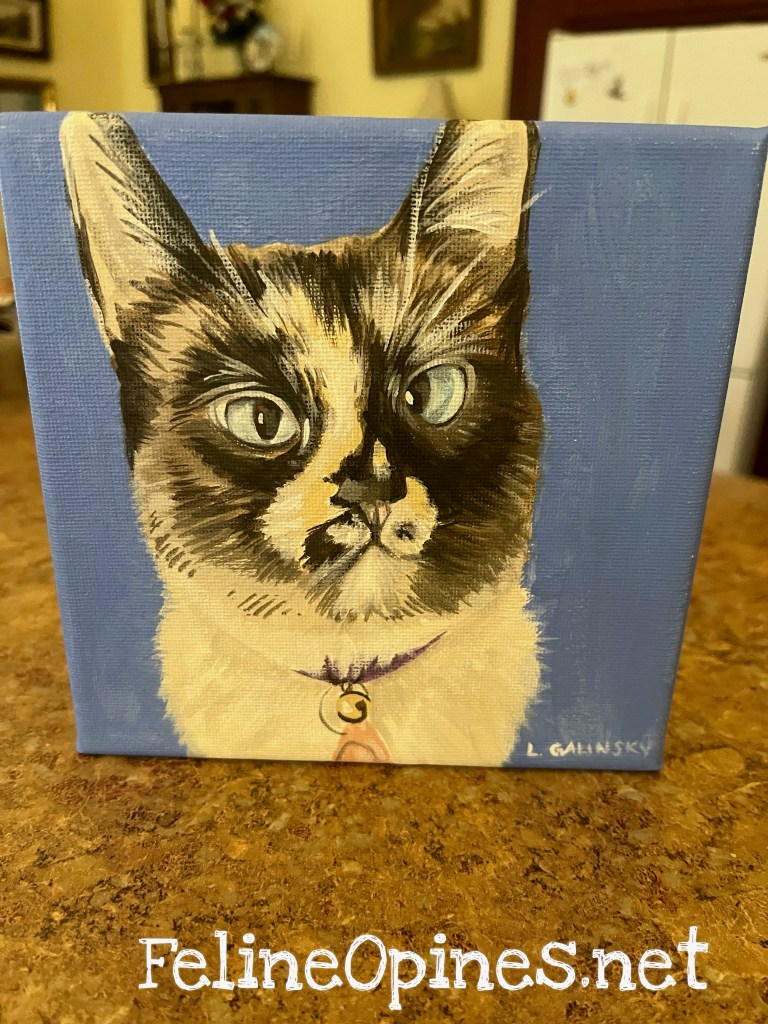
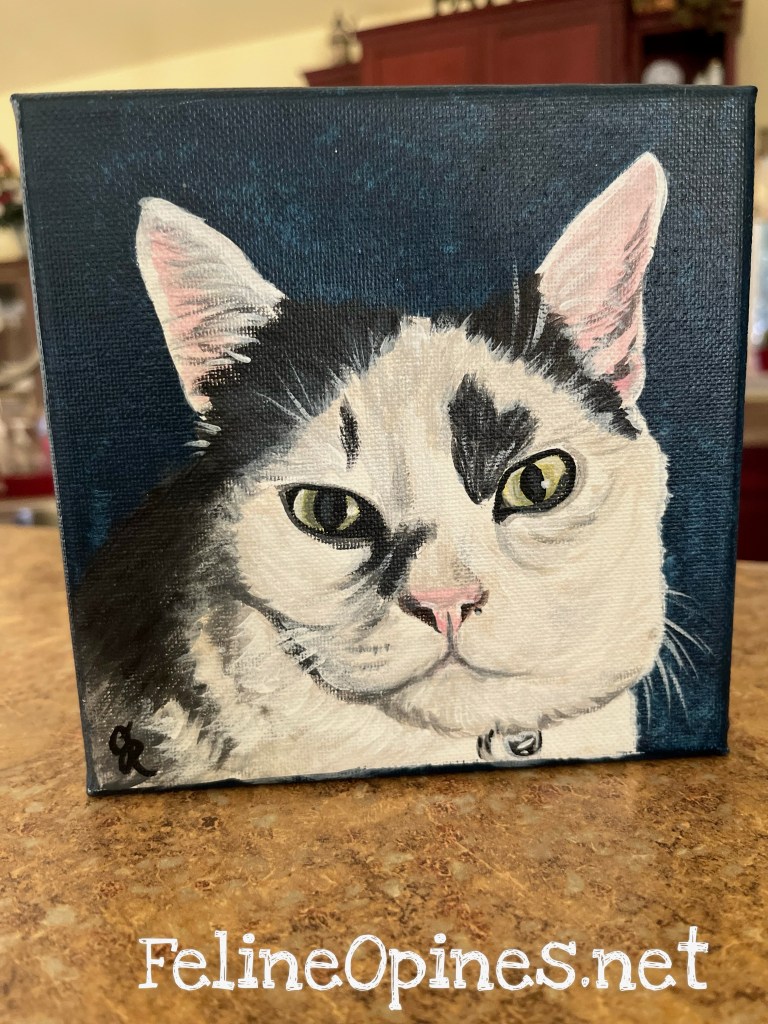
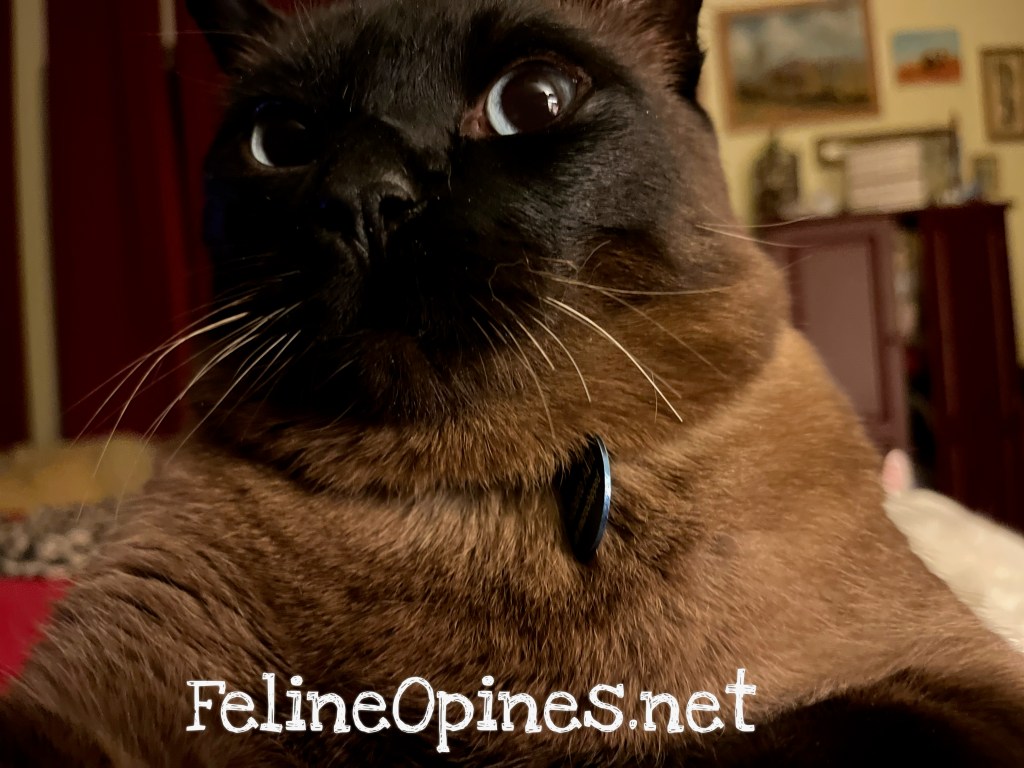



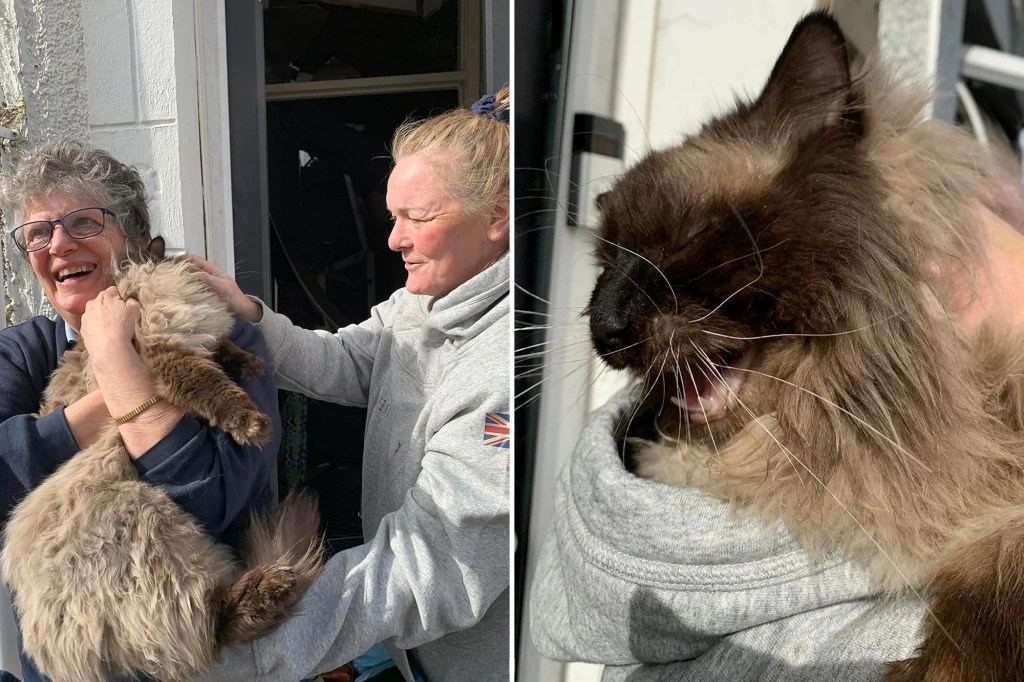

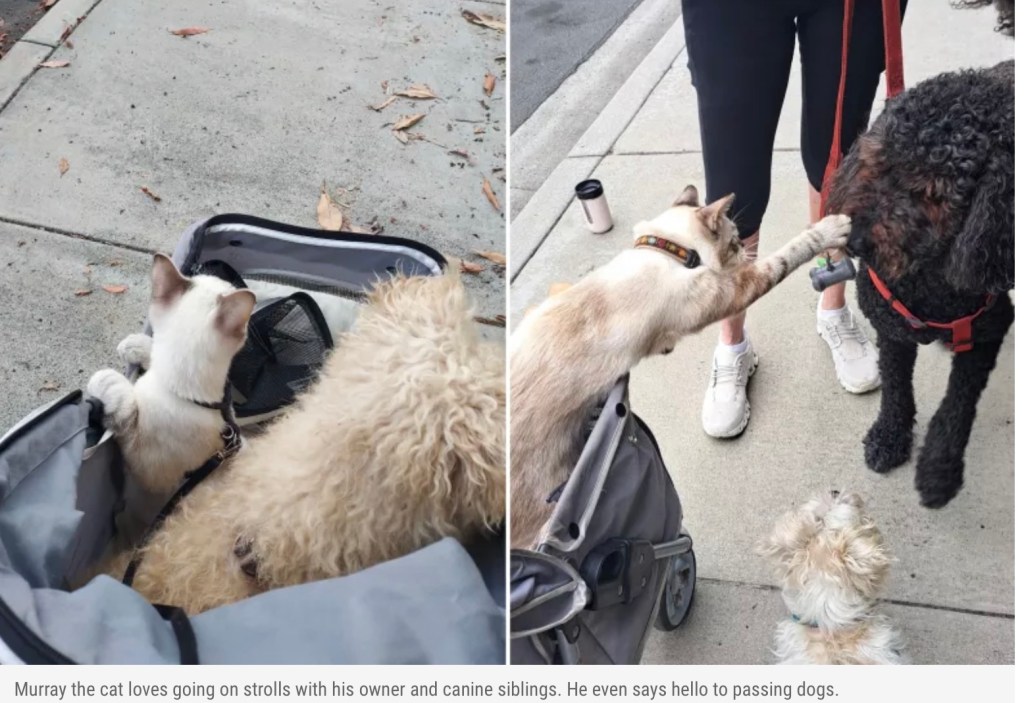




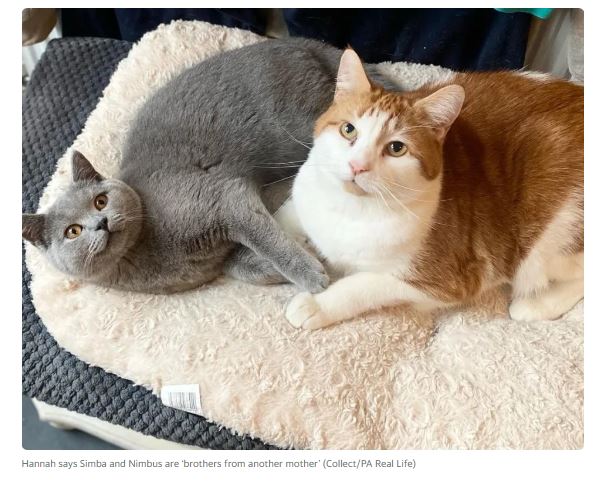
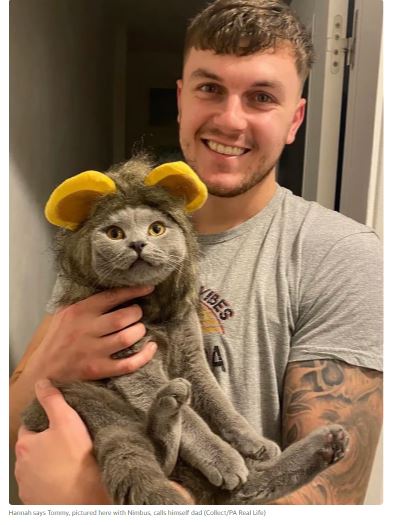




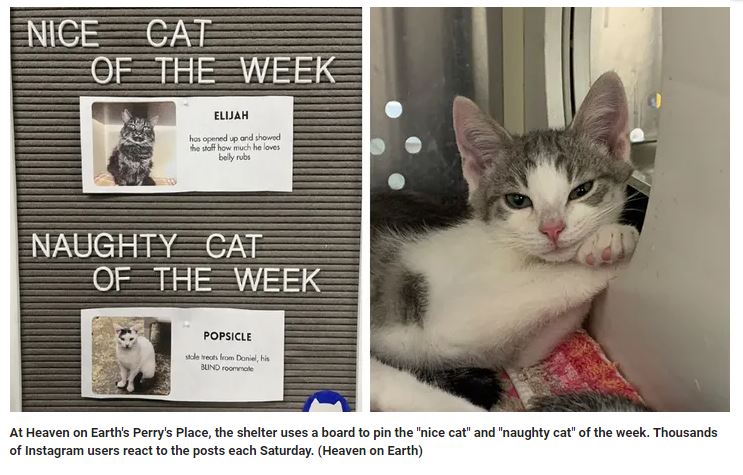


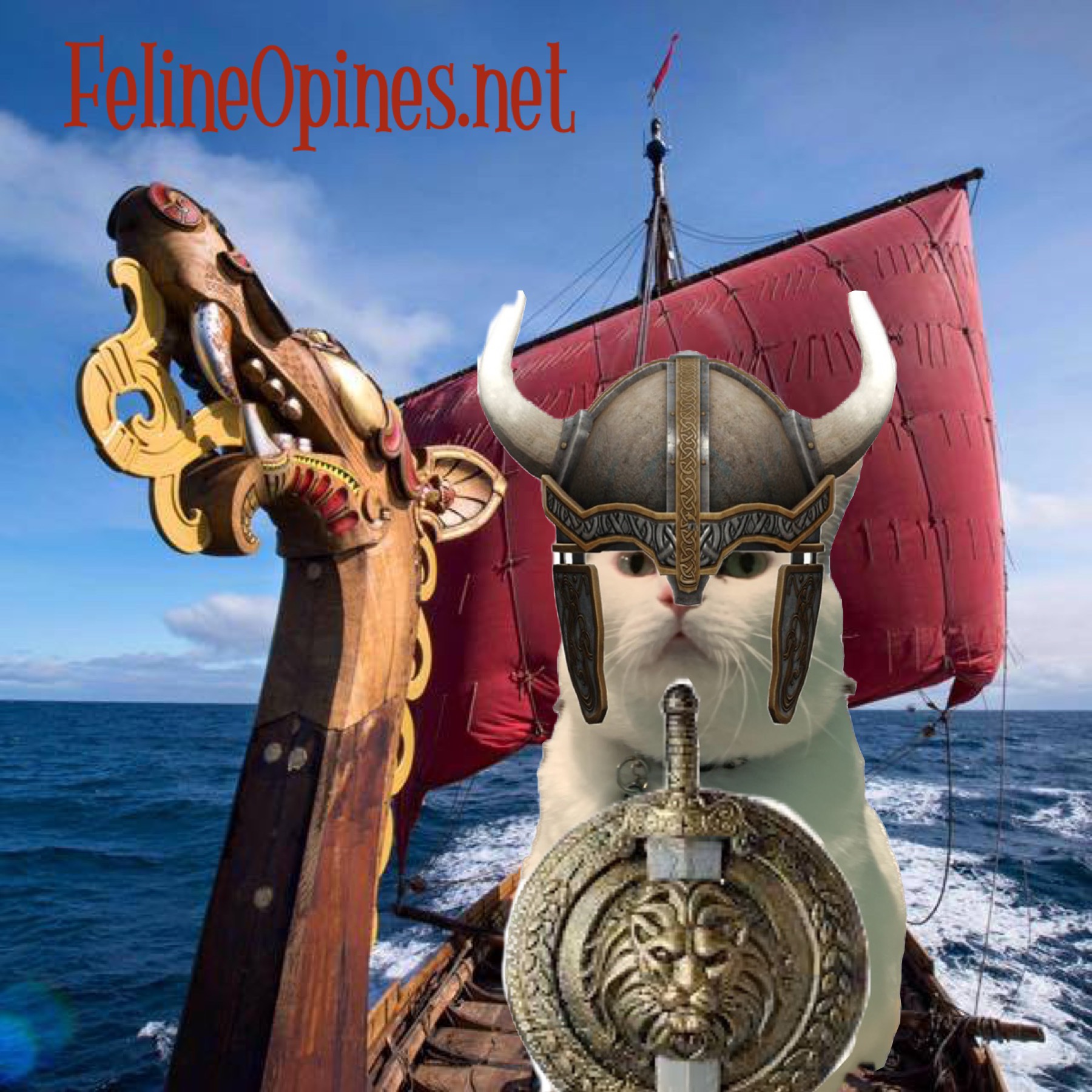


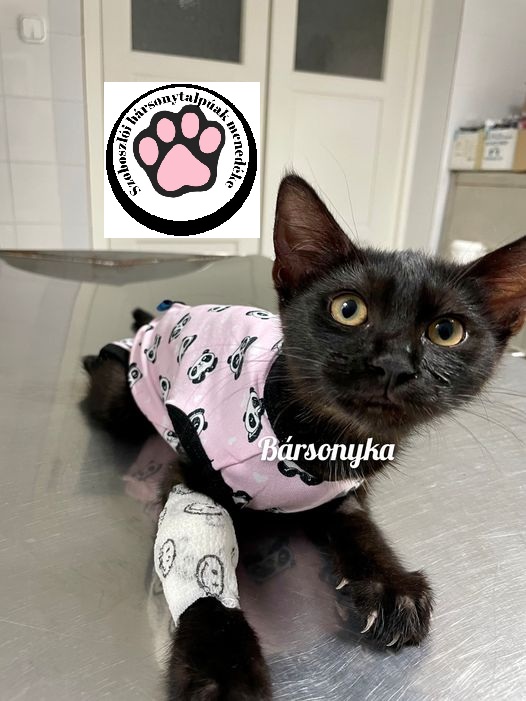


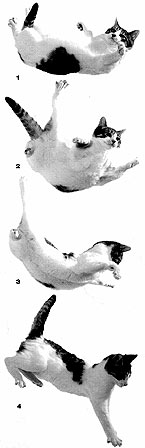




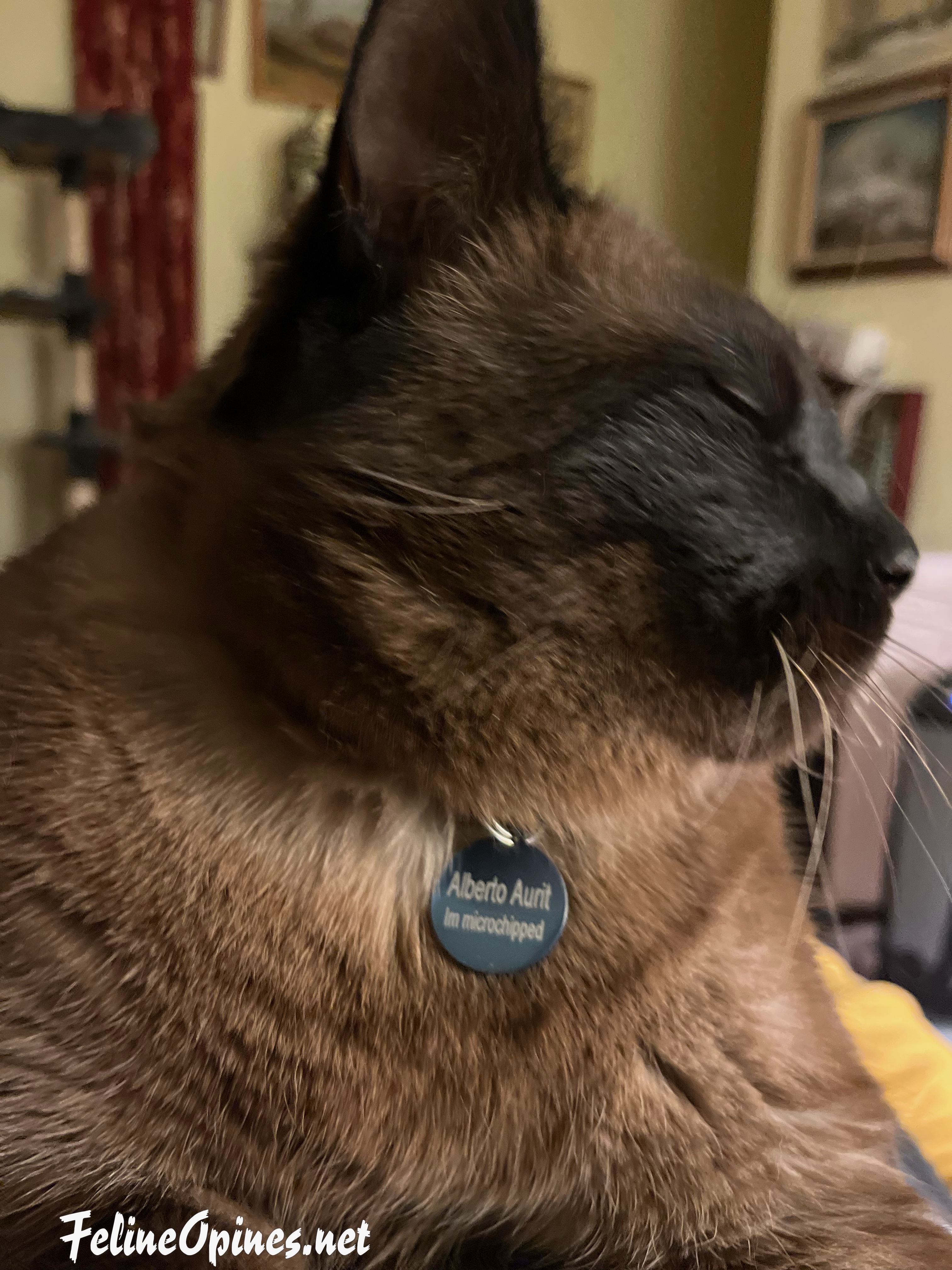


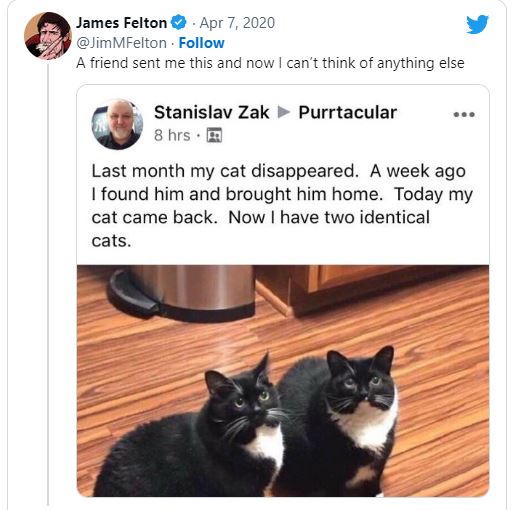


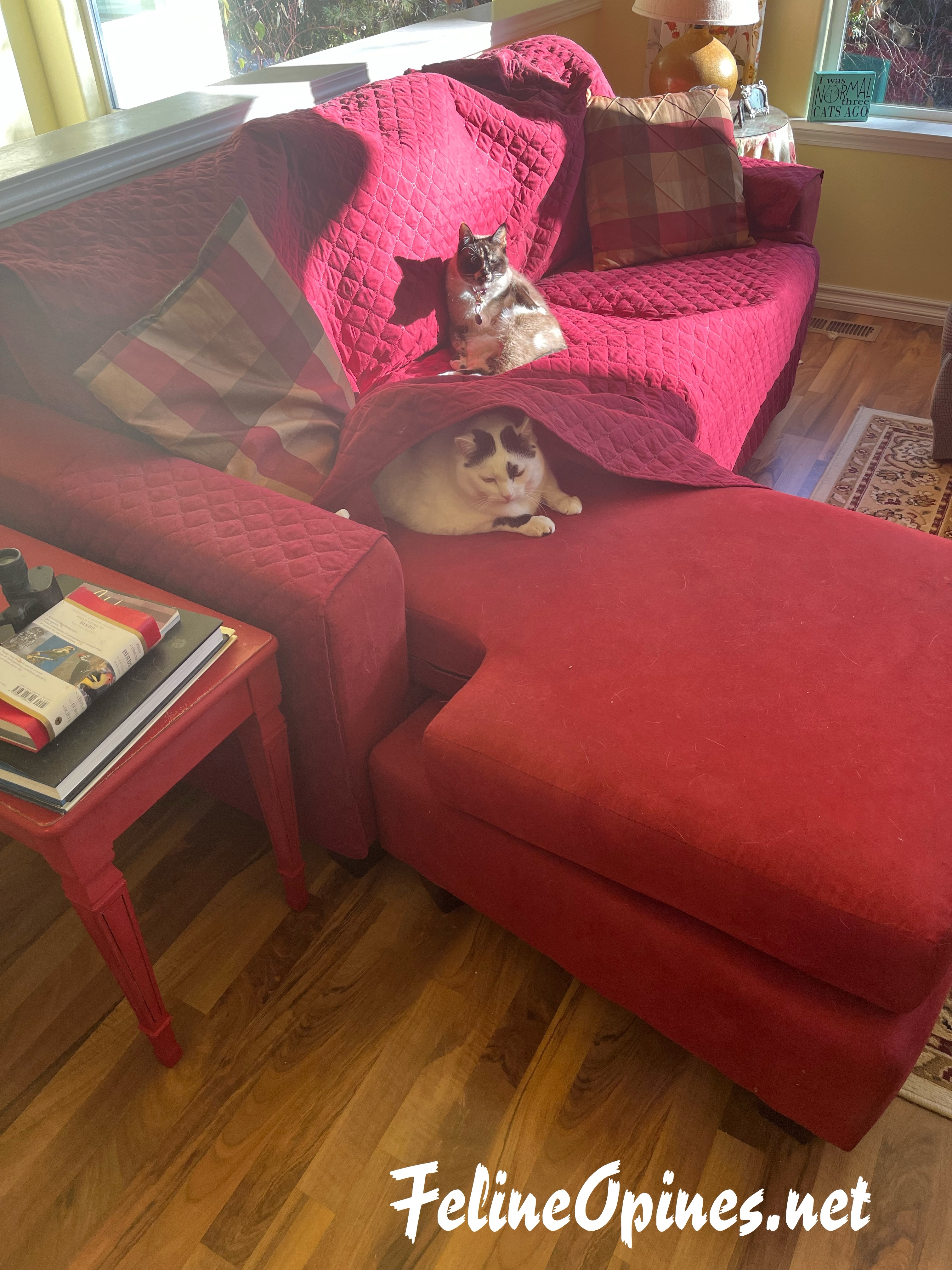

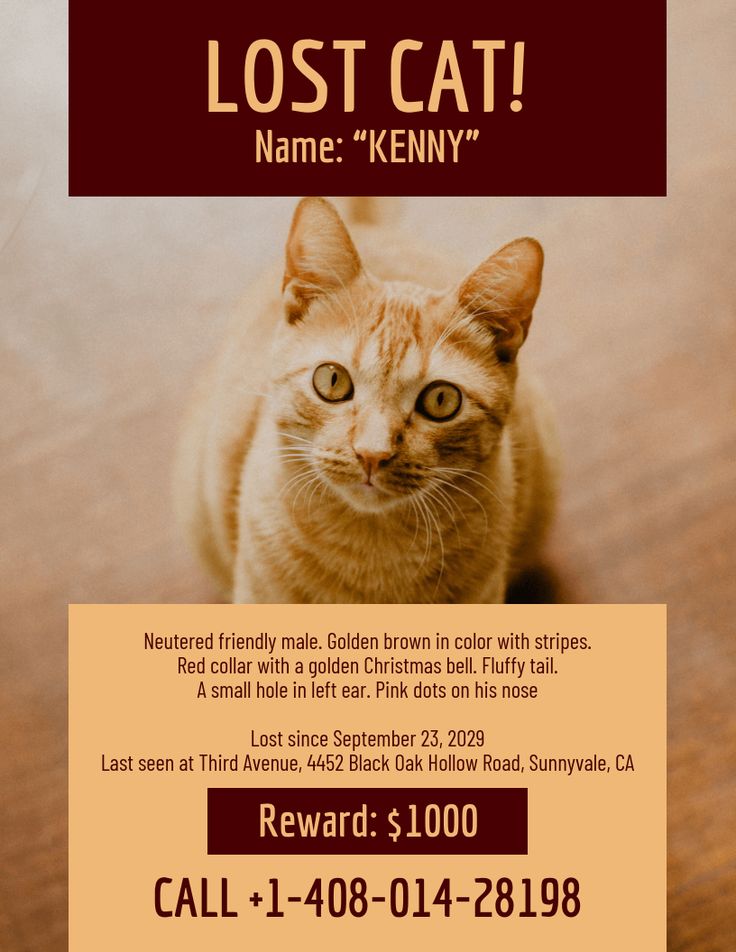

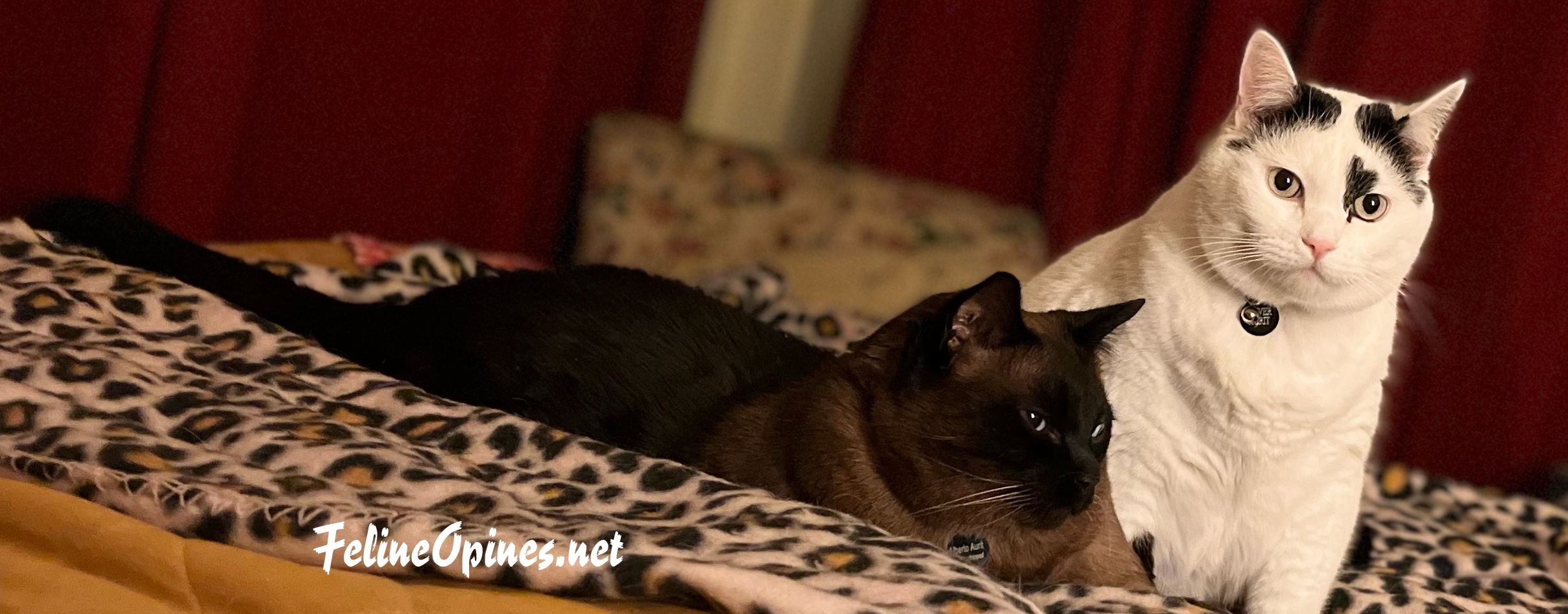
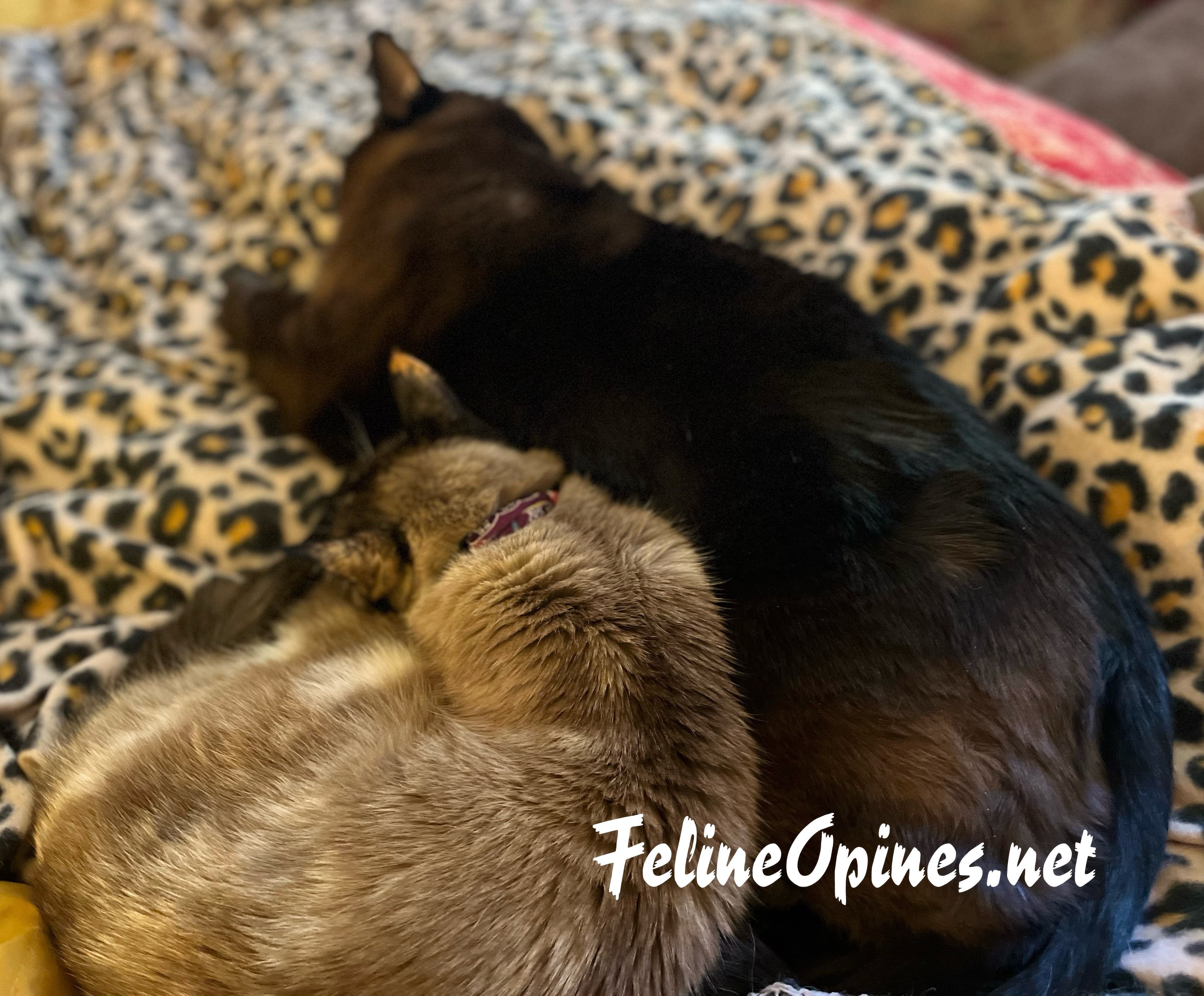
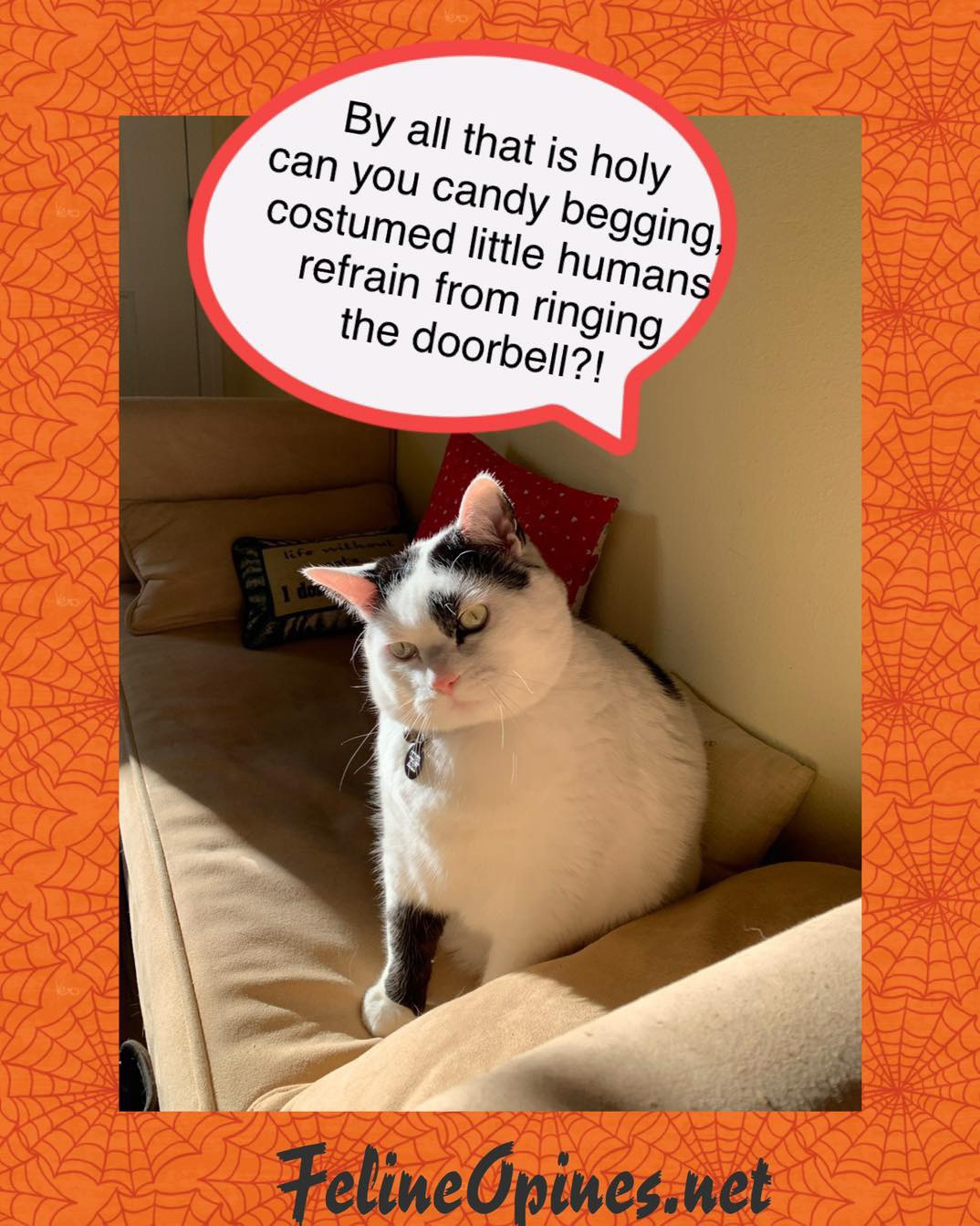


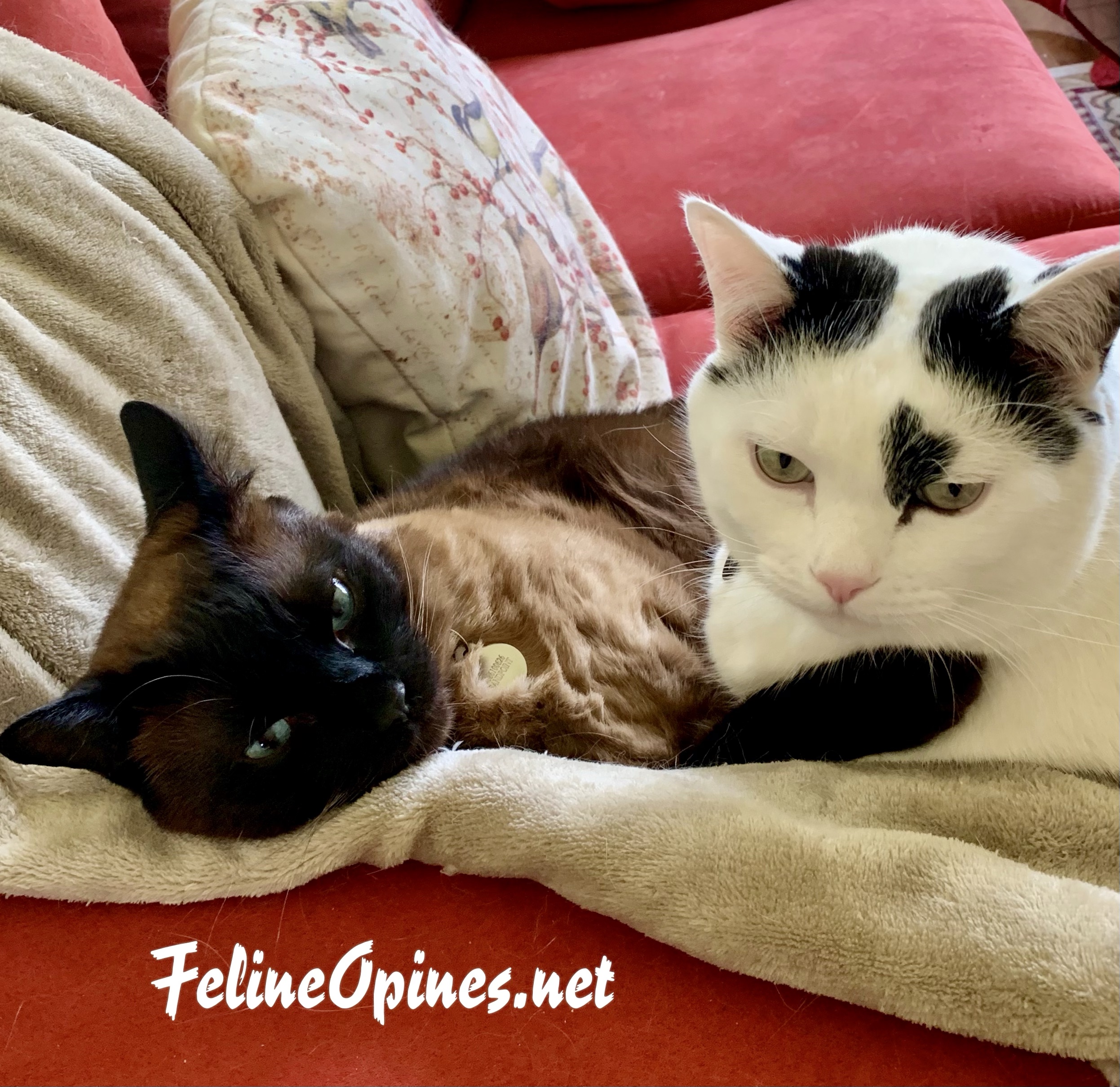

 Home | felineopines