Hello there furiends! We realize we are publishing this on Thursday and not Wednesday. I could tell you why this happened but better that I just continue on with the post.
We live in a place that isn’t known for it’s heat but we do have a week or two in the summer when it’s in the high 90s or low 100s. This was the week. Meowza was it hot! but we muddled through and managed to have a good week anyway. I know many of my furiends are experiencing heat so remind your humans to keep your water bowls filled and for heaven sake, find a cool spot in front of a fan or an air conditioning vent (we don’t have air conditioning in our neck of the woods) and keep a low profile until it gets cooler!
Here’s a glimpse of our week.
When it’s 96 degrees and The Human sets up the evaporative air cooler and the fun to hit you purrfectly in your favorite napping spot.
Human, please stop working and do something about this heat!
I am the back yard snoopervisor although I have no idea why any critters would want to come out in this heat!
Look at me making the local paper…I’m a super star!
So The Human can’t be bothered to cook in this heat so she makes this pesto stuff in the blender. Yuck!
I know many of you humans know the sheer panic felt when one of your feline friends escapes from the house. This story posted by tag24 documents which came from TIkTok user @sayhitomylittlefriends documents the feline “rescue” event.
The video shows two cats, one that is outside and another at an open window who seems to be getting ready to escape too. The TikTok user approaches the first cat, attempting to get it back inside it’s house, saying, “Oh my God, get inside. Get in your house.”
While neither of the cats pay attention to the distraught woman, a third cat appears on the scene, and the chaos seems to escalate but then disaster is avoided. This cat is the woman’s feline named Jerry.
Jerry’s timely intervention proves to be what was needed as he helps to lure the curious escapee back to safety.
If your humans are meowing about you scratching their furniture, you may want to tell them to read this article I found in Eurekalert.org. This international team of reseachers studied what the factors are that cause us to use your furniture as scratching posts and pubished those findings in Frontiers in Veterinary Science.
The researchers asked more than 1,200 cat owners in France about the daily lives and characteristics of their felines and any undesired scratching behaviors. The study’s funder, Ceva Santé Animale, helped with collecting this data.
The researchers’ results indicated that there are several factors that influence cats’ scratching behavior. “We see a clear link between certain environmental and behavioral factors and increased scratching behavior in cats,” Salgirli Demirbas explained. “Specifically, the presence of children in the home as well as high levels of play and nocturnal activity significantly contribute to increased scratching. Cats described as aggressive or disruptive also exhibited higher levels of scratching.”
While some factors that favor scratching – such as the cat’s personality or the presence of children – cannot be changed, there are ways to stop or mitigate the scratching. Placing scratching posts in areas the cat frequently passes or near to their preferred resting spot helps as does the use of pheromones. The Human uses Feliway for multicat homes to keep us calm.
“Providing safe hiding places, elevated observation spots, and ample play opportunities can also help alleviate stress and engage the cat in more constructive activities,” Salgirli Demirbas pointed out. The key is to establish multiple short play sessions that mimic successful hunting scenarios. These play sessions are more likely to sustain cats’ interest and reduce stress, which ultimately can reduce excessive scratching on furniture. They can also foster the bond between cats and their caretakers, the researchers said.
“Understanding the underlying emotional motivations of scratching behavior, such as frustration, which seem to be linked to personality traits and environmental factors, allows caregivers to address these issues directly,” said Salgirli Demirbas. There will be future research on this issue with the goal to develop more effective strategies to manage this behavior, ultimately enhancing the bond and harmony between cats and their caregivers.
GameFi, the combination of gaming and decentralized finance, has soared in popularity, particularly for its play-to-earn (P2E) model, which enables players to gain real-world value. Now mind you, this feline has absolutely no knowledge about this, nor does The Human.
What we did find interesting is a gaming bot called Catizen. It’s on the cloud-based messaging app Telegram (we do know what that is), According to the company, “Catizen provides players with a virtual environment where they can experience relaxation and comfort away from the fast-paced and stressful crypto and gaming world. While players have a pleasant time with the easy-to-play and quickly-learned game structure, they also benefit from P2E game dynamics.” (And I only understood about half of that)
Within the whimsical Meowverse, players start with a digital cat, which not only serves as their companion but also unlocks further game features and opportunities for rewards. Users can merge and enhance their cats, climb the leaderboards, and reap greater benefits as they progress.
The platform also hosts a cute artificial intelligence game called Al Kitty. Users can feed kitties, take care of them, raise kittens and help cats make friends. Younger players can especially accompany the cats’ growth and learn from them.
Catizen, generates revenue through in-game purchases. What we found interesting is that Catizen has community-driven initiatives that appear to be making a tangible difference in the non-profit sphere. With over 1.7 million players, nearly 1.25 million onchain users and over $10 million in-game purchase revenue generated in ten weeks, Catizen pledges 1% of in-game purchase revenue to nonprofits, letting the community vote on the beneficiaries. Catizen plans to continue this journey with its community by launching charity campaigns.
Catizen also encourages users to share stories of saving stray cats which creates a sense of unity and purpose. Participants can post images, videos or text on Twitter or Telegram using their Catizen UID. Community members shared over 10,000 posts about their stories and past experiences with stray cats in just one week, highlighting their active participation. Catizen plans to launch voting for nonprofit institutions, where the community will choose which organizations to support.
I think this is a great idea. If you’re going to play a game that offers in-app purchases why not one that donates money to save cats?
This story, written by Mike Hohnen for the Guardian, who is the human who lives with Bootsy the cat is heartwarming. The author says that Bootsy had a problem with minding other people’s boundaries, sometimes helping himself to whatever was on the table in someone else’s house for instance. This is why he assumed the worst when he received a call from someone who phoned him about Bootsy.
This was no complaint though. The caller wanted to let Mike know Bootsy was sleeping on a chair in her back yard and just wanted him to know where the feline was. He went to meet the neighbor and there began a friendship that transformed a neighborhood in Sydney, Australia.
This story in it’s entirety is a delightful read and today, four years after that phone call, Bootsy wanders off to the 87 year old neighbor Enid’s house when Mike goes to work, returning to his home in the afternoon. Bootsy’s visits have become an important part of Enid’s daily routine.
And Enid isn’t the only human who knows and loves Bootsy. Bootsy can be seen accompanying Enid down the neighborhood streets neighbors stop to greet them both. And through Bootsy’s friendship with Enid, friendships grew between humans in the neighborhood as well.
This is a happy tale of how one feline brought an entire neighborhood together. His human says that Bootsy has shown them the way towards community – and there’s no going back for any of them. Be sure and click on the link and read the whole heart-warming story.
Happy Wednesday Furiends! How are things in your neck of the woods? We’re hanging in there, our weather however, can’t decide if it’s late winter or spring. Still, since we’re indoor felines, the weather has little effect on us. Things are getting greener and The Human is opening the windows more so that’s good.
Oliver and I do a lot of play fighting and my whiskers are the constant casualty. Now, although it’s not unusual for felines to scuffle and for whiskers to be lost. Our whiskers help us navigate through our environment and are our most important sensory organs. As long as the follicles aren’t damaged, my whiskers do grow back but it takes time. Do any of my furiends out there have a feline sibling that shortens your whiskers?
Look at my pitiful whiskers.
Oliver likes to celebrate holidays and his visual contribution this week is his celebration of Hot Air Balloon Day (which is today)
Happy Hot Air Balloon Day, June 5
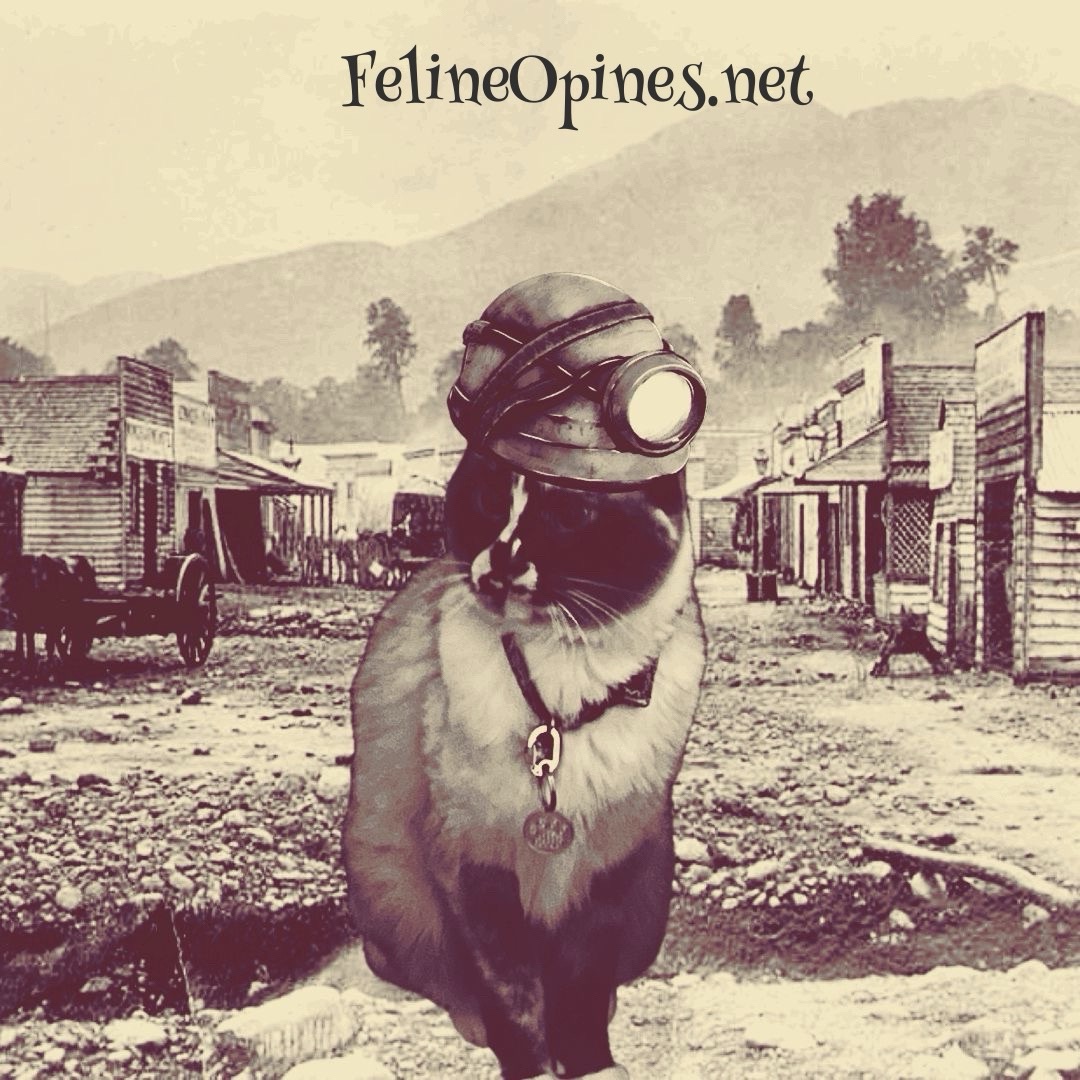
And finally, Miss Lily loved the story of cats in mining towns so much she asked our Purrsonal Assistant to make an image placing her in the past in the days of the cats in mines.
Those mining town felines were fantastic!
Here are this week’s stories and our video of the week, we hope you enjoy!
A group of scientists at the University of Helsinki in Finland discovered a genetic mutation that creates the recently discovered “salty licorice” coloring found in some cats.
According to the scientists’ study of these felines, published in the Journal of Animal Genetics in May. This coat pattern is similar to tuxedo coats, but the “salty licorice” felines differ with dark markings on their faces and dots and an increasing amount of white towards the back portion of the body. Their tails tend to be primarily white. The pattern was first observed among the Finnish domestic cat population in 2007.
The researchers found that the pattern is linked to a variant of the KIT proto-oncogene (KIT) gene, which is “associated with an absence of melanocytes in the skin and hair follicles” and commonly causes the white coat appearance in various domestic animal species.
If any of my furiends are from Finland, I’d love to know if you’ve met one of these unusual felines.
Well of course this article caught my eye as we are Idaho felines. In this article from the Idaho Press on Rick Just’s History Corner, I learned that in the 1860s, in Placerville and other mining camps in Idaho, cats were prized for their ability to keep rodents at bay. The article’s author found a 1934 edition of the Idaho that talked about miners’ cabins being often overrun with field mice and chipmunks.
An entrepreneurial fellow from Oregon named Mooney sold pest control cats in the mining camps. Most of them were gray tabbies with no claim fancy pedigree, yet despite that fact, each sold for $10 which would be more than $300 today.
Mr. Mooney stayed overnight with the Moores of Placerville and gave a pair of kittens to their daughter Lizzie. In later years, Lizzie (then Mrs. Sisk) told of litter after litter of kittens that came along, fetching $2.50 for each tiny cat. For many years after, Placerville was known as the home of large gray cats who kept themselves healthy and large due to an endless supply of mice.
I was so intrigued by the mining kitties story, I sent our Purrsonal Assistant off to find out more about cats in mining villages. She came across an article by Nick Kembel on a website called “Taiwan Obsessed” about his visit to Houtong Cat Village. The photos her are all Nick’s.
Houtong was once a thriving coal mining town and today is home to hundreds of cats. The history of the mining in Houtong is preserved in a park. It’s interesting that the word “Houtong” means monkey as there used to be a cave with monkeys nearby. At its peak, the town had more than 6,000 residents. After the coal mining industry declined in the 1990s most left, and only a few hundred people still live there today.
Your first introduction to the town will probably when you walk through the Cat Bridge. It was built in 2012 and its design pays homage to the old mining tunnels. Since the bridge is covered, it offers shelter to the local felines and you will probably encounter felines napping there.
Several hours in town can be spent checking out the ruins of the coal plant, browse the souvenir shops, drink a cat foam latte and meet a bunch of new feline furiends.
The cat connection began in 2008 when a local resident and cat lover started encouraging locals to take in stray cats. The idea really took off, putting Houtong back on the map as Taiwan’s premier cat village.
The 200+ cats that live in Houtong today are mostly strays that have been sterilized and those cats are identified with the standard TNR procedure of a clipped ear. The cats mostly seem to co-exist, with each claiming its own territory and snoozing spots within the three-lane village built on a hill looking over the train station.
You can’t make your way through the village without stopping to pet the cats sleeping and relaxing along the way.
The local shops offer a plethora of cat themed souvenirs and food items.
And the search for cats in history continued and our Purrsonal assistant found this article by Joy Powers of NPR in Milwaukee. It doesn’t deal with cats in mining towns but it is about the history of cats in the U.S. She interviewed cat historian Paul Koudounaris (who knew there were cat historians?) who said (about cats), “They were domesticated, they were raised to the highest of the highs and they were plunged down to the lowest of the lows and then very, very slowly by the end of the 19th century, they finally built themselves up to be companions again,”
Koudounaris said that many cats came to the Americas by ship with early colonists. They were known as ship cats, they were used to get rid of rodents and protect the boat’s food supply. These cats were one-way passengers and got off the boats at the same time the humans did.
Although cats continued to face persecution in Europe at the time, some early colonists recognized the benefit of the feline’s hunting skills to handle pest controls. In fact, cats were some of the first animals employed by the U.S. Army.
“The United States Army had hired cats long before they had hired dogs,” he explains. “The United States Army had hired cats in the 19th century, again, to protect the commissaries.”
Even though cats played an important role in early U.S. history, it took a few centuries for them to be considered companion animals instead of working animals. Koudounaris says the transition happened slowly, spurred by their popularity in the West (particularly among cowboys who would use cats to watch their rations). Creative folks, like Mark Twain, started bringing cats indoors and their popularity as house pets grew.
Koudounaris is currently writing a book profiling some of America’s most famous cats, including some of the more well-known ship cats like Kiddo, a cat onboard the airship America, the first dirigible aircraft that tried to cross the Atlantic. Unfortunately the dirigible crashed but thankfully Kiddo survived and he went on a national tour in 1911, making $2,000 a week. Our Human wants to know what we could do to make $2,000.00 a week!
Happy Wednesday Furiends! We’re humming along here in our neck of the woods. The Human is working on editing her first book in her cozy series and Ollie and I are looking forward to her getting that book out so we can be famous. I am looking forward to signing pawtographs.
We have a nice litter box at Feline Opines International Headquarters and Oliver decided he’d like to do a “jungly” photo shoot. He wants to know what you think.
Beware the jungle cat!The wild cat sniffs the air searching for prey.I’m watching you Human!
Neither Lily nor I had the desire to pose for any pictures this week so I’ll move on along to this week’s feline internet news.
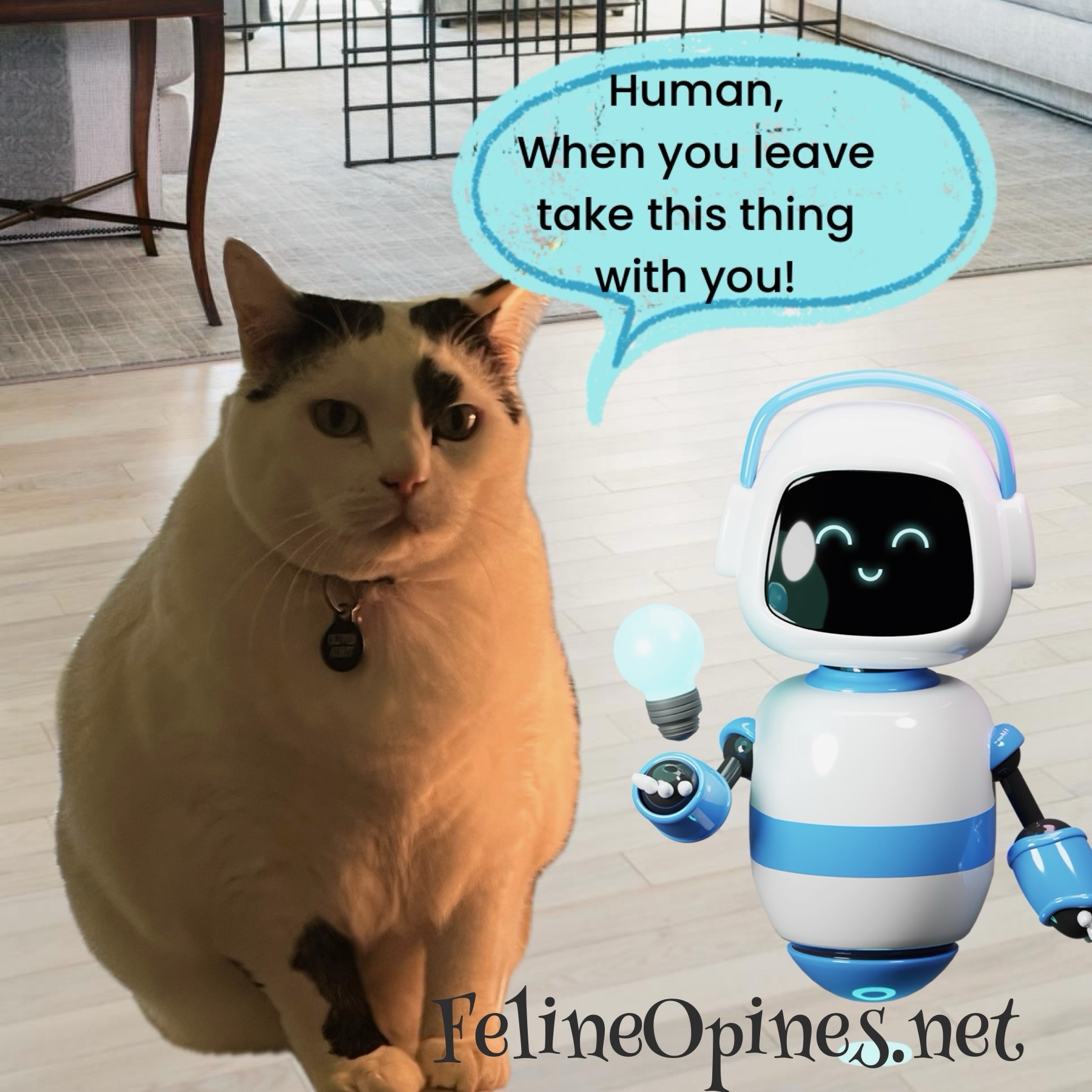
Sanjana Gajbhive from Earth.com wrote an article about robots as cat sitters. Noted was a recent research project called Cat Royale which talked about building trust between cats and robots. Now this feline is no fan of machine, I mean the vacuum monster alone is enough to give a feline a nervous breakdown!
Cat Royale, an award-winning research project, resulted from collaboration between University of Nottingham scientists and Blast Theory artists. This project crafted a “multispecies world.” In it, three cats lived with a robotic arm. They coexisted for six hours each day across twelve days. Good grief humans, coexistence is not what we cat’s want, we need pets, headbutts and skritches.
The researchers of this project wanted to find out what influenced feline-robot trust.
Some findings have been that the environment and the role of the humans in that environment were all factors in the cat’s trust of the robot. Well DUH!
“At first glance, the project is about designing a robot to enrich the lives of a family of cats by playing with them,” said Professor Steve Benford, who led the research. “Under the surface, however, it explores the question of what it takes to trust a robot to look after our loved ones and potentially ourselves.”
The robotic arm at the heart of Cat Royale engaged the feline participants through a variety of playful interactions, including dragging a toy mouse, dangling a feather “bird,” and dispensing treats. An integrated AI system observed the cats’ reactions, learning their preferences and tailoring play sessions accordingly. They designed an environment that was pleasing to the cats.
The researcher’s goal is to create a multi’species system but this cat would ask, what about the human/animal bond? Our Human spent quite a bit of time studying this and she too is a bit skeptical about this.
At least the researcher’s did acknowledge the importance of human involvement in areas like breakdown recovery, animal welfare, and audience engagement. In other words, even in a world of advanced robots, the human touch remains essential. Well, there you go!
Their conclusion is that if you humans want robots to take care of your felines, you’d have to give your home a robot friendly makeover and that you humans have to understand that even the most advanced robot can’t replace the warmth and understanding of a human caregiver. I have three words for all the humans out there-HUMAN-CAT-SITTER.
A recent report from a German pet trade and industry association, revealed that Germans love their pets. Well, our Human is German and she can attest to that! In 2023, 34.3 million dogs, cats, small animals and pet birds lived in German households. There were also numerous animals in terrariums and ornamental fish in aquariums and garden ponds.
According to a market research survey from Skopos done for the Pet Supplies Industry Association 45% of German households have pets.
Felines are still Germany’s number one pet: a total of 15.7 million of them lived in 25% of German households in 2023. In 42% of all cat-owning households there were two or more cats at home.
The head of the market research team said,” We are all the more pleased that the total number of pets kept in households in Germany has remained stable at a high level over the past few years.” I would say they should be pleased that the vast majority of German households are cat lovers!
Sophie Roberts, Lifestyle and Travel Editor for Mirror UK reported on the lack of enthusiasm one cat had regarding the Northern Lights as one man’s cat was photographed with the colorful sky as a background and looking completely unimpressed.
I don’t know what the sky was like in your neck of the woods but it was pretty amazing here. Still, not amazing enough for the Tribe to remove ourselves from the bed and do any sky gazing.
This is how one guy described his cat’s reaction on X: “My cat just experienced the aurora borealis – one of the world’s most radiant natural phenomena – and she doesn’t care.”
His post went viral getting got more than 1.7 million views.
In a Newsweek article this week, a couple who thought they had a broken Roomba discovered their cats were the culprits.
Their cat Winnie became a media star when her human shared a video of her on TikTok. The video shows clearly that the Roomba wasn’t broken, only “detained” by Winnie’s actions.
Some people think Winnie was playing with the Roomba. This feline believes that Winnie was protecting the other cats in the household by keeping the dreaded vacuum monster away from them. Go Winnie!
“Hey neighbors, it’s me, Oliver, in the window. Tell your dog to shut up!”
Reddit users have weighed in on the letter, which asks the homeowner to “please keep your cats out of the window”. Oh my whiskers, the hubris!
A Reddit user shared a letter sent by a neighbor requesting the poster keep their cats “out of the window,” as the cats are causing the neighbor’s dog to bark.Seriously??!!
In a post shared to Reddit, the cat owner wrote, “I own my own home, and I have three cats (plus two new babies I found outside). Two of them love to sit in the window when it’s nice out. They do nothing but sleep. We keep the windows open as we don’t have AC yet.”
But evidently the cats’ habit of sunning in the window inflamed the neighbor who sent a letter reading: “Hey neighbor! Can you please keep your cats out of the window? They are causing my dog to sit in the window and bark all day long. I work from home, so this is very difficult. Thanks.”
What would say to a neighbor who asked your human to keep you out of the window?
This week’s video “pick of the litter”
There are so many human social media influencers. This feline influencer, Uno the Orange cat, is teaching cats how to live the Vida Loca. It should be a must watch for every feline.
Dear Furiends, Evidently we are repeating what seems to have become a habit here at FelineOpines central and that is getting our Wednesday feature out on Thursdays. We have extended quite a bit of grace to our Purrsonal Assistant but this slacking has to stop. Here are the lame excuses she used for running behind.
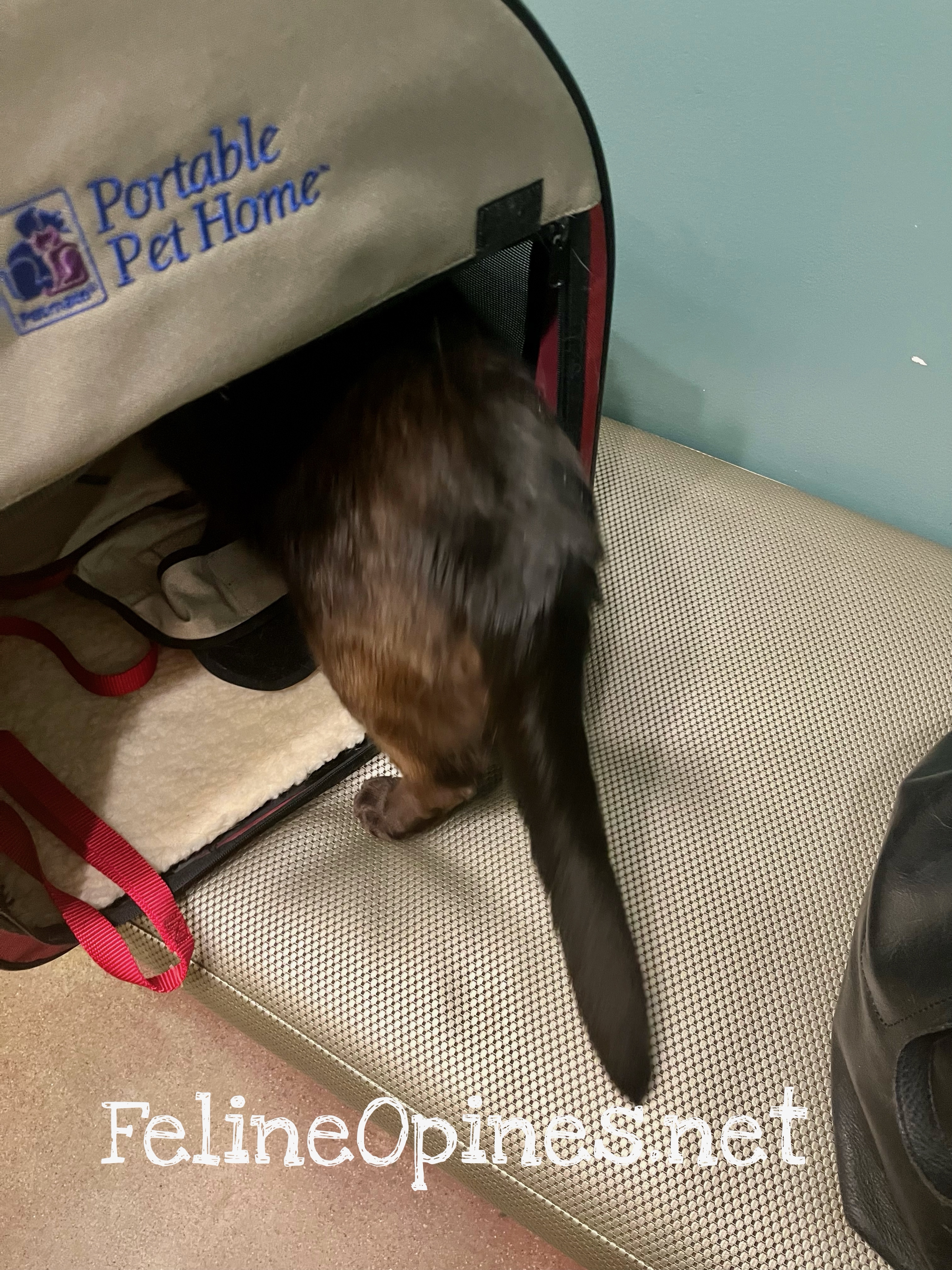
“It took me an entire day to get both Alberto and Oliver to their wellness appointments at the vet.
Oh pulleeze! Taking to cats to the vet’s office isn’t that big a deal. Granted, Oliver and I each weigh 21.5 pounds so she has to take us in separately (which means two different trips to the vet) but still. Maybe she needs to work out a little more if she can’t handle 21.5 pounds on each side. And why is she making such a big deal about it? We’re the ones who suffer. And what about Lily you ask? Well Lily is no fool, after trip number two, Lily took off and went into deep hiding. The Human searched for over an hour and finally had to call the vet and reschedule. Note to self, be like Lily!
Come one more step near me and the claws are coming out!That’s it, I’m done!
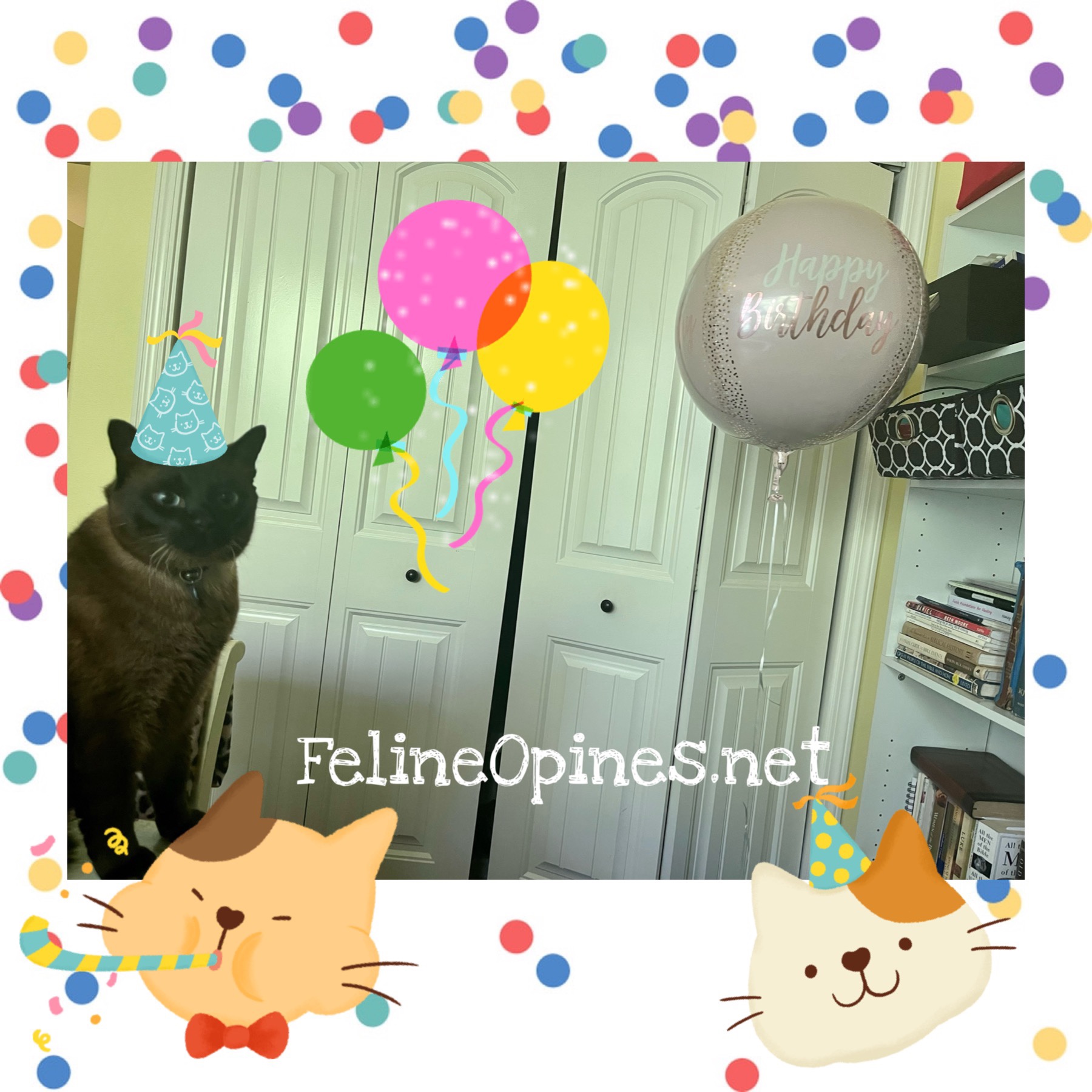
“It was my birthday and I thought I deserved a little time off.”
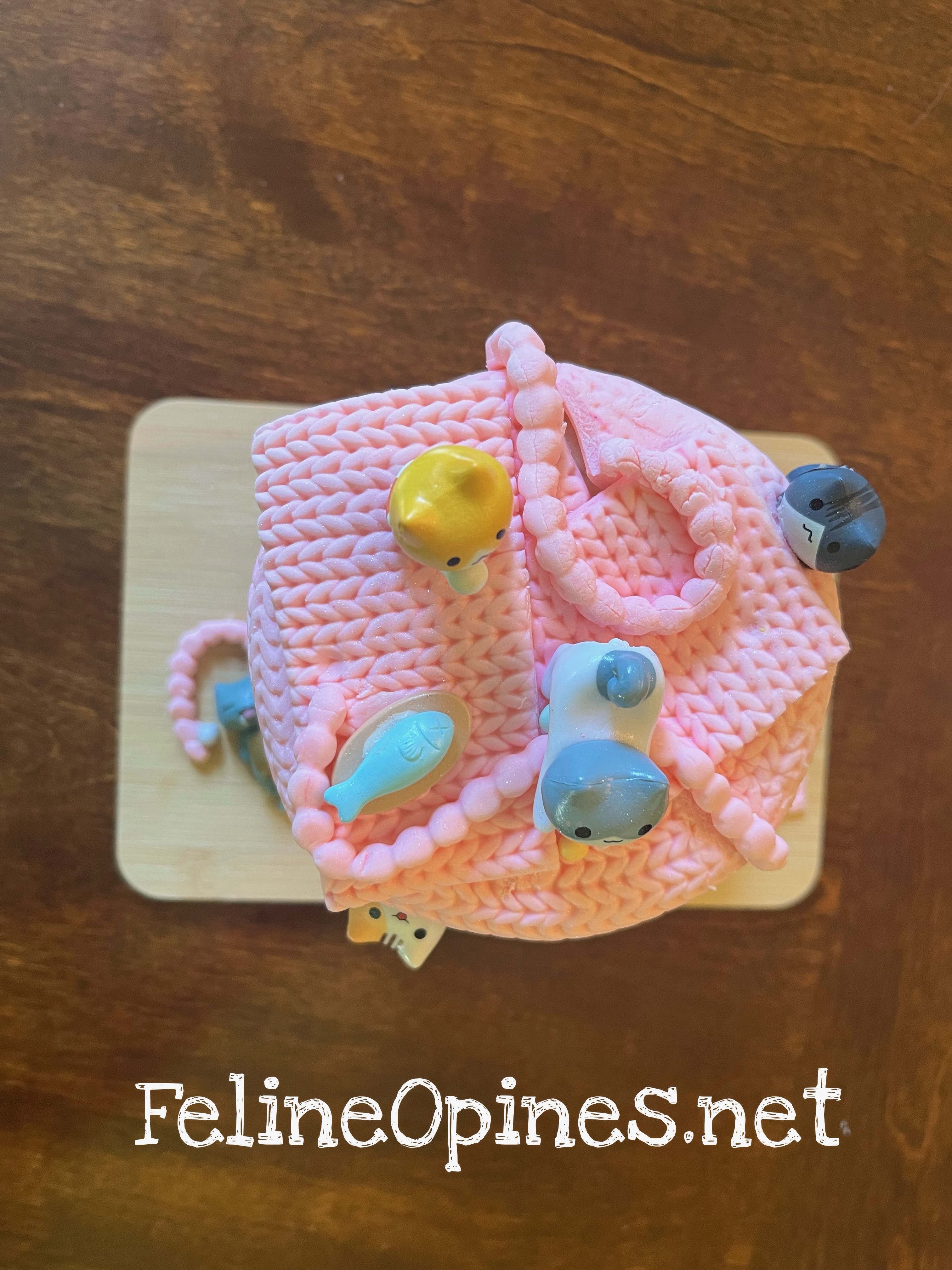
Seriously? We felines are constantly working, posing for photos, dealing with delayed feeding times and, now that she’s working from home, nap interruptions. But in her defense, she does love us a lot and we have a pretty cushy set up here so, we granted her a little time off but reminded her, next week’s feature better be back on schedule! Check out this amazing cake she received.
So Human, we wish you a happy birthday and we’re always grateful for the gift of a furever home you gave us!
Well, it’s time to get to the news at hand. June is Adopt a Cat Month and we’ve included two news items that celebrate cat adoption. Oliver has a little PSA he’d like to share with you.
It’s always easy to look at the world with rose colored glasses when you have a furever home!
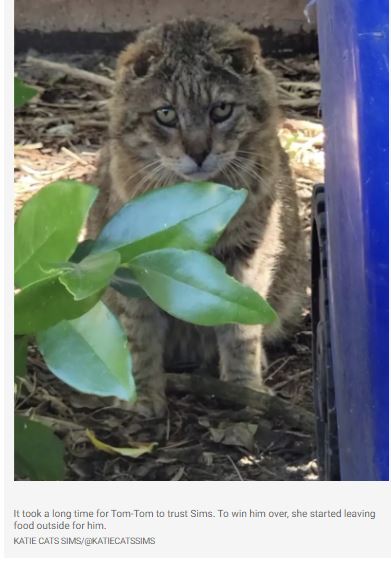
You humans can make such a difference in a cat’s life and Tom-Tom’s story is proof. Once the “neighborhood feral cat” in Portsmouth, Virginia, until Katie Cats Sims noticed him outside her house in March 2022. Sims spent four months earning his trust and eventually lured him inside.
“He looked like he was in pain and his little damaged ears just tugged at my heartstrings,” Sims told Newsweek.
“The way Tom-Tom looked at me, I just knew that he was asking for my help.”
Now, a year later, Tom-Tom is settled into his new home with Sims and her three other felines—Envy, Bru, and Mila.
To celebrate the anniversary of his “gotcha day,” Sims shared Tom-Tom’s tale to TikTok, including a clip of the first time she spotted him. Looking sickly and disheveled, the feral feline melted hearts with the video receiving almost 230,000 views.
And how did she earn Tom-Tom’s trust to come to this happy ending. When she started approaching him, he would run and hide under her car. She talked to him from a distance. Time started to run out because she had to move and she wanted to take Tom-Tom with her so she had to speed up her plan.
She began to leave food out for him and every time Tom-Tom came to eat, she inched the food closer. She then contacted a local rescue center, who provided her with a humane trap. Tom-Tom refused to go inside, even when tempted by treats. So, she purchased some chicken nuggets from Chick-Fila-A and tried to lure Tom-Tom into her kitchen instead.
She left her back door open, put the nuggets on a plate beside in the middle of the floor and she hid behind the door. It took Tom-Tom ten minutes to come in and nibble on the chicken. Sims shut the back door,and Tom-Tom panicked, trying to climb out the kitchen window and then ran and hid in one of the bedroom closets. Sims began talking to him like she did outside to calm him down.
The next day he was taken to the vet, neutered and tested for any diseases. He received antibiotics for his infected ears but sadly diagnosed with liver disease, a heart murmur, high blood pressure, a broken tail, and diabetes. Sims was up to the challenge and over time, despite his hissing at her he finally came to trust her.
Just when Tom-Tom was acclimating to his new home he suffered a seizure and spent five days fighting for his life in an animal hospital.
“It was recommended that I consider his quality of life and not let him continue to suffer,” Sims said. “To all of our surprise, he made a full recovery. He’s quite the fighter.” He had the seizure in October and by Christmas was playing with toys, exploring the house, and bonding with her other cats.
“I’m incredibly proud of his progress,” Sims said. “Since January, he has not gone into the safe place at all and meows very loudly when I leave the room.”
Tom-Tom now living his best life with his fam ily. Photo courtesy of Newsweek
Two paws up for this wonderful lady who was willing to take on all the risks to give Tom-Tom his life back and a loving home!
And if you loved Tom-Tom’s story, you’ll love Nibble’s story and the photos at Cheezburger with these two pals. This man was warned at the shelter that the cat was “feisty” (whatever that means) and no one wanted to adopt him. Well this man adopted him and they are now living their best lives. Be sure and visit the site for more photos and the comments from people who love this story.
The Mystery of the Great Plant Murder
The Human loves to read, write and watch murder mysteries. Needless to say this title caught her eye. One of this man’s cats “murdered” his plant — and you’ll never guess which one. Watch the video below to see if you can figure out who the perpetrator is.
No matter what kind of a loving forever home a cat has, sometimes they get a bit curious and that takes them far from that home. This happened to a cat named Noah who was found n a semi-truck traveling from Brooklyn Park at an Amazon facility in Eagan.
When Noah was discovered by the station manager, it was clear he wasn’t a stray as he was purring and seemed very happy to be found.
The good folks at the warehouse were able to use Noah’s microchip to find his owner in Columbia Heights. Noah was reunited with his owner; who had no idea how he got into the truck.
So my furiends, please remember these two things, make sure your humans have you microchipped and for heaven’s sake stay out of trucks!
Okay, you got us. Another week and another day late. This was however, due to our hard and diligent work as feline authors, bloggers and content creators. Since The Human has shifted her focus to writing (our books and blogs), marketing said writing and finally adding items to our merch shop we have been very busy felines. No more just lazing around the office, we all have a job to do and fame to deal with. Here is a glimpse.
All these book signings are wearing my paws out. Writing is not just writing you know and as the marketing side of the business I’m very busy.My Wednesday news features are important and this feline is sometimes a bit overwhelmed. I’ thinking about hiring some kitten interns. Oh my whiskers, being the “face” of this enterprise is exhausting. So many interviews and then there’s the fans to deal with. It’s a hard job but some cat has to do it.
Well there you go, lest you think The Tribe is not pulling their weight, we’re working our paws to the bone! Now, let’s take a look at the feline news this week.
Sometimes a cat’s gotta’ do what a cat’s gotta’ do. Cleo the cat is a lover of people and very friendly. So much so that she will follow strangers down the street. This behavior has forced Taylor Williams, Cleo’s human to have a collar made for her that let’s folks know about her wandering ways. Sometimes Cleo even tries to get on the bus with other humans and the collar has helped keep her in the neighborhood.
Taylor Williams frequently receives messages from her neighbors about their encounters with four-year-old Cleo. Cleo will regularly follow people to the bus stop, wait for the bus to arrive and hop on board before being shooed away.
Taylor can see Cleo from her living room window, following people down the road. Cleo has a loving family at home, which is why she now wears a color that says, ‘I follow people but I have a home’. So if you meet Cleo on the street, know that there are humans who love her at home.
Hey Guys, turn around. I think that human is talking to us.
Ah, you human researchers, always claiming to have figured out the mysterious ways of the feline population. Now a group of French researchers have looked into “the nuances of cat-human conversation,” with some expected findings and some a little more surprising. The study was published recently in the journal Animals, by a research team out of Paris Nanterre University led by Charlotte de Mouzon. The team wanted to see if cats responded better to people if the humans involved used visual gestures, vocal cues, or both. De Mouzon selected herself as the main participant, heading into a cat cafe with a dozen felines.
Once the cats became accustomed to her, De tried four different ways of interacting with her furry subjects. First, she called out to them only. Second, she silently made gestures toward them, such as reaching out her hand. Next, she tried doing both a vocal and visual cue simultaneously, and finally, for the control part of the experiment, she just sat back and did nothing.
The cats in de Mouzon’s study came up to her more quickly if she used both visual and vocal cues. If she used visual cues alone the cats reacted faster than when she only called out to them. If she was just sitting there, doing and saying nothing, the cats would flick their tails, often a sign of discomfort or stress. So what can you humans take away from this? I guess if you want your felines in residence to pay attention to you, use both vocal and visual cues to get our attention.
You are never too old to do something good for felines. This lady in Winnipeg, Canada keeps herself busy crocheting little blankets for cats.
Gladys Wheeler picks up her yarn and creates small rectangular blankets for the cats at the Winnipeg Humane Society’s satellite location at Best West Pet Foods.
“The cat gets a mat and the mat stays with the feline when they go to their furever home. Taking the mat with them to their new home makes the transition to the new place easier for them.
Wheeler has been making these cat mats since 2006 and since then about 1,000 blankets have been given to cats and their adopted families.
In the 17 years, about 1,000 of her blankets have been given to cats and their “I can’t not do it. I get a minute to spare, there I am crocheting,” she said.
Wheeler’s companion Susan Taylor helps her out with the blankets by tidying up the ends and picking out yarn.
Giving back has always been an important part of Wheeler and her family’s life. She says, “ “Here I am, doing something for the animals and I got my health and I got my family, what else do I need?” Two paws up for you Gladys!
Walter Chandoha was the pioneer in cat photography waaay before the internet or cat blogs like this one existed.
In the 1950’s and 60’s, Chandoha’s cat photos were everywhere: advertisements, greeting cards, calendars, jigsaw puzzles. They could also be found on posters, T-shirts and cans of cat food.
He authored more than 30 books during a career that lasted over seven decades. Some are collections of his cutest cat photos and some are “how-to” books for both budding and professional photographers.
Chandoha took photos of dogs and other animals, too, but he was always drawn to cats.-of course!
“I relished the challenge of making photographs of cats and quickly saw the potential of attempting to capture their naturally expressive personalities,” he wrote.
Chandoha’s career took off shortly after adopting a stray kitten in 1949. The freelance photographer was walking back from classes at New York University when he saw a tiny kitten shivering in the snow. He put the cat in his coat pocket and brought him home to meet his wife, Maria.
They named the cat Loco, and Chandoha started taking pictures of the new family member. He sold some of those photos to various publications, and before he knew it his career was created and ended up earning the title, “the world’s most famous cat photographer”. It’s estimated that over his lifetime he produced more than 90,000 photos of cats.
“If he didn’t have an assignment, he’d go outside. He’d see that one cat just had kittens, and he’d be there all day taking the pictures,” his daughter said.
And, when the internet came along, Chandoha embraced it, posting cat photos and offering cat photography tips.
He advised people that they need to know their subject and their behavior and have patience, lots of it!
Meowza! After reading these stupid myths, this cat needs a glass of wine!
Okay, we felines are a bit weary of some of the tall tales you humans tell about cats, presenting these fabrications as though there are the gospel truth. Here are some that might be new to you, all a bit crazy if you ask me!
1. Cats are gossips.
Excuse me?? Everything I meow is the truth but in the Netherlands, cats are often believed to be gossipy creatures who will happily blab all of your deepest, darkest secrets. For that reason, people try not to have important or private conversations while a cat’s in the room, just in case it’s listening. Well, let me tell you, it’s too late for our Human because our Tribe will blog about everything she does, MOL!
2. A grooming cat means unexpected visitors are coming.
According to Japanese superstition, if a cat washes its face with its paws, it’s not just grooming—it means that visitors are on their way. There are similar superstitions in other countries, too, with some people in the U.S. expecting a visit from a member of the clergy if a cat starts cleaning its whiskers. Let me tell you, none of the grooming of the three of us has every resulted in visitors.
3. A sneezing cat is lucky (except when it isn’t).
In Italy, hearing a cat sneeze is supposed to be good luck. Specifically, if your feline gets the sneezes, it means there’s money coming your way. If a bride hears a cat sneeze on her wedding day, it means the marriage will be a good one. Beware, though—while one sneeze might be good luck, if a cat sneezes three times it supposedly indicates that you’re going to come down with a cold. Oh my whiskers, you’d have to carry a calculator and a list to figure out the meaning of your cat sneezes.
4. Black cats sink ships.
Of all the kinds of cats there are, black cats are the ones with the most superstitions attached. Maybe that’s due to the ancient Egyptian belief that black cats were associated with the goddess Bastet, and keeping one would bring her favor; maybe it’s to do with the European conviction that witches had black cats as familiars making them evil omens. One black cat superstition you might not have heard is that if a black cat walks onto a ship and then back off again, the ship will sink on its next voyage (though according to an old Irish and British superstition, black cats were actually good luck for a ship). In other words, you humans have no idea what you’re talking about.
5. Cats can raise the dead.
In parts of Southern Europe, folklore has it that if a cat jumps across a person’s grave, they’ll rise again as a vampire. Oh spare me, this is really ridiculous.
6. Being a cat lady can help you get married.
Although pop culture has turned cats into a symbol of eternal singledom, according to one book on Pennsylvania German tradition, cats can help a woman who is anxious to get married. All she has to do is “feed the cat from her shoe,” although the superstition doesn’t say what’s supposed to happen next—or how to get the uneaten cat food out of the shoe. Hmmm, since The Human isn’t married maybe she should feed us out of her she but then again, we’ve got a good gig going here and maybe there’s no need to bring a stranger into the mix.
7. Wet cats can make it rain.
You might suspect there’s some cause and effect confusion going on here, but in parts of Indonesia, cats are associated with the weather. If people wanted it to rain, they’d pour water over a cat. Presumably the cat in question then made it rain as revenge. Any of my regular readers know that I take my version of a kitty shower every day and no, it doesn’t rain very day around our house
Hello There Furiends, Great news from our neck of the woods – The Human is now working from her home office, although she still takes off for things she calls “meetings” too frequently for our taste. Of course the most important part of this change is how The Tribe has adjusted. As you can see from the photos below, she has made sure there is accommodation for the three of us so that we can snoopervise in comfort.
I purrfur to move around the office so that I can snoopervise from various positions and, of course, there are my nap times that have to be accomodated.
Scheduled nap times are critical and we have instructed The Human to be especially respectful of that schedule.
Hey, when’s lunch?”
All in all, if you ask The Human, I’m sure she would say that it’s much easier to work from her home office, much more comfortable and there are fewer interruptions.
“Umm, yeah, things are going well, making my deadlines even though there are a few…adjustments.”
So that’s the news here, hope your humans are working as efficiently and comfortably as ours is!
This Instagram video seems to show a mamma cat confronting her “baby daddy”. It’s entertained the web so much that it’s gotten 15.5 million views!
In the video shared by @milasbabies, a black and white tom arrives and paws at the window. It looks like he wants in. Purrhaps that’s because the cute little feline kitten, Mario is the mirror image of the male cat outside.
“I’m pretty sure this is the talking tom that got my cat pregnant,” @milasbabies wrote in the video’s captions.
Mamma cat seems to want nothing to do with him as she greets him with a hiss. The mother’s hostility seems to have no effect on Daddy until Momma runs at the window and he runs away.
You humans talk about “baby daddy drama” and now it seems we felines are experiencing it too.
We felines have been written, sung and spoken about throughout history and I find mythical cats fascinating. The article names 12 cats noted in folklore and mythology.
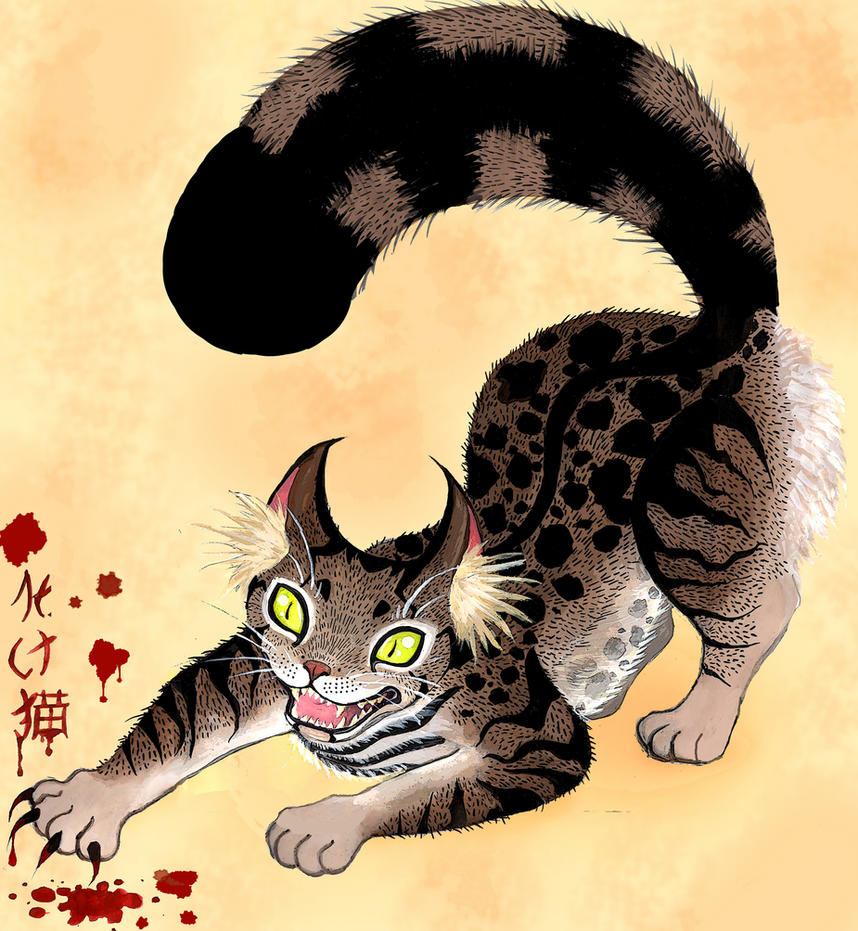
1.Bakeneko
Bakeneko is a monster cat from a Japanese legend that became a yokai (a class of supernatural entities in Japan) and gained supernatural powers. It is said that when cats live to a ripe, old age they will begin developing supernatural powers too and will and fully transform into yokai.
Bakenekos start off resembling regular house cats but then evolve to walking on only their hind legs. As they age, they grow much larger and their powers intensify. They are described as reaching the size of full-grown adult humans. Another myth, Nekomata, is very similar to the Bakeneko but has two tails and is said to live in the mountains.
2. Bastet
Bastet is a feline deity and the Egyptian goddess of the home, women’s secrets, cats, fertility, and childbirth. She was thought to be a bringer of good health and protected the home from evil spirits and disease, especially those affecting women and children.
3. Cactus Cat
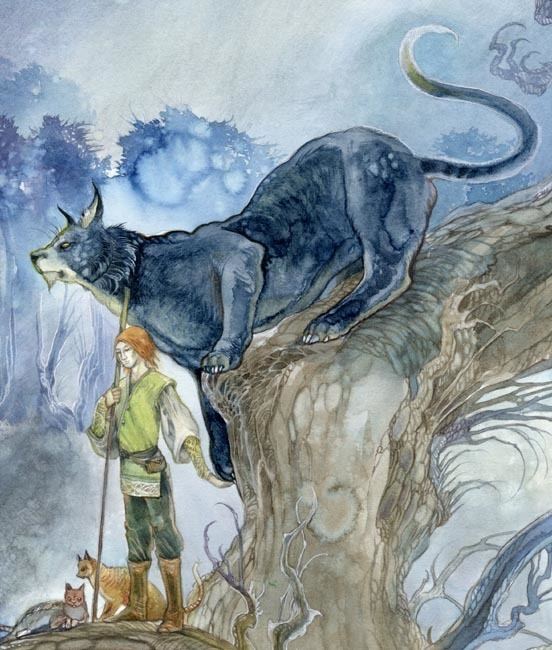
The Cactus Cat is a mythical creature from the American Southwest. Cactus cat is described as resembling a bobcat with thorn-like fur, a branched tail, and sharp bones protruding from its front legs. This mythological cat is said to have been sighted in the Southwestern desert areas of the United States including states like California, Nevada, and New Mexico. Some sightings have even been reported in Colorado.
4.Cat-sith
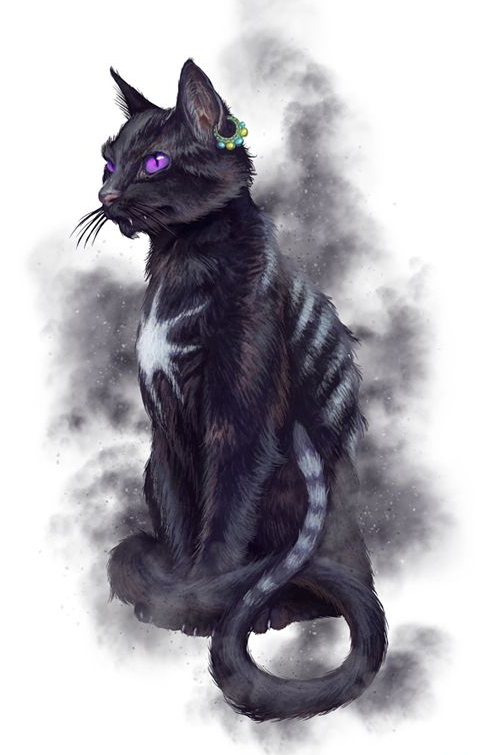
Cat-siths are legendary felines from Celtic mythology that are said to be the size of dogs with black fur and a white spot on their chests. It is said these creatures walk on four legs and act like animals when in the presence of humans but then they shift to bipedal walking when humans aren’t around. Some are even described as wearing clothes.
In most of the myths surrounding cat-siths, they are indistinguishable from regular cats until they are caught standing upright.
5.Cath Palug
Cath Palug was a monstrous cat from both French and Welsh mythology. This cat was said to inhabit the Isle of Anglesey where it ate a number of humans who attempted to slay it. Cath Palug was said to have been slain by King Arthur after wreaking havoc across the land.
6.Cha Kla
Cha Kla is a legend from Thailand, described as a cat with blood-red eyes and completely black fur that runs from back to front. Cha Kla is described as nocturnal and so fearful of humans that it will immediately hide in its hole in the ground if it encounters a human. It is said that if a person were to see it or touch it, they would die. Sorcerers were said to use Cha Kla to defeat their enemies.
7.Dawon
Dawon is from Hindu mythology and is also known as Gdon. Dawon is a fierce tigress given to the goddess Durga for combat. Durga would ride Dawon into battle yielding 10 weapons in each of her 10 arms. Dawon would also take part in battle using her teeth and claws. Those two would be formidable combatants!
8.Hombre Gato
The Hombre Gato, also referred to as Catman, is a legendary creature from Argentina that has the features of both cat and human.
Hombre Gato was thought to only come out at night to prey on humans and animals and became such a widespread legend that it has been captured in Hispanic literature through short stories.
9.Mafdet
Mafdet is a deity from the First Dynasty of Egypt. She was known as the Goddess of judgment, justice, and execution. She is said to be the protector of Ra, the Egyptian sun god.
Mafdet’s depiction in ancient paintings is much like a Savannah Cat or Cheetah. It was said she was able to protect against the bites of scorpions and snakes.
10. Matagot or mandagot
A matagot, also known as mandagot, is a legend from southern France. Matagots are said to be spirits that take an animal form, mostly presenting as a black cat. Matagots have also been described as taking on the appearance of rats, foxes, dogs, and even cows. Matagots are generally seen as evil spirits, but some are believed to bring wealth into a household if it remains well fed.
11.Sekhmet
Sekhmet is the Egyptian Goddess of war and destruction. She is said to have been born from the fire of the Sun God Ra’s eyes. The ancient Egyptians built at least 700 monuments to worship Sekhmet. In some tales, she is considered an alternate form of Bastet, and in others, she is referred to as Bastet’s sister.
12.Wampus Cat/ Cherokee Death Cat
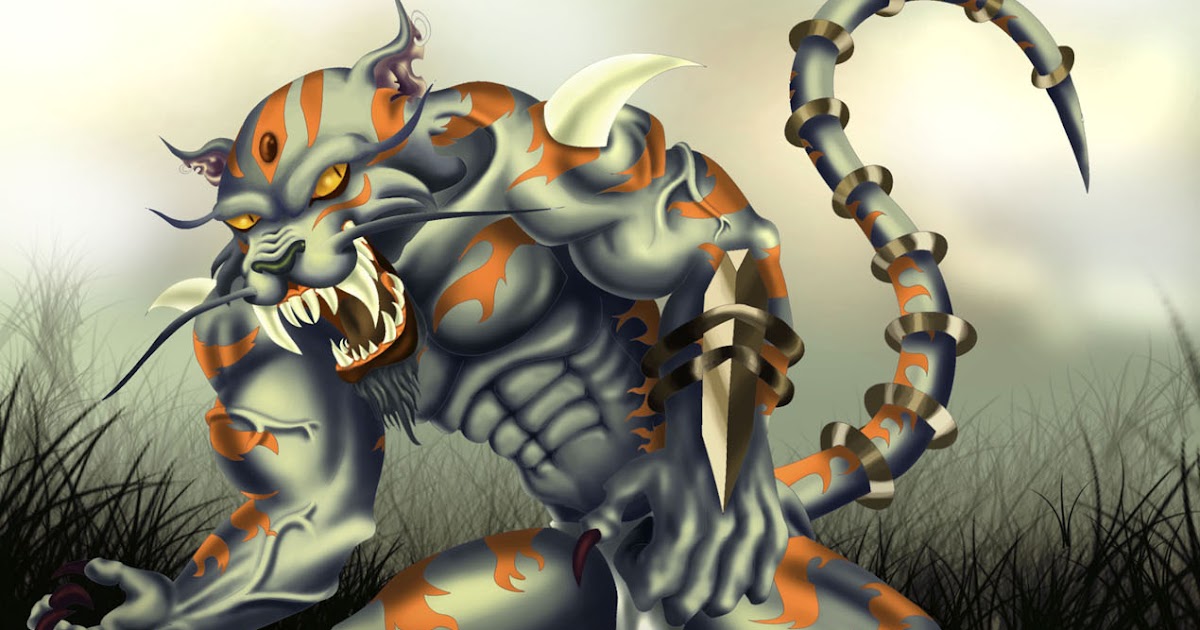
Death Cat. In some regions, the Wampus Cat is a frightening and evil feline, while in others it’s viewed as more comical. In Cherokee mythology, this monster cat is the embodiment of a female cursed by the tribe’s elders that were punished for hiding under the pelt of a wild cat and bearing witness to a sacred ceremony she had no business attending. Some southeastern Native American tribes believed the Wampus Cat to be a shapeshifter. It was said that Wampus Cat went on a livestock killing spree during the 1920s and 1930s, and reports of the creature stretched across the southeastern states into the 1960s.
I have reported on Choupette, the late Karl Lagerfeld’s beloved cat, and now Choupette, has been formally invited to the Met Gala. Lah di dah!
Lucas Berullier, Choupette’s agent and owner of My Pet Agency, which specializes in pet influencers, announced the invite from Paris. (This cat has an agent?? Meowza, what am I doing wrong!!)
“It’s an event in honor of the legacy of Karl, and Choupette is obviously a central part of the legacy,” Berullier addd.
The theme of this year’s Costume Institute exhibition is Karl Lagerfeld: A Line of Beauty. It will celebrate the iconic German designer, who worked for Chanel, Fendi, Balmain and myriad other fashion houses before his death in 2019.
Born a Leo on August 15, 2011, the blue-cream tortie Birman was originally owned by French model Baptiste Giabiconi. He received the kitten on his birthday from friends and named her for the “common nickname in French for cute girls,” according to the New York Times.
That year, Giabiconi asked Lagerfeld to cat-sit around the holidays. The designer was initially reluctant but quickly fell in love.
“It became clear to me that Choupette brought Karl great joy,” Giabiconi told the Times. So he decided to let Lagerfeld keep the kitten.
In 2014, Choupette secured her own makeup line by Shu Uemura, and the fancy feline went on to rake in over $2 million doing a campaign for a German car.
News outlets called the cat “the most famous feline in the world.” She was always by Lagerfeld’s side in a custom $3,000 Louis Vuitton handbag.
“Choupette was a phenomenon. Karl Lagerfeld wasn’t really perceived as a warm and fuzzy person, so it made it incredibly ironic that he basically fell in love with Choupette and she did become his furry muse which kind of humanized him which was sort of lovely,” Kathlin Argiro, a fashion designer professor at the Fashion Institute of Technology, told The Post.
In 2018, Lagerfeld told French magazine Numero that he had named the cat as one of the heirs to his estate. Lagerfeld died in February 2019 at age 85, it was rumored that he left his fortune to Choupette. The exact details of Lagerfeld’s estate as it related to the cat are not known.
In the years since Lagerfeld’s death, Choupette has been ably looked after by his former housekeeper, Françoise Caçote. The cat continues to work on occasion, doing campaigns for the Karl Lagerfeld brand, luxury pet line LucyBalu and L’Oréal.
She also has a philanthropic side and gives back through her new charity organization the Choupette Fund, which aids stray cats.
It seems that although Choupette lost her loving human, she’s still living mener la grande vie.
Evidently there is a Twitter group called #findthecat and Journalist Kate Hinds, of New York City, made Twitter followers go crazy trying to find her elusive feline.
Her cat blends into the apartment scenery very well. After you’ve stared a while and still can’t find the elusive feline, here are some hints.
Hint #1: Someone has a green thumb!
Still need another hint?
Hint #2: Cats can always be found basking in sunlight.
Cats are biologically programmed to always find the warms spots in their home and as winter breaks its cold curse, many felines are jumping at any chance to lay in the sunshine.
Still haven’t found it?
Hint #3: If your cat isn’t messing with your plants, do you even have a cat?
Eating plants actually aids digestion in felines and help move fur balls through the tract.
However not all plants are safe for cats to consume, some to avoid are tulips, daffodils, and lilies.
Given up yet? We don’t blame you! Okay, here is the map to find the cat.
If you take a real close look toward the windowsill on the right, hidden among the dense collection of plants, you can see the gray fur on the cats back.
Naval cats have had the names Tom the Terror, Wockle, Bounce, and Dirty Face. They traveled thousands of miles on warships with some of the saltiest sailors. They were valued members of the crew, and were often issued custom miniature uniforms and their own tiny hammocks. Many never set a paw on dry land during their entire lives. They were the cats that served in the world’s navies.
Cats have been on ships for almost as long as humans have been going to sea, and sailors have been largely responsible for spreading cats across the globe. Ancient Egyptian tomb paintings depict cats hunting from boats sailing down the Nile, while Phoenicians recognized the value of controlling the rodent population on their ships as they traded throughout the Mediterranean.
Rats and mice were a major problem on ships because they ruined the crew’s food, chewed through equipment, and spread disease. Cats were a cheap and effective solution to any vermin infestation. The U.S. government, in an effort to protect documents from nesting rats, began to purchase clowders of cats in the 19th century, eventually supplying them to the U.S. Navy. In the United Kingdom, one of the earliest and largest cat rescue programs occurred during the First World War, when thousands of strays were rounded up in cities and given to the military. The cats supplied to the Royal Navy even received a weekly “victualing allowance” of 1 shilling and 6 pence to pay for treats from the ship’s canteen.
Early sailors believed that cats could control the weather with their tails. When feline tails twitched in a certain manner they thought it meant the cats were angry and preparing to unleash a violent storm that would soon fall over the ship. Later sailors realized that cats twitched their tales when they were agitated by a sudden drop in air pressure, indicating that the ship was heading into unfavorable weather. Crews began to monitor all the mannerism of their ship’s cats and viewed any unusual behavior as a storm warning. The felines were, in a sense, little furry barometers.
Cats were also a source of superstitions: Seamen preparing to sail considered it good luck when a cat chose to board their vessel. However, they feared disaster if they had a longtime ratter that decided to jump ship just prior to setting sail. Even worse, sailors thought their fate was sealed if they saw two cats fighting on the pier: It meant that an angel and devil had already started to battle for the souls of the crew.
Though cats are known for their aversion to water, they acclimated quite well to life on the sea. Unlike the “limeys” of the Royal Navy, who famously had to drink citrus juice to prevent scurvy, cats make their own vitamin C and can survive on a diet consisting of fish and mammals without needing to eat fruits and vegetables. And when rodents were in short supply, cats had different methods for catching fish for themselves. The easiest prey were the ones that simply washed up on the deck. Some cats overcame their dislike of water to become skilled divers that could snatch fish from the ocean. The cats that never got comfortable with swimming still managed to hunt by deftly knocking down fish leaping over the ship’s bow. Because cats got most of the moisture they needed from eating the fish, they did not require a lot of potable water like human sailors. In addition, cats have an excellent internal filtration system that allows them to drink a bit of sea water if necessary.
Feline companions were also important for boosting morale among homesick sailors on long voyages, providing the crew with much-needed affection. Since cats were considered mascots to be shared by all the sailors, they also helped to create bonds among the crew.
Some sailors claimed they learned to “speak cat” and were able to get their mascots to perform feats such as standing at attention, saluting, walking tight ropes, and ringing bells. This especially contributed to the U.S. Navy’s goodwill efforts in foreign ports when locals were invited for ship tours that included a brief show featuring performing cats.
Larger navy ships could have as many as two dozen cats that established their own territories. The one that was smart enough to claim a ship’s galley usually became the fattest (that would be our Oliver if he ever decides to go to sea). Other mousers stayed in the bowels of the ship where they would not be as bothered by all the activity on the deck and the sounds of the guns. The friendliest felines were happy to stay in the berthing area where they received plenty of attention from sailors and could sleep in hammocks that reduced the swaying of the ship.
Following the end of the Second World War, the special position that cats held on navy ships began a rapid decline. Due to improvements in fumigation and pest control, cats became outmoded in their primary job to rid ships of vermin. Ship captains who were not cat lovers started to categorize felines as an unnecessary distraction. How rude!!
A bigger problem for cats in the U.S. Navy was that they became a political and legal liability in the immediate post-WWII era. The defense budget was slashed and the Navy was downsized dramatically, alarming admirals who believed that they were being cut to the bone and left without a fleet sufficient enough to protect the nation’s interests against the rising threat of communism. Members of Congress who were advocating deep defense cuts ridiculed the admirals by revealing that one ship had used resources for a three-man committee to plan a funeral for their mascot cat. It was cheap shot because the costs of keeping cats to maintain morale was nominal (and often paid by the crews themselves), but it embarrassed the admirals by giving the public the impression that the Navy was spending money frivolously.
More than anything, it was new and stricter international quarantine laws that ended the tradition of the ship’s cat. Prior to the 1950s, many nations gave ship’s cats special status that made them exempt from quarantine laws, allowing them to roam free in foreign ports where perhaps the worst consequence was a scrap with a local tom. The laws enacted by most countries after the war forbade cats from leaving a ship before going through a lengthy quarantine period. If local officials caught a cat sneaking off a ship, the captain could be heavily fined or even placed under arrest.
Current U.S. Navy policy does not explicitly ban cats on ships, but the special permission that sailors now need to bring a feline friend on board is almost never granted. Most navies of the world have adopted a similar policy—except for Russia.
Hello Furiends, I do apologize that I’m a day late with my feature but I did manage to obtain a little gift for you all as an apology for this (more on that in a bit).
We are in the full throes of autumn here in our neck of the woods and that means much cooler weather, even in the house. The Human keeps meowing about the budget and she has installed a thing called a “nest”. Although we’ve combed the hou8se searching for said “nest” we still haven’t found one but we understand it is to blame for keeping the temperature a frosty 64 during the day. Oh the horrible circumstances we are forced to live under! The temperature situation has forced us to put aside our differences and cuddle up.
Oliver felt a certain way about Halloween. Lily and I hung out in the bedroom but Ollie insisted on staying in the living room and running under the table every time the door bell rang.
And now for the little surprise. My regular readers have followed Oliver’s quest to keep the fall leaves under control but alas, we were having a sunny, non-windy fall and there was no leaf danger. That has changed and, in order to immortalize Oliver’s brave defense of our home, The Human put together this video. We hope you enjoy.
That’s it for us, I hope you enjoy this week’s news items.
You may be wondering why I’ve included this in my news report but I was intrigued and so was The Human as she’s about three chapters away from finishing a cozy mystery she’s writing that includes Oliver and myself in the story and she is considering adding this twist to the story,
Evidently new research has recognized that we felines can be sources of evidence in crimes. How is that you ask? Well the fur of a cat can retain enough DNA shed by a human who has been in their vicinity that it can serve as evidence. So, even though we felines can’t point our paw at the perpetrator and say, “He did it!”, we have other ways of helping to catch the bad guys,
This study is the first to examine how household pets can contribute to DNA transfer and there’s a lot more work to be done but it presents another opportunity to help in crime solving.
“Collection of human DNA needs to become very important in crime scene investigations, but there is a lack of data on companion animals such as cats and dogs in their relationship to human DNA transfer,” says forensic scientist Heidi Monkman of Flinders University in Australia.
“These companion animals can be highly relevant in assessing the presence and activities of the inhabitants of the household, or any recent visitors to the scene.”
In recent years, DNA analysis technology has become so sophisticated that even the most minute traces of genetic material can be relevant for a crime scene investigation. And we messy humans leave our DNA everywhere. Even just brief contact with an object can transfer traces of our genetic material.
Touch DNA obtained from a surface doesn’t even require that the human to touch that surface. It can be transported by a number of means, in skin cells or hairs that drift from a passing body, for example. Which is where we felines may play a role.
Monkman and her Flinders University colleague Mariya Goray, an experienced crime scene investigator, teamed up with forensic scientist Roland van Oorschot of the Victoria Police Forensic Services Department in Australia to see if they could extract traces of readable human DNA from pet cats.
Their study was conducted on 20 cats from 15 households. At the homes of the study participants, the researchers swabbed the fur on the right side of each cat twice, and collected DNA samples from the study participants. The humans also filled out questionnaires about the daily behavior of the felines in their homes.
Detectable levels of DNA were found in 80 percent of the cat swab samples. For all cats, there was no significant difference between the amount of DNA present, and the time since last contacted by a human, or length of hair on the cat.
The team was able to generate DNA profiles from 70 percent of the cats in the study that could be interpreted well enough to be linked to a human. Most of the DNA was from people in the cat’s own household, but on six of the felines, only unknown human DNA was detected (makes me wonder what strangers were touching those cats!)
One case was cited as being particularly interesting from a two-cat, two-person household. One of the cats, a hairless sphynx, carried the DNA of an unknown third human. The other cat, a short-haired ragdoll, did not. Both cats had interacted equally with the humans in their household.
Possible sources could include direct transport of the DNA from a human, such as by patting, or by the cat brushing against a contaminated surface. The DNA could also have been lingering since the last time the cat had contact with a visitor.
Further research is needed and will be done but in the meantime, if you are planning on committing any crimes…STAY AWAY FROM THE CAT!
Those of you who follow this blog know what delight The Human takes in photoshopping our Tribe so why should other humans be any different? These images of cat’s “reactions” to salad are pretty hilarious.
I have a tendency to get a bit “hissy” when humans attempt to put felines and their behavior in a box.
Solid Gold commissioned a study about feline purrsonaities which was conducted by OnePoll. Participants were asked to define the personality types their cat’s exhibited.
Over half (53%) said their cats were true “revenge seekers” when they hunt down their toys or hiss at the outside world. Nearly as many (52%) said their cats were “tornadoes” infamous for knocking items off of counters and causing a mess of mischief wherever they go.
Cat owners also have a near 50/50 shot of ending up with a “climber (51%) clawing their way up to the highest points of the home, or a “cuddler” (49%) who shamelessly lay across keyboards or piles of clean laundry to get some affection.
The study also found 65% swear their cats act like they’re from a completely different planet. A good portion of that sentiment comes from the strange things owners have caught their cats in the middle of.
Nearly four in five “cuddlers” (78%) are seen as complete angels by their owners when they’re not causing any trouble and 71% of “graffiti artists” are anything but angels when the havoc they bring has to be repaired or replaced by distressed owners.Solid Gold / SWNS / OnePoll
Many shared the wildest behaviors they’ve witnessed from their felines: gifting owners with their “kills” in the form of cat toys and pinecones, begging for bananas or learning to turn door knobs to get into rooms.
“We love our cats because of how unique their personalities can be,” said Steve Ball, CEO at Solid Gold. “No matter what kinds of chaos they bring, there’s no denying the things we would do for our furry friends. At the end of the day, pet parents want to make sure their cats are able to be their unique selves for as long as possible.”
Despite all the drama they cause, 70% of cat owners said there’s “nothing” they would change about their cat.
It seems all the frustration caused can be cured when cats turn cute, which according to those polled, is wherever they’re playing (50%), eating (40%), purring (37%) or sleeping (37%).
More than three in five (63%) said nothing is more exciting to them than mealtime for their cat. At feeding time, cats are most likely to let their humans know they’re ready when they meow (49%), paw (37%) or headbutt (34%).
“Mealtime is a universal ‘stop-destroying-the-home-and-come-eat’ moment for cats,” continued Ball. “It’s so important to make sure your cat is getting the proper holistic nutrition they need in order to get back to doing what they do best.”
While I find all this interesting, I still believe each feline is unique and trying to paint us all with the same brush is just wrong.
My brother Oliver and I are thankful that we were adopted together and this rescue story is great!
TikTok user @ZeroandOllie are a perfect illustration of why sometimes two cats are better than one. Adopted cats can be nervous in their new home and having a litter mate with them can help a feline adjust so much faster.
Sometimes the cats look like brothers. Sometimes they are like Oliver and I, nothing alike but bonded by love nonetheless. I can’t recommend enough that you consider giving two siblings a furever home!
There may be a cure for humans who get sneezy around felines.
Scientists at UCLA say they’ve tested a new form of treatment that might allow people to tolerate symptoms of cat allergies.
After a year, researchers found that those who received a combined therapy of tezepelumab and regular cat allergy shots had maintained resistance against allergic reactions.
Now I don’t know about you, but I am no fan of the Stabby place and getting stabbed and The Human feels the same way.
Happy Wednesday Furiends, It’s been a snowy and icy week in our neck of the woods. The Human got a call and it looks like her garage door may be fixed this afternoon. I sure hope so because she’s been cranky! Sliding into the ice berm the city city left at the end of her driveway this morning and having to get herself out in time for a speaking engagement did nothing to improve her mood!
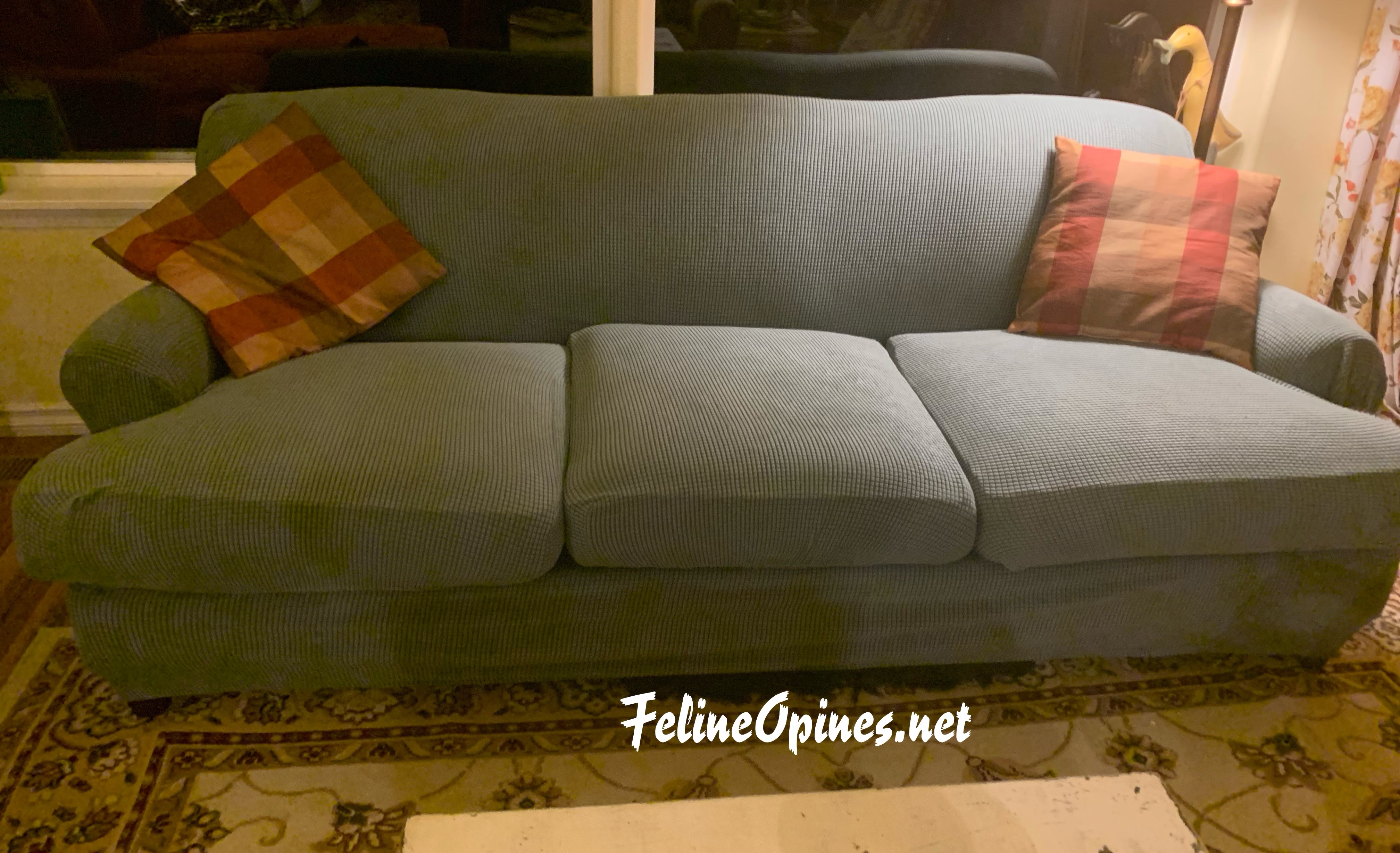
We did have a chance to snoopervise when she received a new sofa cover. Frankly, I don’t know how she would get along without us!
“Hey, I’ll just sit here while you figure out the cushion covers.”“Okay, looks like you’re getting the hang of it. Good job!”Thanks to our close snoopervision, we have a refreshed sofa!”
Lily shirked the snoopervisor duties but immediately took the opportunity to sit on the back of the newly revitalized sofa to survey the woods from the living room window.
The Human also tends to have “guests” when she has breakfast in the morning.
“Instead of local honey and cinnamon, how about trying some tuna for breakfast?”
“Is this the coffee you always insist on drinking before you give us our wet food or express any coherent thoughts?
Sigh, and now you all know what I have to put up with!
Even feline movie stars can be discovered in strange places. This was the case with Puzzum who was found by actors Nadine and Katherine Dennis. They trained Puzzums to cross his eyes, suck from a bottle, and — no, I’m not kidding — laugh on command.
It is said that there was a comic strip in those days that featured a cat named Puzzums which would be quite a coup for a feline that started life as a little shivering kitten found in an alley.
After appearing in the 1927 Los Angeles Cat Club show, Puzzums caught the industry’s eye when the Los Angeles Times published photos of his antics. While the cat show featured many pure-breds, Puzzums stole the show with his tricks. (Take that pure bred feline snobs)
Silent-comedy producing mogul Mack Sennett made Puzzums the first — and only — feline to sign a studio contract. (Literally. He signed with his paw print dipped in ink.) The three-year contract was for $50 per week, which was more than the Dennis sisters were making as extras. MOL!
His movie rolls were quite exciting, starting a prison fire in Cecil B. DeMille’s The Godless Girl or firing a gun in Charlie Chan’s Chance. Puzzums overshadowed famous actors like Carole Lombard, Jeannette MacDonald, and Maurice Chevalier. Unlike movie dogs Lassie and Rin-Tin-Tin, Puzzums was not the focus of a franchise of any kind. Rather, he appeared as a standout moment in films, unique to each setting, and often offering comic relief.
Many movie acting felines had doubles (Bell, Book and Candle used 13 different Siamese cats to portray Kim Novak’s Pyewacket) but Puzzums handled all of his own scenes. Sadly, much of Puzzums film work has been lost and is not available for us to enjoy today.
When he died of a tooth infection in 1934, Puzzums had a lavish funeral. The newspapers covered his death like the passing of any other great star.
Sometimes it pays to purruse the police blotter like this one from Sonoma County, CA. A purloined kitty was returned to its owner after an alert veterinarian scanned the cat’s microchip. A deputy determined that a couple had rented an Airbnb in the 17900 block of Railroad Avenue and apparently took a cat belonging to one of the neighbors. The cat’s owner didn’t realize the cat had been stolen until the vet contacted them. The deputy wrote a report and sent it to the District Attorney for review. Note to my readers, if you own or are near an Air B & B, watch your felines!!
Japanese Artist creates unbelievably life like cats out of felt
I love this story and the way this “movement” is catching on-GO FELINES! Posters have been popping up all over Toronto, Canada. At first glance, people think they are lost cat posters but no, each one has a large heading that says, “LOOK AT MY CAT’ and below the heading is a cat photo and a funny caption.
One caption read, “Cuddles would like to wish you a Meowy Catsmas!” Another said, “Just look at this little guy,”
These posters are all over the city and are also featured on an Instagram account, @lookatmycat_to
The originator of this project purrfers to remain anonymous. But someone who did comment saying, “We really loved the ‘Look at my Cat’ memes on Instagram and TikTok, so why not take that idea and create posters of our cats to plaster around the city — who doesn’t love seeing an adorable cat? We knew that if it made us smile, it was guaranteed to make strangers smile, and everyone needs that these days,”
While the project started with just the group of three, they say their friends quickly started requesting posters be made of their own cats. Of course, you humans love showing off your felines, so naturally, the trend quickly caught on beyond their circle. And now other Canadian cities are looking to start their own “Look at my cat” movement.
If you live in Toronto and want to get in on the fun, you’re in luck! Since their project has gained so much pawpularity, the group is planning on doing a cat scavenger hunt in the near future. People can submit photos of their feline friends to the @lookatmycat_TO Instagram account, which will then be plastered in a random neighbourhood in Toronto. Then you’ll have to go on the hunt for your cat’s poster.
Purrhaps it’s time for someone to start a “Look at My Cat” movement here in the U.S.A.. I’ve said it before and I’ll say it again, CATS RULE!!
Matt Wood, video game developer and founder of Double Dagger Studio, in Bellevue, WA is fascinated by cats.
“In some ways, they’re kind of mysterious,” Wood says. “They’re unpredictable, right? But at the same time, they’re always loving.”
Matt and his family reside with two felines, Mario and Roxy. His felines in residence helped him come up with Double Dagger’s first video game inspired by his cats and kids. While brainstorming ideas with his kids one of them said, “I would love to play as a cat.” Right then and there the idea of Little Kitty, Big City was born.
Little Kitty, Big City is a game where you play as a mischievous cat, who is lost and has to find their way home,” Wood says. “But on the way home, they find out there’s a lot of other really fun things to see and do in the city. (That sounds pretty cat-like to me).
When Wood put a sample of the game on the internet, the response was overwhelmingly positive. Take a look at the video and decide if this is a game you’d like to play.
We are pleased to announce that our third book is out! It came out of the experience we had with the loss of Tucker and Jasmine this year and The Human’s certification and work in pet grief counseling. And the best news? If you have Kindle Unlimited you can get the ebook for free!
We wrote this book to offer comfort and advice for all our two and four-legged furiends whose kitties have crossed the Rainbow Bridge. If you read the book we would love it if you would leave a review on Amazon.
Fall has come in all its glory to our neck of the woods. Oliver loves to sit on the living room window sill and watch the leaves fall and check out what beasts are in the forests, racoons, deer, moose, bear, skuk, even the visiting neighborhood felines hunting mice. A cat never knows what he’ll see down there!
Lily is far less interested in what goes on in the woods and is much more intereted in what’s going on inside the house.
Oliver is struggling during this time of “weight management”. The Human took a seminar on feline obesity and life hasn’t been the same for poor Ollie. He struggles between attempting to squeeze himself in tight places and begging for tuna casserole. Sigh, life is hard for a portly feline.
Gee, Al fits in here just fine.I swear this bed shrunk in the washer!Oh come on, just a little bite of tuna casserole won’t set my diet back that far!
Well, that’s the news from our neck of the woods now let’s check out the feline news from around the web.
Stories where you humans go above and beyond to help kitties find furever homes just make my whiskers quiver. And, thanks to Paul Haddix and Haddix Construction the Central Purrk Café will be opening in a few months.
The company is donating their services to help build the interior cat lounge where adoptable cats will recline in fancy modern digs.
Visitors can reserve time in the cat lounge at $12.00 per hour, $6.00 per half hour. The lounge has a “free roam” area where visitors can get know the cats in an environment that is more like a home, allowing the humans to picture the kitties in their own homes.
Central Purrk will also host special events like Yoga with Cats, Trivia Nights, Beer & Wine Tastings, and offer birthday or other party packages. All cats are adoptable directly from the cat café and 100% of the adoption fees go to the respective humane society. Cats will be spayed or neutered, up to date on their vaccines and be microchipped.
Temptations, the cat treat company premiered the first ever horror movie for cats last week.
The story is about a kitty who makes his way through a haunted house. While storm rages outside, a ball of yarn leads the cat from room to room with all kinds of scary things around each corner. The kitty finally ends up in the kitchen to face the scariest thing of all…a cucumber!
So have your human break out the Temptation movie treats and watch this together this Halloween.
We felines don’t care much about your past. We just want you to pet us and love us and feed us. This arrangement works out purrfectly at the Pendleton Correctional Facility, a maximum security prison in Indianapolis.
Six hours every day, seven days a week the handful of men selected for the FORWARD program (Felines and Offenders Rehabilitation with Affection, Reformation and Dedication.) care for more than 20 cats. Those kitties repay the care and housing they receive while they’re prepared for adoption with love and affection for their inmate caretakers. The inmates gain skills such as empathy, responsibility and self-esteem. Many inmates have said that caring for the cats gives them a reason to get up in the morning. I say this is a purrfect “win-win’ situation!
This is an encouraging tale for all my feline furiends who have challenges. Determined kitties can accomplish great things with the help of their humans. These best furiends, Penelope and Orville just helped their local shelter, Hancock County Humane Society, win $1,500.00, $1,000.99 in cash and $500.00 for food.
Shelter volunteer Kathleen Free wrote the story about Penelope, a kitty born with no eyes, and Orville, the kitten who befriended her and became her “seeing-eye cat. The story won the Clear the Shelters Adoption Story Challenge hosted by The Animal Rescue Site and GreaterGood.org.
Humans, it’s never too early to spoil your felines for the holidays and at this price ($23.00) you can’t afford not to buy it. And since humans like Christmas too, there’s a beautiful kitty ornament included. Don’t wait, go to Chewy and make your felines happy for the holidays.












































 Home | felineopines