Walk Through The Web Wednesday – 6/19

Hello Furiends,
It looks like it might be summer here, finally. I know some of you are suffering from the heat already and I hope your humans have air conditioning, fans or other cooling means available to you.

Did you know this is one of the best months of the year for kitties? June is National Adopt a Cat Month! Needless to say, the three shelter kitties in this home are thankful that The Human adopted us from our local shelter.

Oliver and I were foster “failures” and The Human says it’s a failure she’s thankful for. She was at an event at the shelter when one of the shelter board members introduced her to Lily and it was love at first sight. There are so many kitties waiting in shelters around the world for forever homes. Please consider bringing one home to your house!

Cat refuses to let human leave

I think all my feline furiends will agree that it’s nicer when our humans stay home with us. This kitty, caught in a TikTok video, foils his human’s attempt to leave the house in a hilarious way.

I would note that this is an orange cat (I recently shared an article about orange cats and how energetic they are).  The cat takes possession of the human’s keys and hisses whenever she tries to take them off the table.

For all of you who don’t believe we felines are smart, BondVet recently declared that we have brains that allow us to problem solve, remember things in the past.

The humorous scene highlights cats’ intelligence and the attachment they can have toward their owners. According to BondVet, we felines have brains that allow us to solve problems, remember past events, and understand our human’s emotions. It’s said we have the intelligence of a human two year old.

In other words, this kitty who is guarding the keys knows exactly what he’s doing!

Cats May Be The Only Mammals Who Can’t Taste This 1 Flavor

So you’re telling me that even if you gave me a bit of that muffin, I wouldn’t be able to taste it?

Amy Glover at the Huff Post UK filed this interesting report about cats and our ability to taste sweet things. Have you ever wondered why your cat tries to steal a bite of your pizza but refuses to eat the expensive canned food you just bought him? What flavors motivate us? Well the Scientific American says that we felines are missing a vital protein that is necessary to taste sweets. The article says that the sweet receptor consists of two coupled proteins generated by two separate genes: known as Tas1r2 and Tas1r3,” We felines “lack 247 base pairs of the amino acids that make up the DNA of the Tas1r2 gene.”

What does that mean? We probably taste something when we eat sweets but we don’t taste what you humans do.  

PetMD writes that cats are “seemingly alone among the mammal groups” with this evolutionary quirk regarding tasting sweets.  

Despite this physical reality some of my feline friends seem to love sweets but experts say it’s probably the fat in the sweets, not the sugar that attracts them.

What tastes do we like? The article says we “also have interest in anything with animal protein in it (such as milk, cream, or ice cream), foods with strong smells, or warm food (the temperature of freshly killed prey),” they add ― and anything with a new mouth feel is likely to pique their curiosity.

And if you’re feeling bad that we can’t taste sweets, we do taste some flavors that you humans have, like adenosine triphosphate (ATP), a compound that provides energy for living cells.  

Cat kidney transplants: For some, the pricey procedure is well worth it
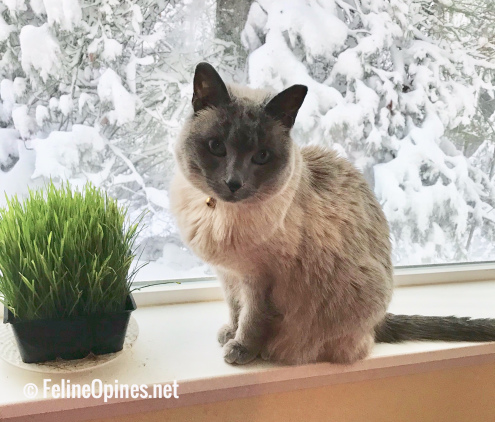
Our beloved Angel Jasmine.

We lost our dear Jasmine due to complications from kidney disease. The human gave her subQ fluids every other day, fed her special food and supplements but the disease took her away from us. For years kidney disease has just been a fact of life for older kitties but things are changing. This article by Marlene Cimons from The Washington Post brings news about kidney transplants for cats.

When the feline “Despy” suddenly developed a congenital form of advanced kidney disease at age 2 the veterinarian gave him only months to live. His human vowed to do whatever he could to save the cat. “He took care of me when I was sick,” says Segal, a software developer who lives in San Jose. “It was my turn to take care of him. It’s that’s simple.”

Segal, then living in the Boston area, drove his cat to the University of Pennsylvania School of Veterinary Medicine in Philadelphia where Despy underwent a kidney transplant in 2018. Today, Despy is thriving. So is Stevie, the kidney donor cat from a local shelter that Segal agreed to adopt as part of the renal transplant. He adores them both. “They play together, they groom each other, they roughhouse,” Segal says. “We’ve become a comfortable, loving family.”

Chronic kidney disease is one of the most common conditions in aging cats and a leading cause of death. It can also be inherited, which is what happened in Despy’s case, and can result from toxin exposure, such as eating lilies. (A cat who eats even a small amount from any part of a lily plant can suffer fatal kidney failure within days.)

Kidney transplants in cats began more than 25 years ago, although they still are rare, and only three facilities perform them: Penn Vet, the University of Wisconsin School of Veterinary Medicine and the University of Georgia College of Veterinary Medicine.

Penn Vet has performed 185 transplants since 1998, the Georgia school more than 40 since 2009, and Wisconsin 87 since 1996.

Not all cats are candidates for the procedure, and for those who are, it can be expensive, up to $25,000 for the surgeries to retrieve the donor kidney and transplant it into the recipient cat. Yet the surgeons who do them say they find it personally gratifying to give people more time with their cherished companions. Also, they add, the surgeries and long-term follow-up in cats can provide knowledge that potentially can benefit human health.

Most cats gain an average of two to three years, although there are exceptions. Despy, for example, is six years post-transplant. “Our longest survivor was nearly 13 years,” says Chad Schmiedt, the Alison Bradbury chair in feline health at the Georgia veterinary school. “Shilo was 3 when we did the transplant in June 2009 and lived until April 2022.”

About 40 percent “go out three years post-transplant,” says Robert J. Hardie, clinical professor of small-animal soft-tissue surgery at the Wisconsin veterinary school, adding that survival often depends on whether postsurgical complications occur. “Some live longer. We’ve had some out 10 years.” At Penn Vet, up to 70 percent are alive and doing well one year after transplant, and two recipients lived 13 years after the surgery.

“It is a life-expanding procedure with the possibility of relatively good outcomes — sometimes dramatic outcomes — in terms of longevity that is of great value to many pet parents,” Hardie says. Moreover, scientists could learn more about immunosuppression in cats that could be applicable to humans, he says.

The cats getting new kidneys typically are between the ages of 8 and 12, although younger cats without other potentially serious medical conditions often do better and live longer, experts say. Schmiedt usually won’t perform a transplant on a cat older than 16. Hardie says the oldest cat transplanted at Wisconsin was 18. Aronson once did one on a nearly 18-year-old who had no other health problems and was youthful in behavior and who lived for another two years with the new kidney.

Cats with moderate kidney disease are better candidates than those with mild or advanced disease, because of the balance between surgery risks and benefits, although age provides an advantage for young cats who may have advanced kidney disease. The cats also can’t have chronic infections or cancer because they must take the immunosuppressive drug cyclosporine for life, which can worsen both conditions. Severe heart disease also rules them out. “You want a recipient who has the best chance of making it” through surgery and beyond, Schmiedt says.

Matching is easier for cats than it is for humans needing a transplant because there are only two blood types among all cats.

Although this transplant is expensive it is still good news for kitties like Despy. His human says he’s full of energy and living his best life.

Kidney transplants for dogs is more challenging as dogs often suffer problems with immunosuppression.

Woman wakes up with four cats in bed with her. She only has three cats.

Anne-Sophie Mielke and Steffi Feldman from TAG24 provided this amusing story.

A Reddit user (username u/trixy_treat), shared a picture on the platform that has Reddit users talking. The lady who lives in Britain found herself snuggling in bed one morning with four cute felines who were nestled into her blankets and pillows. This woman sleeps with her cats so the sight was not unusual as she lives with three cats named, Pancake, the Tortie; Oreo, and Quinn.  The fourth cat was not a member of her household but a visiting neighbor feline.

The visitor named Bluey, lives next door and is a buddy of her cat Quinn. The woman supposes that Bluely enjoys sleeping at her house because  he lives with a large dog and a toddler.

If Bluey doesn’t sleep over he will appear at her window and meow loudly for her cats to come and play. Now it seems he’s graduated from morning play time to sleep overs.

House of Black Cat Magic celebrates 1 year of business, helping home 150 black cats

The House of Black Cat Magic in Asheville, N.C. hosts parties, community events and more in its Black Cat Lounge, giving people a chance to meet a variety of cats that are up for adoptions.

Joel SeymourSun from ABC13 News reported about their anniversary celebration, their first anniversary “purrty, “magical market” and a silent auction and cat food drive to benefit Binx’s Home for Black Cats food pantry.

Sterling “TrapKing” Davis, who runs TNR Humane Cat Solutions, was there to offer informative sessions about the importance of TNR programs — Trap, Neuter, Return — which help stabilize feral or community cat colonies by trapping them, then spaying or neutering them, and finally, returning the cats back to their community so they can live out their days without continuing to reproduce. We love Sterling, he is a rock star among his feline fans.

Sterling said about TNR, “”A lot of areas, they get a lot of cats so they overpopulate, they start fighting over resources, they end up getting sick, injured, harmful to one another,” Davis said. “So, it’s good to control the population in a good way… that’s what TNR is — you’ve got to spay and neuter your pets!”

I love humans who go above and beyond to help ferals and work to find forever homes for cats.

The Catio Guy

The Human does not support allowing us to go outside as there are all kinds of predators in our neck of the woods but she does provide the opportunity for us to sit on the upstairs patio in our own pop-up catio. 

This guy custom builds cations and they are amazing. We definitely think this is a home renovation The Human should consider.
This week’s video “pick of the litter”

How many of my feline furiends out there can rock a skateboard like this guy?

Walk Through The Web Wednesday – 6/5

Happy Wednesday Furiends!
How are things in your neck of the woods? We’re hanging in there, our weather however, can’t decide if it’s late winter or spring. Still, since we’re indoor felines, the weather has little effect on us. Things are getting greener and The Human is opening the windows more so that’s good.

Oliver and I do a lot of play fighting and my whiskers are the constant casualty. Now, although it’s not unusual for felines to scuffle and for whiskers to be lost. Our whiskers help us navigate through our environment and are our most important sensory organs. As long as the follicles aren’t damaged, my whiskers do grow back but it takes time. Do any of my furiends out there have a feline sibling that shortens your whiskers?

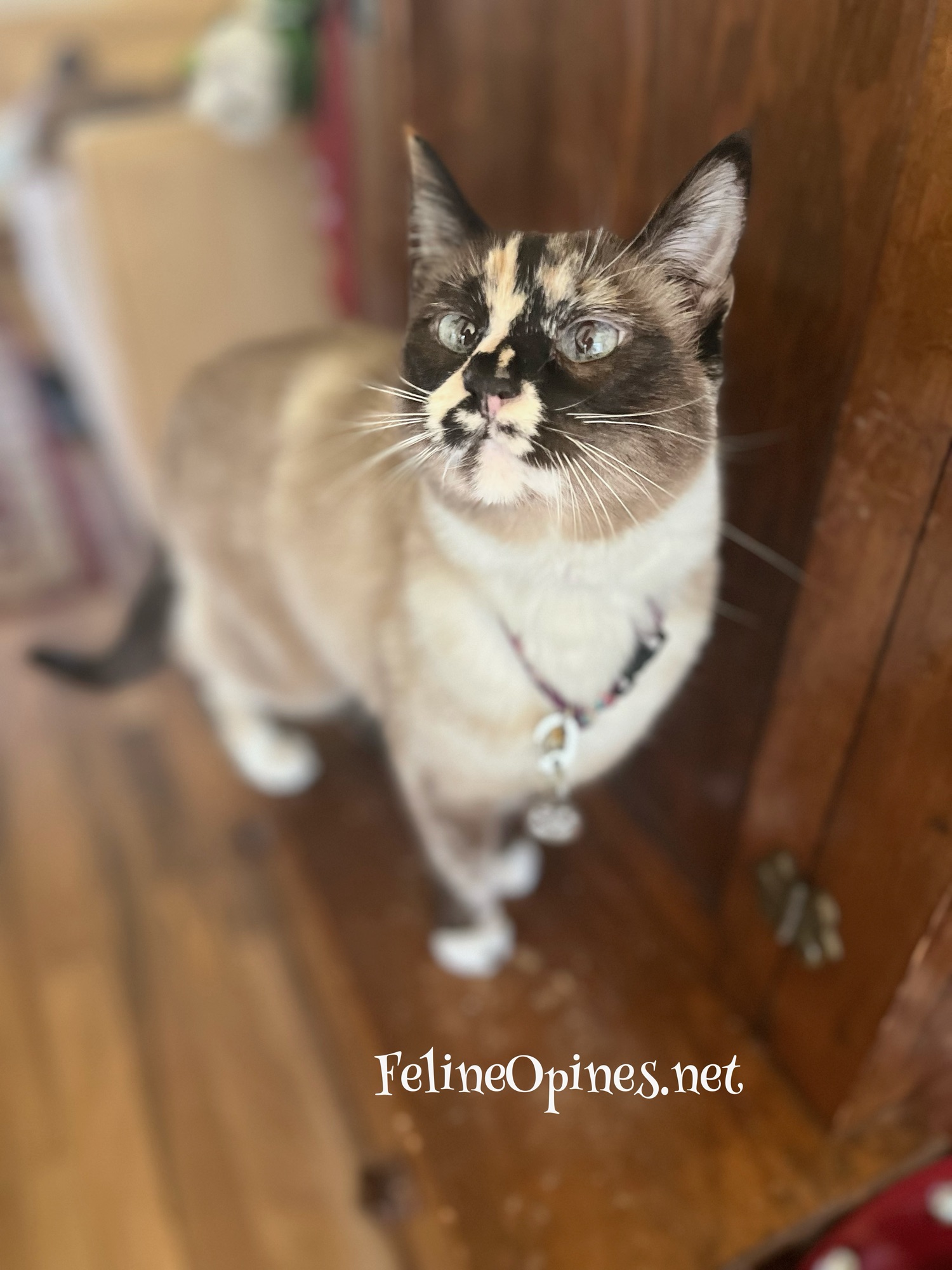
Look at my pitiful whiskers.

Oliver likes to celebrate holidays and his visual contribution this week is his celebration of Hot Air Balloon Day (which is today)

Happy Hot Air Balloon Day, June 5

And finally, Miss Lily loved the story of cats in mining towns so much she asked our Purrsonal Assistant to make an image placing her in the past in the days of the cats in mines.

Those mining town felines were fantastic!

Here are this week’s stories and our video of the week, we hope you enjoy!

      New ‘Salty Licorice’ Cat Coat Pattern Linked to Genetic Mutation, Study Finds

A group of scientists at the University of Helsinki in Finland discovered a genetic mutation that creates the recently discovered “salty licorice” coloring found in some cats.  

According to the scientists’ study of these felines, published in the Journal of Animal Genetics in May. This coat pattern is similar to tuxedo coats, but the “salty licorice” felines differ with dark markings on their faces and dots and an increasing amount of white towards the back portion of the body. Their tails tend to be primarily white. The pattern was first observed among the Finnish domestic cat population in 2007.

The researchers found that the pattern is linked to a variant of the KIT proto-oncogene (KIT) gene, which is “associated with an absence of melanocytes in the skin and hair follicles” and commonly causes the white coat appearance in various domestic animal species.  

If any of my furiends are from Finland, I’d love to know if you’ve met one of these unusual felines.

Cats in mining camps

Placerville today

Well of course this article caught my eye as we are Idaho felines. In this article from the Idaho Press on Rick Just’s History Corner, I learned that in the 1860s, in Placerville and other mining camps in Idaho, cats were prized for their ability to keep rodents at bay. The article’s author found a 1934 edition of the Idaho that talked about miners’ cabins being often overrun with field mice and chipmunks.

An entrepreneurial fellow from Oregon named Mooney sold pest control cats in the mining camps. Most of them were gray tabbies with no claim fancy pedigree, yet despite that fact, each sold for $10 which would be more than $300 today.

Mr. Mooney stayed overnight with the Moores of Placerville and gave a pair of kittens to their daughter Lizzie. In later years, Lizzie (then Mrs. Sisk) told of litter after litter of kittens that came along, fetching $2.50 for each tiny cat. For many years after, Placerville was known as the home of large gray cats who kept themselves healthy and large due to an endless supply of mice.

Houtong Cat Village: Taiwan’s Cat-Themed Coal Mining Village

I was so intrigued by the mining kitties story, I sent our Purrsonal Assistant off to find out more about cats in mining villages. She came across an article by Nick Kembel on a website called “Taiwan Obsessed” about his visit to Houtong Cat Village. The photos her are all Nick’s.

Houtong was once a thriving coal mining town and today is home to hundreds of cats. The history of the mining in Houtong is preserved in a park.  It’s interesting that the word “Houtong” means monkey as there used to be a cave with monkeys nearby. At its peak, the town had more than 6,000 residents. After the coal mining industry declined in the 1990s most left, and only a few hundred people still live there today.

Your first introduction to the town will probably when you walk through the Cat Bridge.  It was built in 2012 and its design pays homage to the old mining tunnels. Since the bridge is covered, it offers shelter to the local felines and you will probably encounter felines napping there.

Several hours in town can be spent checking out the ruins of the coal plant, browse the souvenir shops, drink a cat foam latte and meet a bunch of new feline furiends.

The cat connection began in 2008 when a local resident and cat lover started encouraging locals to take in stray cats. The idea really took off, putting Houtong back on the map as Taiwan’s premier cat village.

The 200+ cats that live in Houtong today are mostly strays that have been sterilized and those cats are identified with the standard TNR procedure of a clipped ear.  The cats mostly seem to co-exist, with each claiming its own territory and snoozing spots within the three-lane village built on a hill looking over the train station.

You can’t make your way through the village without stopping to pet the cats sleeping and relaxing along the way.

The local shops offer a plethora of cat themed souvenirs and food items.

The ‘Feline States of America’: How Cats Helped Shape the US

Kiddo the lucky cat

And the search for cats in history continued and our Purrsonal assistant found this article by Joy Powers of NPR in Milwaukee.  It doesn’t deal with cats in mining towns but it is about the history of cats in the U.S. She interviewed cat historian Paul Koudounaris (who knew there were cat historians?) who said (about cats), “They were domesticated, they were raised to the highest of the highs and they were plunged down to the lowest of the lows and then very, very slowly by the end of the 19th century, they finally built themselves up to be companions again,”

Koudounaris said that many cats came to the Americas by ship with early colonists. They were known as ship cats, they were used to get rid of rodents and protect the boat’s food supply. These cats were one-way passengers and got off the boats at the same time the humans did.

Although cats continued to face persecution in Europe at the time, some early colonists recognized the benefit of the feline’s hunting skills to handle pest controls. In fact, cats were some of the first animals employed by the U.S. Army.

“The United States Army had hired cats long before they had hired dogs,” he explains. “The United States Army had hired cats in the 19th century, again, to protect the commissaries.”

Even though cats played an important role in early U.S. history, it took a few centuries for them to be considered companion animals instead of working animals. Koudounaris says the transition happened slowly, spurred by their popularity in the West (particularly among cowboys who would use cats to watch their rations). Creative folks, like Mark Twain, started bringing cats indoors and their popularity as house pets grew.

Koudounaris is currently writing a book profiling some of America’s most famous cats, including some of the more well-known ship cats like Kiddo, a cat onboard the airship America, the first dirigible aircraft that tried to cross the Atlantic. Unfortunately the dirigible crashed but thankfully Kiddo survived and he went on a national tour in 1911, making $2,000 a week.  Our Human wants to know what we could do to make $2,000.00 a week!

This week’s video “pick of the litter”

This one will make you say “Awwwwwww”

Walk Through The Web Wednesday – 5/15

Happy Wednesday Furiends!
We’re humming along here in our neck of the woods. The Human is working on editing her first book in her cozy series and Ollie and I are looking forward to her getting that book out so we can be famous. I am looking forward to signing pawtographs.

We have a nice litter box at Feline Opines International Headquarters and Oliver decided he’d like to do a “jungly” photo shoot. He wants to know what you think.

Neither Lily nor I had the desire to pose for any pictures this week so I’ll move on along to this week’s feline internet news.

Would you trust a robot to look after your cat?    

Sanjana Gajbhive from Earth.com wrote an article about robots as cat sitters. Noted was a recent research project called Cat Royale which talked about building trust between cats and robots. Now this feline is no fan of machine, I mean the vacuum monster alone is enough to give a feline a nervous breakdown!

Cat Royale, an award-winning research project, resulted from collaboration between University of Nottingham scientists and Blast Theory artists. This project crafted a “multispecies world.” In it, three cats lived with a robotic arm. They coexisted for six hours each day across twelve days. Good grief humans, coexistence is not what we cat’s want, we need pets, headbutts and skritches.

The researchers of this project wanted to find out what influenced feline-robot trust.

Some findings have been that the environment and the role of the humans in that environment were all factors in the cat’s trust of the robot. Well DUH!

 “At first glance, the project is about designing a robot to enrich the lives of a family of cats by playing with them,” said Professor Steve Benford, who led the research. “Under the surface, however, it explores the question of what it takes to trust a robot to look after our loved ones and potentially ourselves.”

The robotic arm at the heart of Cat Royale engaged the feline participants through a variety of playful interactions, including dragging a toy mouse, dangling a feather “bird,” and dispensing treats. An integrated AI system observed the cats’ reactions, learning their preferences and tailoring play sessions accordingly. They designed an environment that was pleasing to the cats.

The researcher’s goal is to create a multi’species system but this cat would ask, what about the human/animal bond? Our Human spent quite a bit of time studying this and she too is a bit skeptical about this.  

At least the researcher’s did acknowledge the importance of human involvement in areas like breakdown recovery, animal welfare, and audience engagement. In other words, even in a world of advanced robots, the human touch remains essential. Well, there you go!

Their conclusion is that if you humans want robots to take care of your felines, you’d have to give your home a robot friendly makeover and that you humans have to understand that even the most advanced robot can’t replace the warmth and understanding of a human caregiver. I have three words for all the humans out there-HUMAN-CAT-SITTER.

In Germany, cats remain the most popular pet

Deutsche Katzen sind die besten!

A recent report from a German pet trade and industry association, revealed that Germans love their pets. Well, our Human is German and she can attest to that! In 2023, 34.3 million dogs, cats, small animals and pet birds lived in German households. There were also numerous animals in terrariums and ornamental fish in aquariums and garden ponds.

According to a market research survey from Skopos done for the  Pet Supplies Industry Association 45% of German households have pets.

Felines are still Germany’s number one pet: a total of 15.7 million of them lived in 25% of German households in 2023. In 42% of all cat-owning households there were two or more cats at home.

The head of the market research team said,” We are all the more pleased that the total number of pets kept in households in Germany has remained stable at a high level over the past few years.” I would say they should be pleased that the vast majority of German households are cat lovers!

Cat’s nonchalant reaction to Northern Lights leaves everyone laughing

Sophie Roberts, Lifestyle and Travel Editor for Mirror UK reported on the lack of enthusiasm one cat had regarding the Northern Lights as one man’s cat was photographed with the colorful sky as a background and looking completely unimpressed.

I don’t know what the sky was like in your neck of the woods but it was pretty amazing here. Still, not amazing enough for the Tribe to remove ourselves from the bed and do any sky gazing.

This is how one guy described his cat’s reaction on X: “My cat just experienced the aurora borealis – one of the world’s most radiant natural phenomena – and she doesn’t care.”

His post went viral getting got more than 1.7 million views.

Cat Owners Thought Their Roomba Was Broken, Until They Discovered the Truth

In a Newsweek article this week, a couple who thought they had a broken Roomba discovered their cats were the culprits.

Their cat Winnie became a media star when her human shared a video of her on TikTok.  The video shows clearly that the Roomba wasn’t broken, only “detained” by Winnie’s actions.

Some people think Winnie was playing with the Roomba. This feline believes that Winnie was protecting the other cats in the household by keeping the dreaded vacuum monster away from them. Go Winnie!

Homeowner Sends Neighbor a Note — and Asks Them to Not Let Cats Look Out the Window

“Hey neighbors, it’s me, Oliver, in the window. Tell your dog to shut up!”

Reddit users have weighed in on the letter, which asks the homeowner to “please keep your cats out of the window”. Oh my whiskers, the hubris!

A Reddit user shared a letter sent by a neighbor requesting the poster keep their cats “out of the window,” as the cats are causing the neighbor’s dog to bark.Seriously??!!

In a post shared to Reddit, the cat owner wrote, “I own my own home, and I have three cats (plus two new babies I found outside). Two of them love to sit in the window when it’s nice out. They do nothing but sleep. We keep the windows open as we don’t have AC yet.”

But evidently the cats’ habit of sunning in the window inflamed the neighbor who sent a letter reading: “Hey neighbor! Can you please keep your cats out of the window? They are causing my dog to sit in the window and bark all day long. I work from home, so this is very difficult. Thanks.”

What would say to a neighbor who asked your human to keep you out of the window?

This week’s video “pick of the litter”

There are so many human social media influencers. This feline influencer, Uno the Orange cat, is teaching cats how to live the Vida Loca. It should be a must watch for every feline.

Walk Through The Web Wednesday – 3/20

Happy Wednesday Furiends!

The weather in our neck of the woods is teasing us, snow is melting and sun is out and now The Human tells us that the weather people (whoever they are) are saying we’re going to get more snow. Meowza, is it spring or not??? The Tribe has decided to take each day as it comes and are enjoying ourselves despite the unpredictable weather (good thing we’re house cats!)

Rain, snow, I don’t care as long as the fireplace is working.
Spring, summer, winter or fall, I don’t care as long as I have my comfy office bed.

We hope that the weather in your neck of the woods isn’t so crazy.

Cat rescued from Minnesota rest stop nearly 2 years ago now a model for Target

The story of Hercules the cat began in June 2022 when bystanders called for help after spotting a car jammed with cats at a county rest stop. The sheriff’s department and Animal Humane Society took 47 cats to vets and shelters from the car on that 94 degree day.

One of those cats (now named Hercules) escaped. Volunteers from Tuff Start Rescue found him a month later, lying motionless, near death, his fur drenched in urine. He had a severe jaw fracture and a maggot infestation that was so bad that it had eroded through his cheek tissue.

Dr. Nicole Perreault at St Francis Vet Clinic in Isanti helped put Hercules back together again. He had multiple surgeries, including several on his jaw, which at one point was held together with surgical thread and blue buttons.

“With his referral care and everything, we are probably $12,000 in on him,” Perreault said. “We basically say they are worth every penny.”

Perreault approached her friend Jill LeBrun, a registered nurse, to foster Hercules and LeBrun said, “It was love at first sight.{“

As a result of his jaw fracture, Hercules’ tongue hangs out a lot. And then, one day his human heard that an animal talent agency was looking for cats with unusual faces. Hercules got the job and did so well, the agency wants him back for more work.

And how much did Hercules earn for his first meowdeling gig? A nice $100.00.  Now The Human is calling us slackers since we’ve never earned any income. How rude!

Owner Pays $350 for Vets To Check Growling Cat—Unprepared for Diagnosis

Brandy Mink of southern Illinois told Newsweek that she decided to bring her cat Remi to the vet for a general exam since her cat was also experiencing some skin problems and also growled and swatted every time Mink picked her up. Mink worried that her cat was in pain

After a $350 trip to the veterinarian, Mink’s TikTok video posted to the account @_toe..beans_ in October revealed that her cat was diagnosed with “tortitude.”

If you humans don’t know about “tortitude” you should learn. All you need to do is watch Remi’s TikTok video for a class on “tortitude”.

Remi is Mink’s second cat. The first cat in the home is a sweet tempered Tabby. Now the house has one sweet cat and one sweet and spicy cat (Remi).

Remi’s TikTok clip has reached over 2.2 million views, 223,300 likes, and 633 comments as of Saturday afternoon.

Now that Mink knows about “tortitude” she better understands Remi. She said about Remi,  “She is loving, playful, and will probably forever have a small side of sass we call ‘tortitude,’ but I wouldn’t have it any other way.”

What do all my Tortie furiends think? Is “tortitude” a real thing or is this just another way for people to malign cats?

Which animals make the best friends for your cat?

I love the idea of felines getting along with roommates of another species. This article is helpful if your humans want to bring another animal into your household.

“A cat’s affinity with other animals, whether they’re of the same species or not, will depend a lot on how it has been socialized with its mother and littermates, as well as its character,” says Celia Alesanco, a feline ethologist at Sanicat, a company that manufactures kitty litter. In general, cats tend to get along best with other members of their species and with dogs.

The socialization period for house cats lasts until they are around 16 weeks old, and is key to its later interactions with people and other animals. “If an early introduction is made correctly, it will be much easier for the cat to share its home with other animals down the line. But if it’s done badly, that can generate fear and aversion towards new companions,” Alesanco says.

In general, young animals are more flexible when it comes to adapting to different situations. “For example, if they are born surrounded by sheep, chickens and horses, it will seem totally natural for cats to spend time around those species,” explains Helena-Bat, a psychologist who specializes in ethology and animal wellness. Still, older cats can also live happily with other animal companions. “Despite the fact that cats are more receptive to socializing when they are kittens, that doesn’t mean that an older feline can’t get used to the presence of other animals — just that the process will be a bit more complex,” says the ethologist. Helena-Bat says that middle-aged adult cats exhibit a range of behaviors: “Each one has its own personality and response to interacting with other living beings.”

A cat’s character also influences its way of relating to other animals. “Some establish unexpected ties, while others simply coexist alongside other animals in the home. Links can be formed with dogs, but also rabbits, guinea pigs and hamsters. With smaller rodents and birds, it’s important to supervise interactions, because the cat’s hunter’s instinct can take over,” says Alesanco.

Each cat is different, so it’s impossible to generalize when it comes to what kind of attitude they will have towards living with other animals. “In some situations, a cat who is already living in a home will perfectly integrate with new companions, while in other cases, adopting a well-socialized cat can result in a harmonious coexistence with the rest of the members of the family,” says Alesanco. But she warns that other cases can be quite different: “Even if you’ve evaluated the cat’s temperament and properly socialized them with other species, it could be that they don’t adapt to another animal and that they are unable to successfully live together.”

The most difficult time for a cat in terms of easily connecting with other companions is when they are more than 10 years old or when they are ill.  “An older cat, especially if they are female or have an illness, will find changes more difficult and more stressful. In these cases, it’s advisable to focus on the needs of the animal so it can be as comfortable as possible,” says Helena-Bat.

When your animal family is due to grow and already involves a feline member, it’s good to keep in mind the following tips towards achieving pet harmony. Ethologist Celia Alesanco recommends the following:

  • Look for an animal with a compatible personality. For example, if your current cat is very mellow, avoid bringing them home a hyperactive companion.
  • Bring a sense of calmness and patience to the animals’ first interactions to avoid generating conflict. In some situations, coexistence will happen easily and quickly, and in others, it will be a longer process. Either way, it’s best to keep the animals separated initially if you’re not there to supervise, especially if there are small rodents or birds involved, because their lives could be at risk if the cat decides to hunt them.
  • Monitor the environment in which the animals spend time together, including details like keeping their rest and feeding areas separate from one another. During their first interactions, you can opt to install a gate that allows them to smell and see each other, but precludes any possibility of physical conflict. Once they make it through this separation period, it is still advisable to continue monitoring their interactions at all times, especially when one of the animals is smaller.

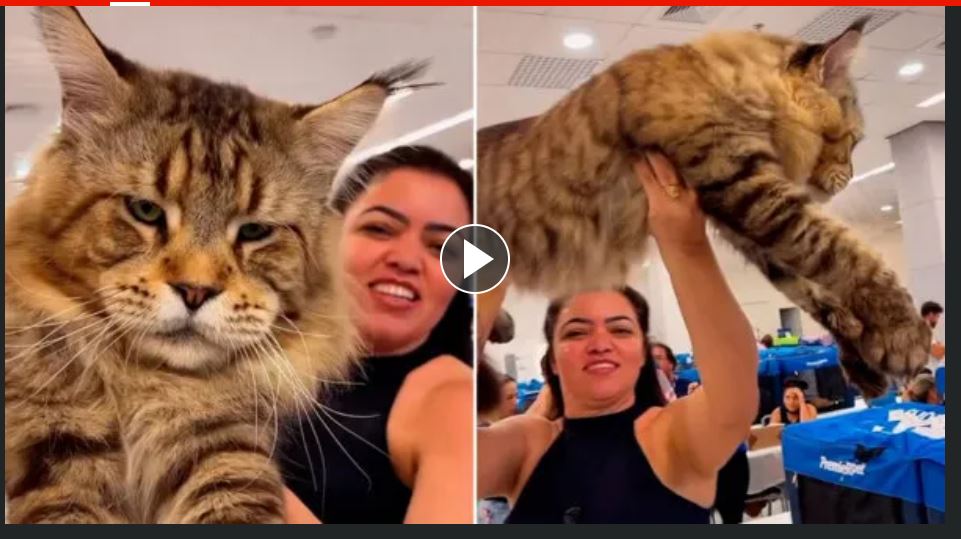
My kitty’s a contender for the world’s biggest CAT – he was the smallest in the litter but now he’s as big as a cheetah

Six-year-old Xartrux, from Brazil, measures 4.2ft in length and weighs just over 10kg (22 lbs) – making him as big as a cheetah.

Now wait a minute. Both Oliver and I are 21 ½ pounds! Does this mean that we’re almost as big as a cheetah? The Human needs to start showing us some respect!

While an average cheetah is much heavier than Xartrux, they are between 3ft 7in and 4ft 11in long – a bracket Xartrux comfortably falls into.

A breed of Maine Coon, Xartrux is expected to be naturally big, due to the breed”s title as one of the largest in the world.

But he has grown to such a monumental size that owners Marcia Oliveira and Jean Martins, from Jau, in Sao Paulo , claim their pet is longer and heavier than the biggest domestic cat currently alive.

They reportedly filed their case with Guinness World Records in January, with footage showing a grumpy-looking Xartrux participating in the Rio Cat Club Exhibition in March 2023.

The breed is one of the largest in the world and was previously considered the biggest until the introduction of the Savannah cat in the mid-1980s.

Cartoon Cats: Fun Facts About Our Favorite Animated Felines

Our very own Felix the Cat
Felix the Cat

Felix the Cat is over 100 years old, but he remains forever young. First introduced in 1919, during the silent film era, Felix was one of the very first cartoon characters to become famous. The grinning, googly-eyed little tuxedo cat is instantly recognizable, and his antics have delighted many generations of fans.

Surprisingly, there’s been much debate over who actually created Felix. While producer Pat Sullivan‘s name is on all the cartoons, Otto Messmer was the artist who animated him, and today most people say Messmer is the true father of Felix. One thing that hasn’t been questioned? Felix is an icon, and the standard against which all cartoon cats since have been judged.

The most hapless cartoon cat: Tom

The first of many legendary cartoon series created by William Hanna and Joseph Barbera (who would go on to create The FlintstonesThe Jetsons and many more popular shows once they formed their own animation studio, Hanna-Barbera, in 1957), Tom and Jerry debuted in 1940 as a series of MGM short films, and has remained exemplary of the age-old game of cat-and-mouse ever since.

The typical Tom and Jerry cartoon centers on Tom, a gray tuxedo cat, as he attempts to catch Jerry the mouse. While Tom may be quick on his paws, Jerry’s wit is even quicker, and he always manages to escape. Tom and Jerry is known for its goofy violence, and inspired the even more over-the-top show-within-a-show Itchy & Scratchy in The Simpsons.

The silliest cartoon cat: Sylvester

“I tawt I taw a puddy tat!” Sylvester, the red-nosed tuxedo cat, and Tweety, the little yellow bird he antagonizes, are one of the best-loved Looney Tunes duos. Created by cartoonist Friz Freleng, Sylvester made his debut in 1945, and has been a legend ever since.

Sylvester, whose full name is the very regal Sylvester James Pussycat, Sr., holds the distinction of having the most Academy Awards of any Looney Tunes character. That’s right: In the ’40s and ’50s, three shorts starring the funny feline won Oscars!

The most fed up cartoon cat: Mr. Jinks

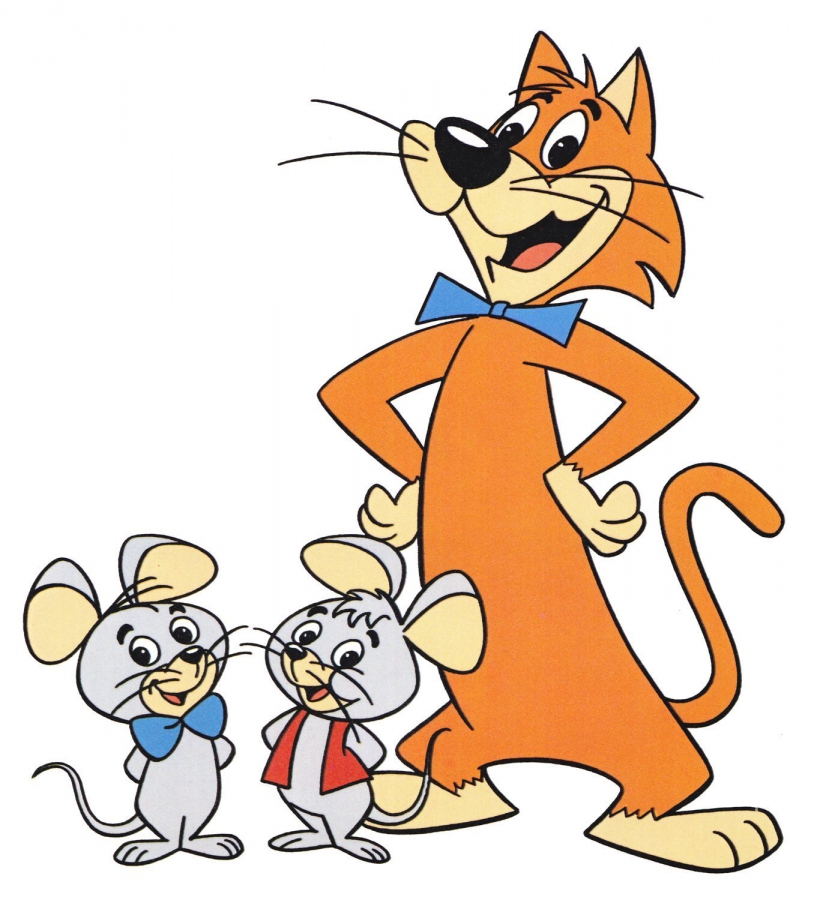
Pixie and Dixie and Mr. Jinks was another Hanna-Barbera cat-and-mouse creation. From 1958 to 1961, the slapstick cartoons were part of The Huckleberry Hound Show, and they followed a formula similar to Tom and Jerry (if it ain’t broke, don’t fix it, right?). Unlike the earlier cartoon cat, Mr. Jinks had not one but two mouse adversaries, Pixie and Dixie.

Mr. Jinks, an orange cat with a blue bowtie, became known for his grammatically incorrect catchphrase, “I hate you meeces to pieces!” While he may not be as well-known as some of the other Hanna-Barbera cartoon cats, Mr. Jinks remains an amusing example of the constantly foiled feline.

The most street smart cartoon cat: Top Cat

Top Cat was created by Hanna-Barbera in 1961. While his show only ran one season, he remains a beloved cartoon kitty thanks to his street smart persona and creative array of get-rich-quick schemes.

Top Cat is the leader of a gang of New York alley cats, and he cuts an unforgettable figure with his yellow fur and snazzy purple vest and fedora. While Top Cat was popular with kids, the series aired during prime time, and the wisecracking, constantly scheming feline was heavily inspired by comedian Phil Silvers‘ Sergeant Bilko character, which gave him a broad appeal to midcentury viewers of all ages.

The most elegant cartoon cat: Marie

The 1970 Disney movie The Aristocats brought an adorable array of cartoon cats into the spotlight, but Marie is the character who stole most viewers’ hearts. Unlike the other cats on this list, Marie is a lady — and she won’t let you forget it!

Marie is a charming little gray-and-white ball of fluff from a posh Parisian family. When she winds up among the alley cats, she’s quick to differentiate herself as the fanciest cat of all, and she wears pink bows on her neck and head that complement her little pink nose and ears. She even has long eyelashes and purplish eyelids (hey, wait a minute — is this cat wearing makeup?). No wonder she was named after Marie Antoinette!

The laziest cartoon cat: Garfield

Garfield debuted as a newspaper comic strip in 1978, and quickly rose to the cartoon cat pantheon. Created by cartoonist Jim Davis, who grew up with cats and noticed a distinct lack of felines in the funny pages, Garfield became a household name in the ’80s as he got his own cartoon TV show and started appearing on all kinds of merchandise.

Garfield is a fat, lazy orange cat who hates Mondays and loves eating lasagna and annoying his owner. Garfield’s sarcasm makes him one of the most relatable cartoon cats, and as his creator described it, “Basically, Garfield is a human in a cat suit.”

The most swashbuckling cartoon cat: Puss in Boots

Puss in Boots was introduced in the 2004 animated film Shrek 2, and became a fan favorite who got his own spinoff movies. While Puss in Boots is computer-animated, and not hand-drawn like the other cartoon cats on our list, he secured his place thanks to his suave, swashbuckling persona.

Voiced by the eternally charming Spanish actor Antonio Banderas and loosely based on the classic fairytale of the same name, Puss in Boots is adventurous and confident. He knows his way around a sword fight and looks quite dashing with his hat, cape and boots, but like many cats, he’s also not afraid to widen his eyes and lay on the cuteness to get what he wants.