

Hi There Furiends and a happy Wednesday to you all!
We sure have been seeing a lot of you meowing about your human kids going back to school. We felines are glad we don’t have to go to school but we were wondering what it might be like if we did. We had The Human use her new app Clip2Comic to create some cartoons of the three of us on our first day of school. We hope you enjoy.





That’s our cartoon version about what it would be like if The Tribe had a first day of school. What about you, any of my feline furiends interested in getting an education? And how are you surviving with some of your human family leaving you to go back to school?

16 Colleges That Allow Cats: Where to Study With Your Feline Friend

In celebration of our “back to school” edition of WTTWW we are excited to share this article. Did you know there are 16 colleges that understand that the stress of college can be mitigated by the love of a feline and thankfully, may colleges are allowing pets on campus. If you want to know where you and your cat can get a higher education, check out these colleges. And please note, there’s a forward thinking college in our state at the University of Idaho!!
Here’s the list.
1.Eckerd College- St. Petersburg, Florida-Private, four-year
Eckerd College is generally considered the most pet-friendly college in the country. They were one of the first to allow pets on campus, starting in 1973. According to Eckerd rules, cats are considered “large pets” and are permitted in designated dorms. Students must register their cats with campus staff and pay a fee. Only cats older than 6 months that have lived with the student for at least three months are permitted. Students may not adopt or buy new cats while living on campus. Eckerd holds a “pet graduation” along with human graduation each year.
2.Stephens College-LoColumbia, Missouri-Private, four-year, women’s college
Stephens College has allowed pets on campus for 10 years. Spayed and neutered cats older than 6 months are allowed in designated dorms. Students are allowed one pet only and must register them and pay an annual pet fee. In addition, students must keep their cats up-to-date on shots and free of fleas and ticks. The college also requires students to get maintain a current pet license from the city of Columbia. Overall, Stephens is very welcoming to pets and even has a foster partnership with a local animal rescue group.
3.Johnson and Wales University – Povidence, Rhode Island- Private, four-year
Johnson and Wales first began welcoming pets to campus in 2013. Cats over a year old are allowed in designated residential areas on campus, and one pet per person per room is permitted. Students must register their cats each year and pay an annual fee. Cats must be spayed or neutered and current on their shots. The university provides a helpful guide to all incoming pet owners, outlining all rules and responsibilities. It also includes contact information for local veterinarians and pet supply stores.
4.Lyon College-Batesville, Arkansas-Private, four-year
Lyon College opened its first pet-friendly residence hall in 2018. Cats at least 6 months old are allowed, one per room. Students are not allowed to acquire new pets while living on campus, and cats must be registered before arriving on campus. Students can only move their cats in during a two-week window at the beginning of each semester. The university strongly encourages students to purchase pet insurance and provides a list of local veterinarians who offer student discounts.
5.State University of New York at Potsdam-Potsdam, New York-Public, four-year
This college maintains pet-friendly floors scattered across various residence halls. Students can bring one cat to campus with prior approval and registration. They must sign an agreement that states, among other things, that they will scoop the litter box daily and change out the litter completely once a week. Room checks may happen at any time to ensure students follow the rules. The college also maintains strict policies to ensure that cats are being well-cared for, including penalties for not promptly taking a sick animal to the vet.
6.Stetson University -Deland, Florida – Private, four-year
Stetson University allows cats in designated locations on campus. Students may bring cats at least a year old that they’ve owned for at least a year. The university requires purchase, adoption, or vet records to confirm how long the cat has lived with the student as well. Only one pet per room is allowed, so negotiations are necessary if both roommates want to bring a cat. Animal-friendly housing on campus is limited and extremely popular, and students must get their applications in as early as possible.
7.University of Illinois – Champaign, Illinois – Public, four-year
The University of Illinois allows cats in one of their on-campus apartment buildings. Up to two pets or one per roommate are permitted in the apartments. Students must get permission to keep a cat with them before bringing the animal to campus. The university charges a monthly pet fee in addition to the monthly cost of the apartments. Students must provide yearly copies of vaccination records and keep their cat and apartment free of fleas and other parasites.
8.University of North Carolina-Charlotte – Charlotte, North Carolina – Public, four-year
UNC-C allows cats in one residence hall and various Greek Village houses. Spaces in these pet-friendly areas are given out on a first-come, first-served basis and fill up quickly each year. Cats must be at least a year old, spayed or neutered, and current on their shots. Students must pre-register their pets and pay an annual fee. Students have to take their cats with them during breaks and can’t leave them alone for more than 12 hours at a time.
9.University of Northern Colorado – Greeley, Colorado – Public, four-year
This college allows cats older than 6 months in two residential communities on campus. Students must submit all paperwork before being considered on a first-come, first-served basis. One pet per room is allowed, with a maximum of two within a four-room suite. Starting with the 2022-2023 school year, an entire residence hall on campus will have pet-friendly single rooms, making this college one of the best for taking your cat and getting some privacy too.
10.Washington and Jefferson College – Washington, Pennsylvania – Private, four-year
Washington and Jefferson designated its first pet-friendly dorm in 2006. They now offer three locations on campus where cat-loving students can room with their pets. One pet per room is allowed, and recent renovations to the pet halls on campus have brought improved comfort and larger living spaces to students and their cats. Some students are even training service dogs on campus, showing that this is a college that welcomes pets and recognizes their value.
11.Wilson College – Chambersburg, Pennsylvania – Private, four-year
Wilson College allows cats in residence halls. Only one cat per student is allowed, and the animal must be at least 6 months old. Students must register their cats before arriving with information such as a photo and physical description, proof of vaccination, and proof of flea prevention. They must also pay a registration fee for each academic year. Students can pet sit for other residents but must have prior approval and registration.
12.Lees-Mcrae College – Banner Elk, North Carolina – Private, four-year
Lees-Mcrae allows cats in several designated residence halls and on-campus apartments and houses. No aggressive cats are allowed; they must be older than 6 months and have lived with the student for at least 3 months before coming to campus. Only cats used to living indoors are allowed. If students get a new cat over the winter holiday break, they won’t be allowed to bring them to campus until the following academic year.
13.University of Idaho – Moscow, Idaho – Public, four-year
The University of Idaho allows spayed and neutered cats in on-campus apartments. Two pets per apartment are permitted, and they must be pre-registered and approved. The university does not allow aggressive or nervous animals. Cats must be up-to-date on shots and licensed according to city or state laws. Students must pay a pet deposit and agree to keep their cats confined anytime maintenance is required in their apartment. If pets are left alone for more than 24 hours, the university can remove them.
14.PennWest Clarion University – Clarion, Pennsylvania – Public, four-year
PennWest Clarion allows cats in designated residence halls. Cats must be at least 6 months old and owned by the student for at least 2 months. No new cats can be acquired during the school year, and students must register their cats and pay a yearly fee. PennWest also allows cats in summer housing for an additional fee. The university suggests that students take out liability insurance on pets living with them. If a cat becomes sick for an extended time, the university may ask that they be removed to avoid infecting other pets or disrupting residents.
15.Pfeiffer University – Misenheimer, North Carolina – Private, four-year
Pfeiffer opened a pet-friendly dorm in 2017. Space is limited, and students wishing to take advantage must act quickly once accepted. As part of the registration process, students must pick an alternate caregiver for their pet to help ensure their cat is taken care of no matter what. Students have to periodically check in with their resident advisor regarding their pet’s health, well-being, and daily care.
16.State University of New York College of Technology at Alfred – Alfred, New York – Public, four-year
SUNY College of Technology recently began allowing cats in specific residence halls. Cats must be at least a year old and belong to the student for at least 10 months before moving to campus. This is the only college on our list with cat breed restrictions: Bengal cats are prohibited. Cats must be registered ahead of time, with proof of vaccination, spaying or neutering, and flea prevention provided. The university may request ongoing proof of flea treatment as well. Students should make a plan for their pets in the event of fire drills or campus evacuation, so they aren’t left behind.
The Human read many of the HABRI (Human Animal Bond Research Institute) studies when she was working for her diploma in cat behavior and anxiety. If you’d like to learn more about this subject, check out this article from the Purdue University journal on The Role of Pets in the Lives of College Students: Implications for College Counselors.
Cats and humans combine costumes at Massachusetts competition
And speaking of the human/animal bond, what could bond a cat and it’s human more than wearing costumes together? While this feline is scratching his head (I hate costumes) I’ll leave it for you to decide if this is a bonding experience or not.
Cat travels ‘over 500 miles’ trapped in Welsh taxi’s grille for days
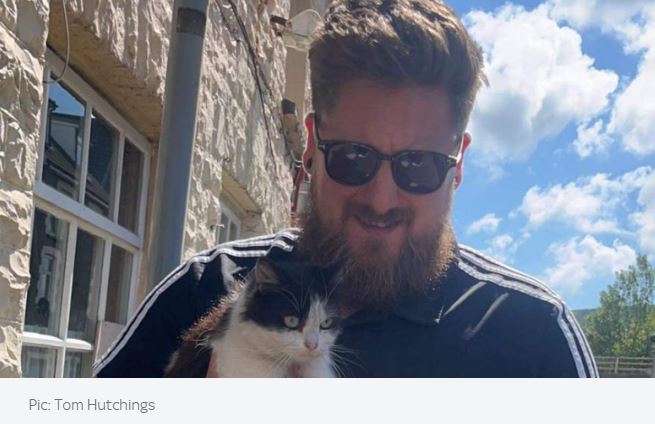
Oh my whiskers, here’s another kitty who took an unexpected trip and, thank goodness made it safely home. A taxi driver named Tom Hutchings, , from Tonyrefail, Rhondda Cynon Taf in Wales, told Sky News he “jumped a mile” when he discovered the cat in the grille of his taxi. He said, “The next 10 minutes was me trying to figure out how to get the cat out, “I still to this day can’t understand how he got in there.”
Mr Hutchings believes the cat travelled over 500 miles – and that’s only on the morning it was discovered.
The cat was “quite stressed out” during the attempt to rescue her from inside the grille and “she was clawing away at [Mr Hutchings’] hand”.
Gizmo the cat was “quite happy” when she was finally freed.
“She climbed onto my shoulder when I got her out,” Mr Hutchings said.
Gizmo was from Miskin, around 10 miles from Tonyrefail in South Wales.
“I hadn’t been to Miskin in weeks so it’s not like I’d gone there and she jumped in,” Mr Hutchings said.
After Gizmo was taken to have her microchip scanned, her human family was found and they were happy and thankful to have her back, safe and sound. Ah, this feline loves happy endings!
Turning felines into farm hands: Sister Kitten’s organic solution to pest control also saves lives

Cats with jobs, not that makes me happy. When I read this news item at first the “rattlesnake” thing had me worried so I had our Purrsonal Assistant do some research on this and she found a very informative article. After I calmed down I read the rest of the article.
Carolyn Shepard was looking for a natural way to control rattlesnakes, which had become a recurring problem at her western North Carolina home and barn. “I wanted to look for organic and natural ways to manage natural and organic problems, if that makes sense, so I just started looking into the best way to manage the rattlesnake problem,” Shephard said, “figuring out that they were coming here for the rodents, the field mice, and, you know, whatever else is creeping around.”
Then, she heard about Sister Kitten Animal Rescue’s Working Cat Program.
Eric Phelps, the founder of Sister Kitten, explained the intent and benefit behind the program.
“What the working cat program at Sister Kitten seeks to do is to pull feral or semi-feral cats from municipal shelters where they would otherwise be euthanized,” he said. “All cats that are chosen for the program are brought up-to-date on vaccines and are also spayed or neutered to ensure they are more likely to stay close to the property.”
Through the program, the cats’ lives are saved while humans benefit from their natural hunting instincts that translate to natural pest control.
Phelps explained that working cats prefer to do just that — work. They were born in the wild and therefore prefer to live outdoors, enjoying their predatorial work, rather than living indoors as house cats. Phelps said oftentimes, people try to trap these cats and bring them to shelters in the hopes of seeing them adopted, but in reality, these feral and semi-feral felines are happiest and most content mostly being away from people and going about their business.
“These are animals that are living in neighborhoods; they’re living around businesses or other places. People will trap them, thinking that they’re doing the right thing by taking them to a municipal shelter, that they’re going to be okay, they’re going to be able to adopt them out,” Phelps said. “The problem is that these are not animals that are socialized with people. These are animals that are terrified of people.
“The point is to try and get them out, put them in a property that wants these cats to help try to, in a sort of an organic way, control their rat and mouse populations or snake populations or whatever.”
Through the Working Cat Program, these cats can be taken care of by getting the veterinary care they need — vaccines, spay or neuter surgery — and then being fed and cared for by their owners while maintaining their preferred distance to humans.
“Any cats that are placed at a new location will be crated for 30 days to give them time to acclimate to the new property,” Phelps said. “They have to get used to the new people that they’re going to see and they’re going be feeding them every day. They have to get used to do whatever dogs might be on the property other cats and they also have to be able to acclimate in a safe space so that they know what predators might be there so they can avoid them. “
Usually, the cats live outside, in some sort of covered area like a barn or a wood shed, maintaining their feral lifestyle, but they have been known to become friendlier as they adjust to the humans with whom they interact on a daily basis.
Carolyn Shepard tells News 13 that working cats have not only controlled her rattlesnake problem, but they’ve brought a few pleasant surprises with them as well.
“They kind of take care of the bugs and spiders. It’s really fantastic,” Shepard said. “These are things I wasn’t really expecting.”
Okay, this feline now feels better and as long as folks are caring for their working cats I would say it’s a “win-win” for everyone.
Watch the touching moment this couple’s cat returns home after going missing for 7 days

After a dream Emily Alba says she had about her missing pet, Chloe, returning home, the cat appeared seven days later. Be sure and watch the video, it will make your heart smile!
Lahaina woman’s home didn’t survive but her cats did
Susie Richter travels every morning to the burnt-out shell of her house in Lahaina, Hawaii, to feed her three cats, who survived the blaze that devastated Maui earlier this month. When we can report on something positive and happy from the Maui fires it lifts our spirits. I hope this story lifts yours.
 Home | felineopines