“Oh garçon, another catnip martini if you please.”
Hello Furiends! I had quite the experience this week when The Human took me for a spa day! Now lest you think The Human was completely altruistic in doing this, let me provide a bit of background. One day, The Human came across a place on social media that was fairly close to our neck of the woods called The Catnip Getaway. She was absolutely shocked when she saw photos of piles of hair next to various felines, and not all of those felines were long-haired. She began to wonder if Julie Rosengrant, the owner and operator of The Catnip Getaway could do the same miracles for me. The Human calls me the “sheddiest” cat she’s ever known and a look at the daily collection inside the vacuum monster will attest to this. But I digress.
The Human decided she’d make an appointment for a spa day for me. She did this with some trepidation as she was concerned that the long drive and the grooming itself might stress me out and bring on another bout of idiopathic cystitis (and those of you who follow our blog knew this was not a fun time for me last August). We decided to do the treatment as Julie is a vet tech and The Human felt comfortable that Julie would keep a close eye on me.
The 50-minute drive was uneventful and I was surprised to see the beautiful, quiet spot where the Catnip Getaway was located.
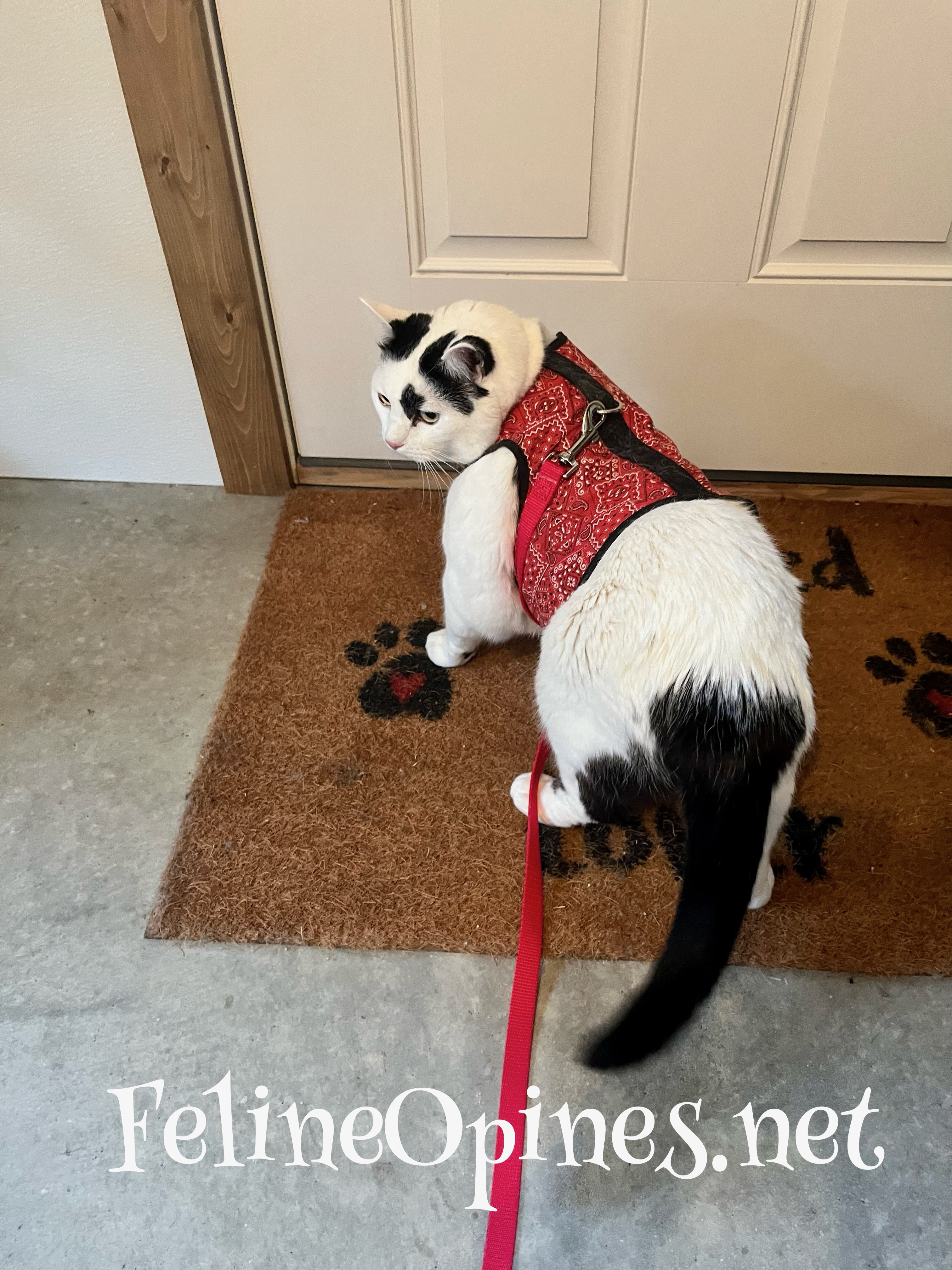
I did travel in my soft-sided carrier and also wore my stylish vest and matching leash. When we got inside I took a stroll around and quickly decided I was ready to leave.
“Nice place, thanks for showing us around. Let’s go Human!”
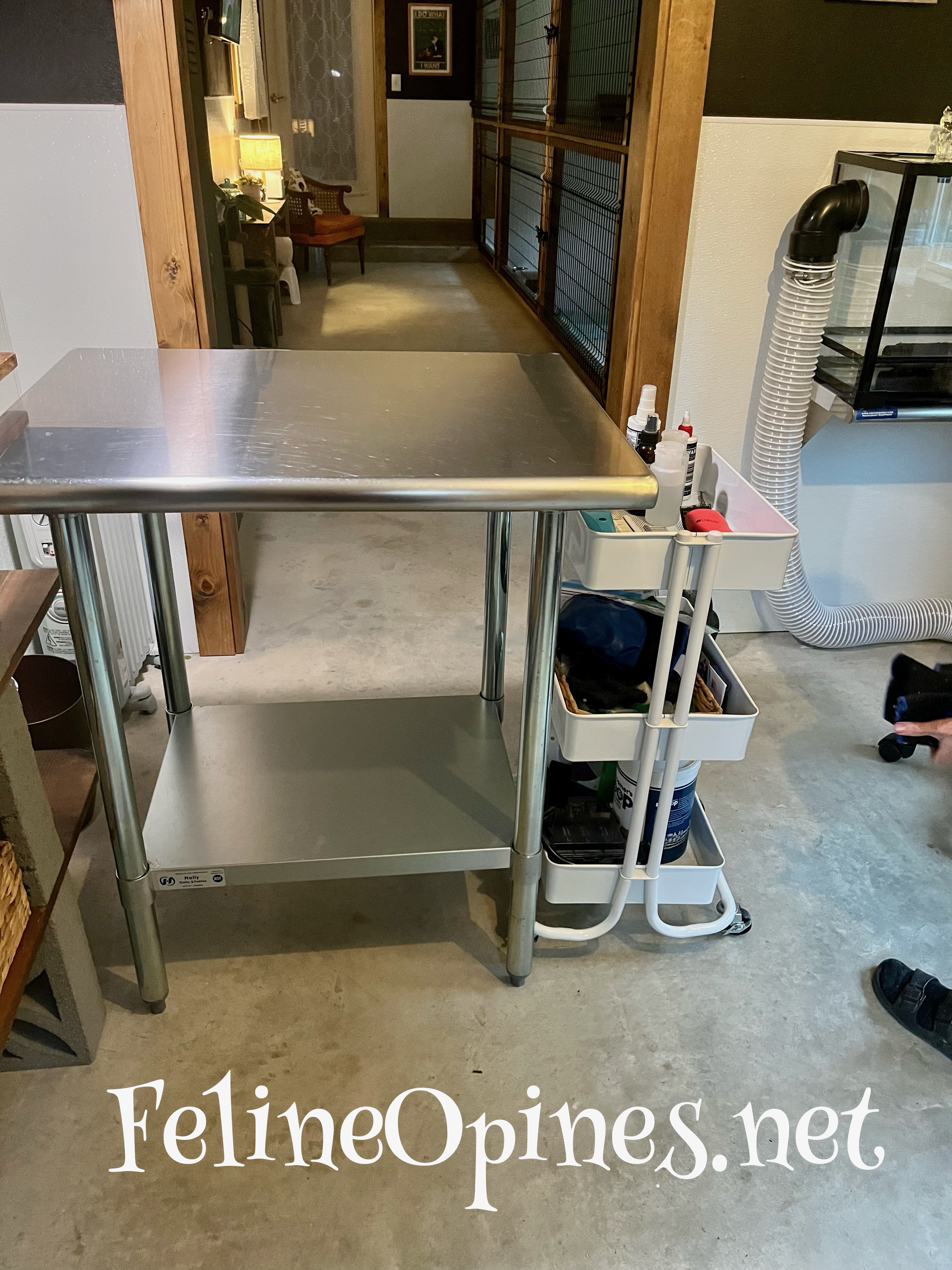
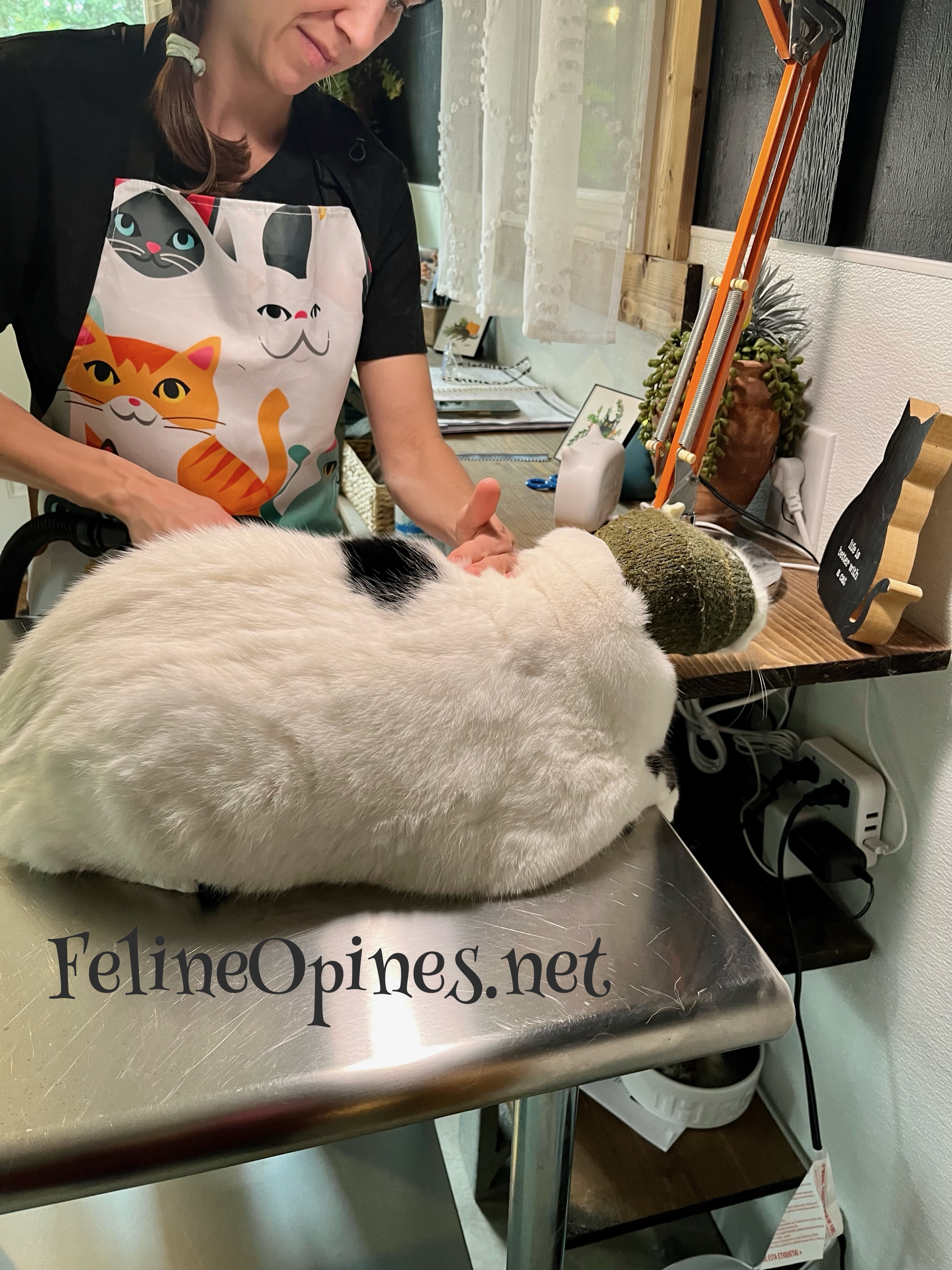
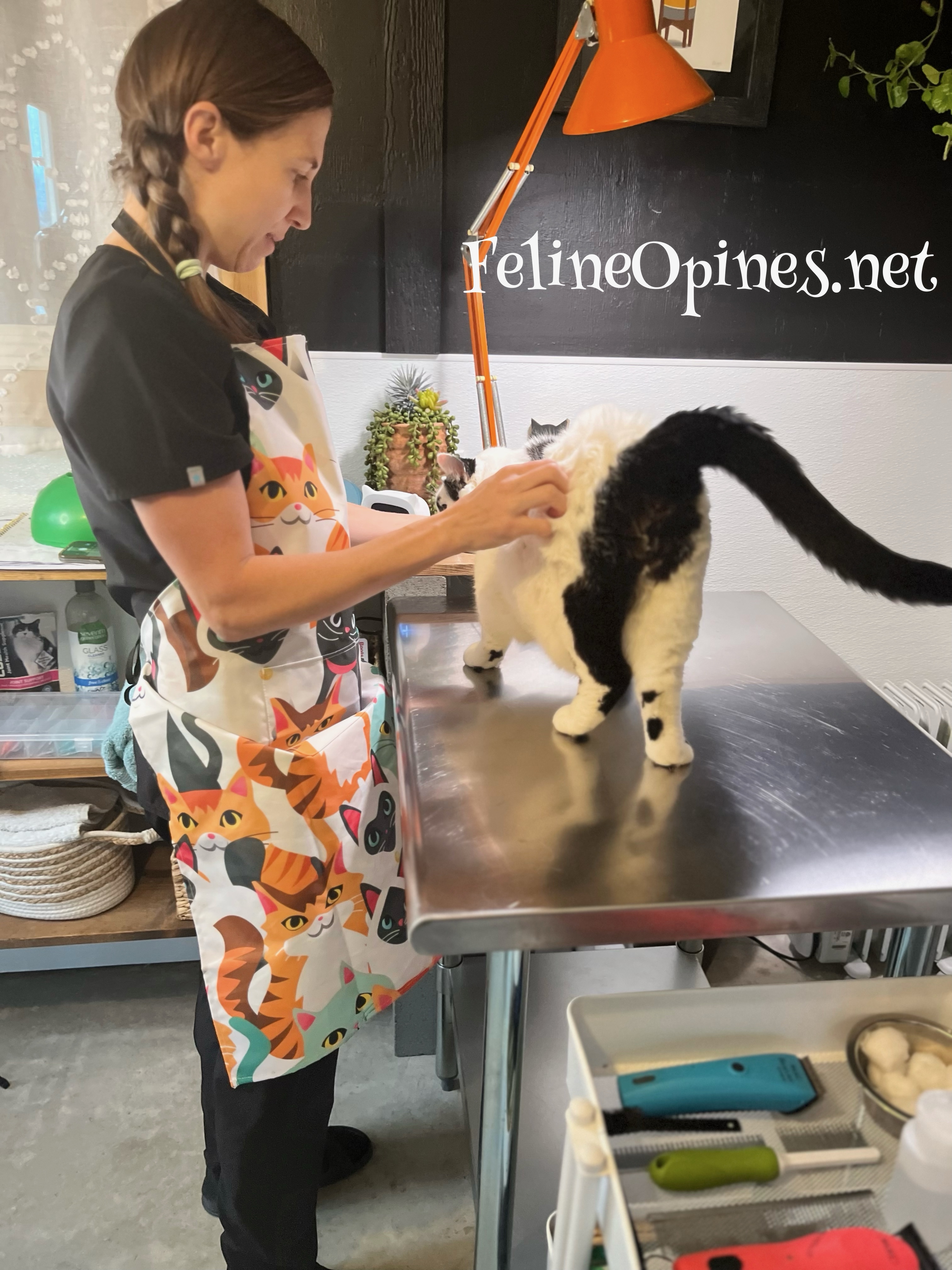
The place was nice but that big metal table reminded me a bit too much of the table at the stabby place. I was comforted that the human spa person was not wearing a white coat and instead, had a colorful apron decorated with cats. The Catnip Getaway is also a feline resort and it’s a pretty cool place (more about that and some of the guests there a bit later).
The scary metal table.
The lovely feline hotel area.
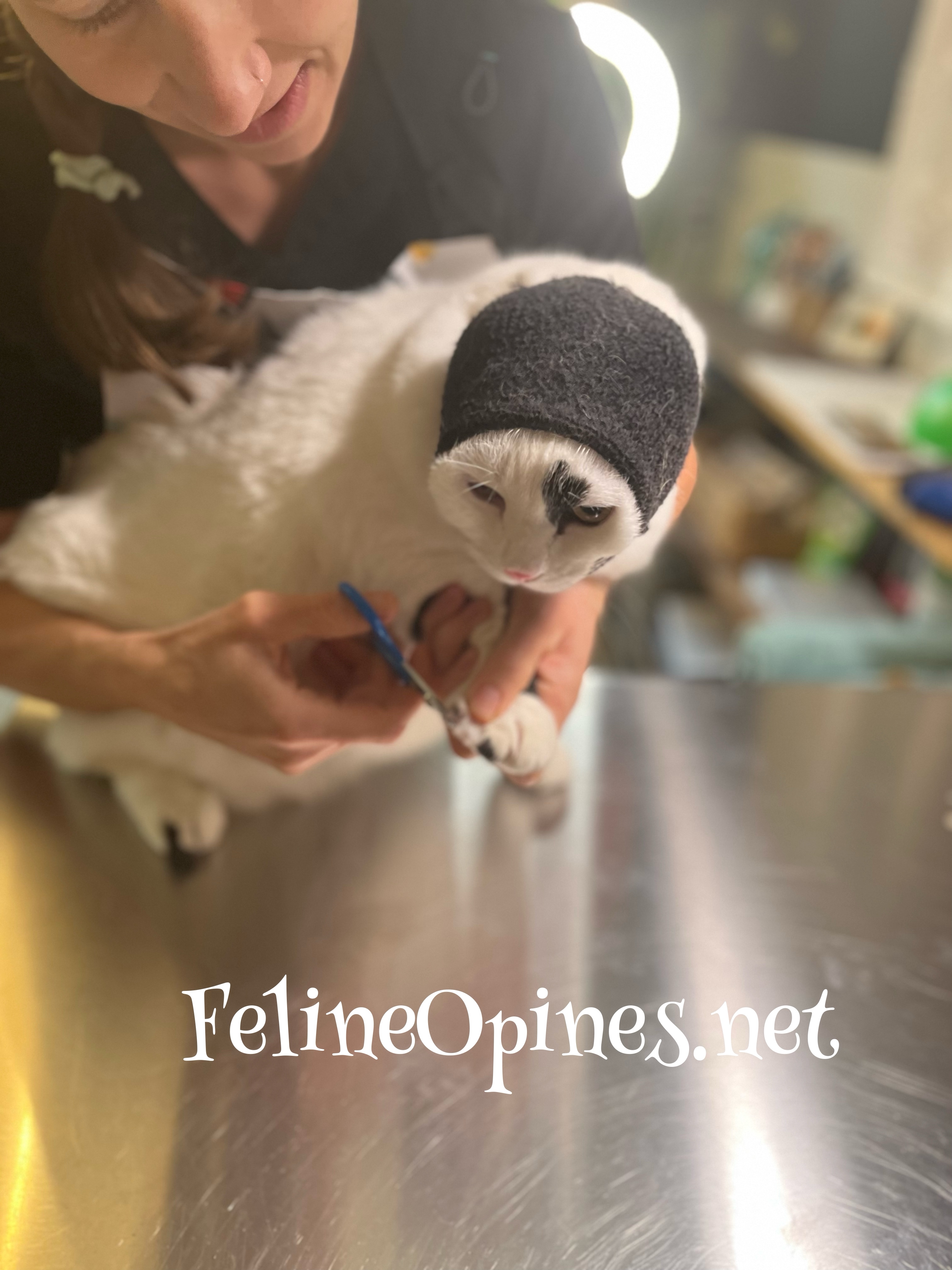
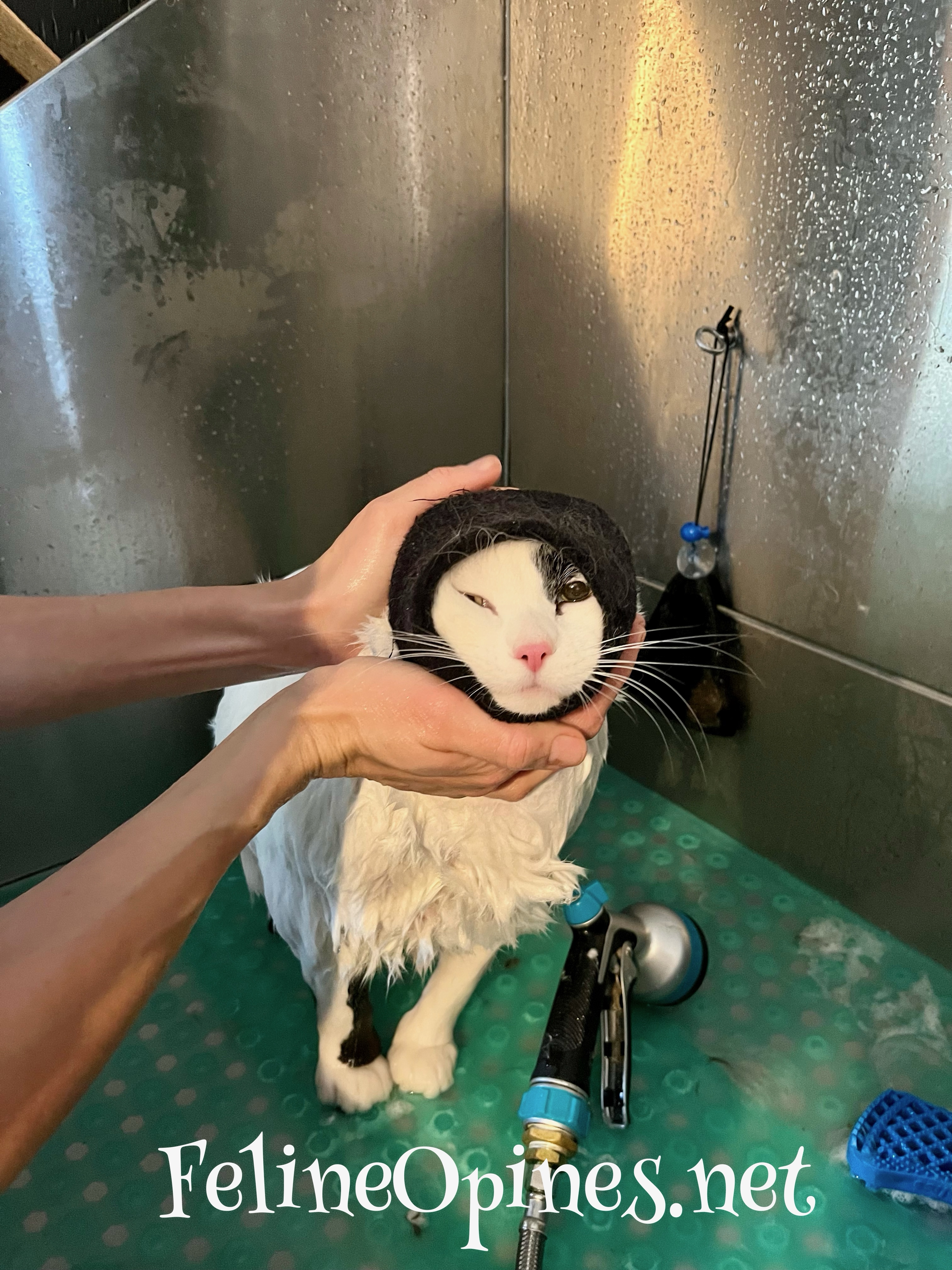
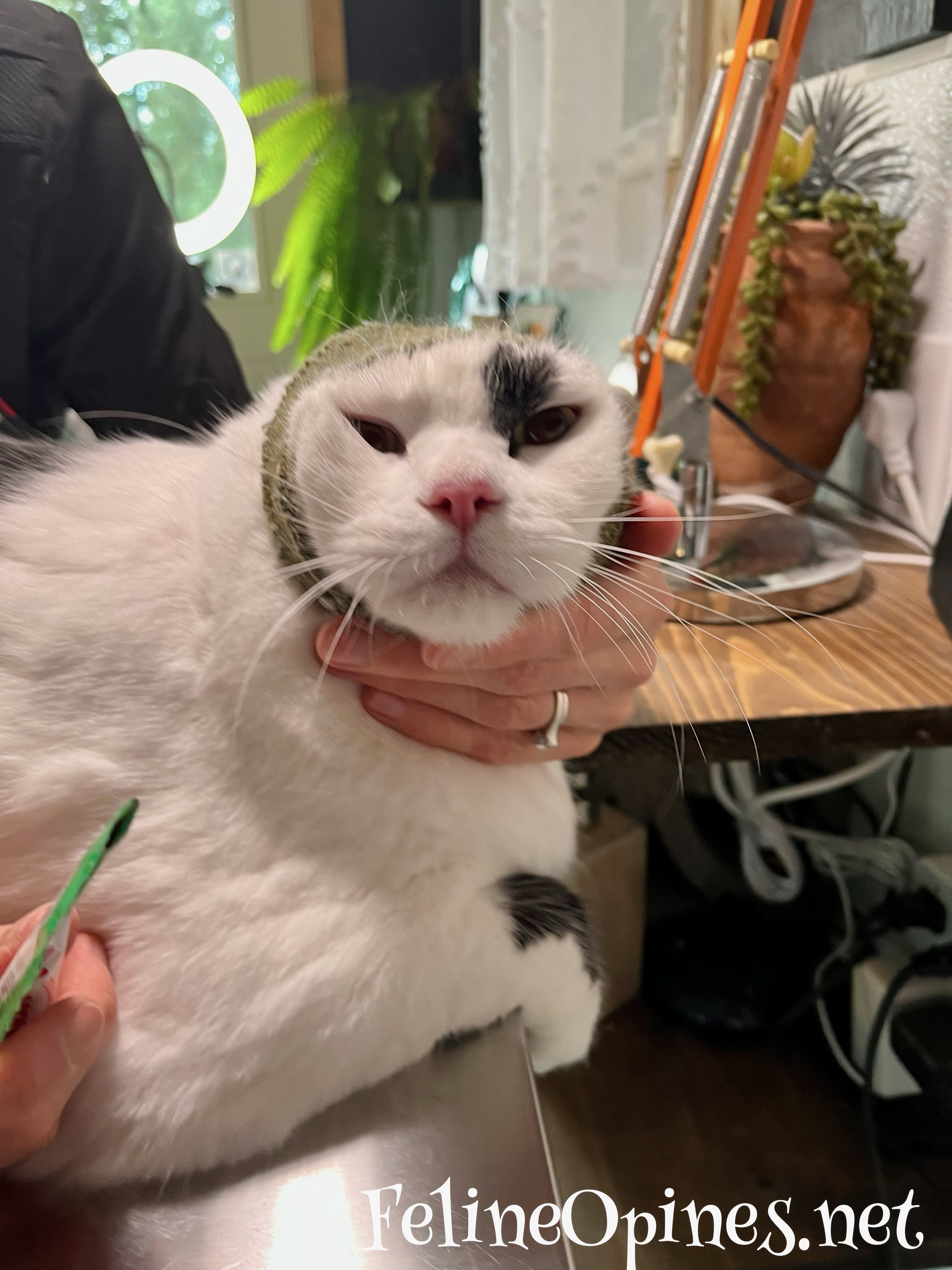
I decided I would stay and see what this spa thing was all about. After I was divested of my vest, a “happy hoodie” was put over my head to protect my ears from water. Granted, I may not look too happy but I really didn’t mind it. The first order of business, before the bath was a Mani Pedi. Note, a Mani Pedi at the spa is way better than The Human’s ineffective efforts.
How do you like my “happy hoodie?”
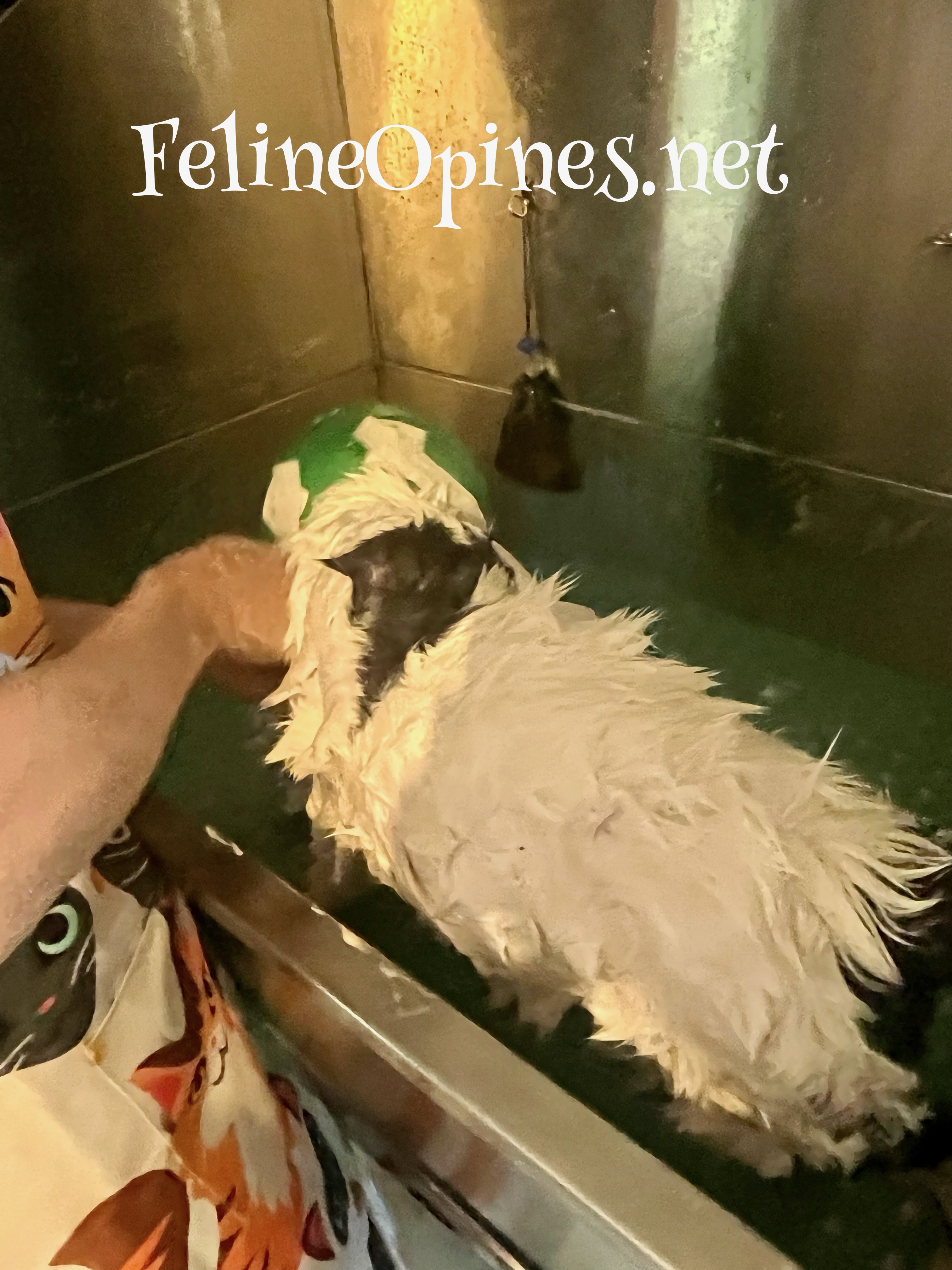
After my nails were purrfect, the next step was the bath. To make sure no water got into my ears, I was fitted with a little cone (NOT a cone of shame) to keep my happy hoodie and ears dry. The bath felt good, the kitty shampoo was great and the massage I got as the shampoo was applied made me purr!
One thing that shocked The Human was how dirty my coat was! I groom myself constantly, she drags out the vacuum monster and mops the floors every day but I wasn’t as pristine as we thought I would be.
And speaking of the vacuum monster, The Human had some BIG reservations about the blow drying portion of my visit. The vacuum monster at the place was way louder than the one that lives at our house (so loud Julie had to wear earphones!). And, in order to get the blow dry done, I would have to have all 21 1/2 pounds of myself inside a glass cage. First, I got a nice towel dry and then into the chamber of the vacuum monster. The Human was a bit nervous about this part but I sailed right through it!
That towel dry felt good!That thing was way more powerful than our vacuum monster!And here I am after my blow dry, safe and sound and not bothered.
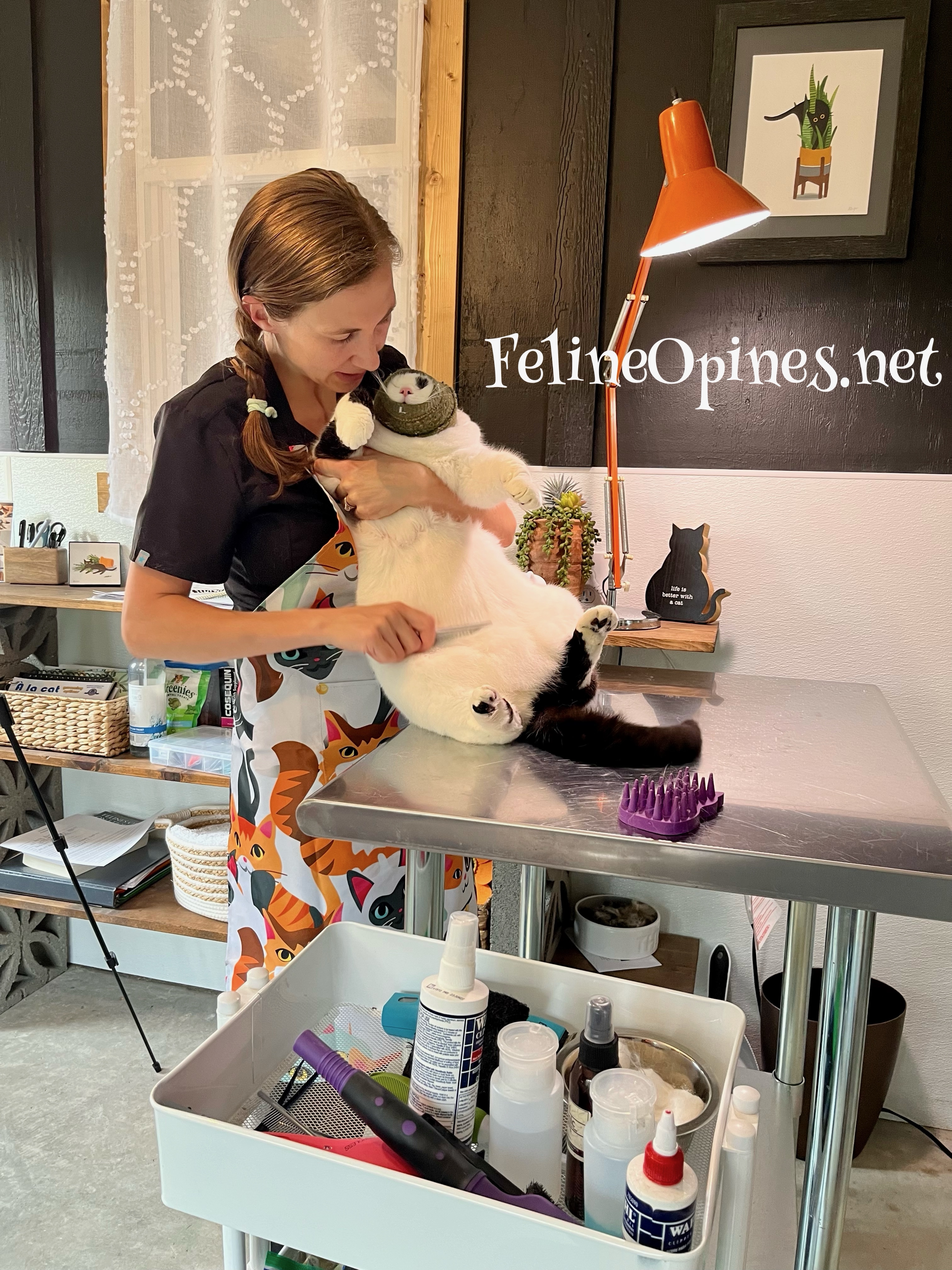
Once I was fluffed and dried, the real work began. Combing, combing and more combing and fortunately, small breaks for a lick or two of Inaba Churu treats. I don’t know any feline that doesn’t love these treats!
Brushing…Brushing…..Brushing….Brushing……and a quick treat!
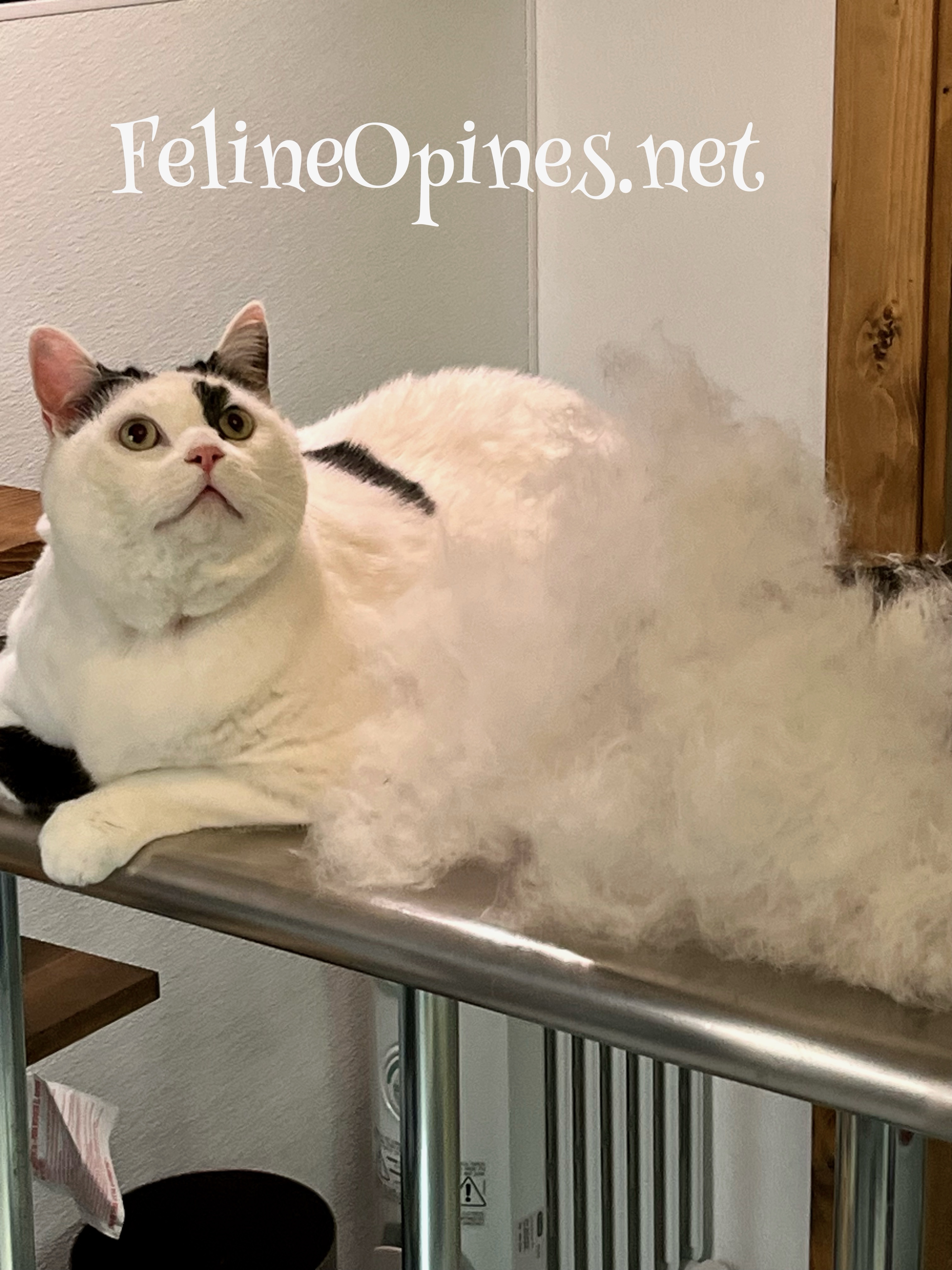
And the results? As amazing as all the photos The Human saw on The Catnip Getaway’s Facebook page!
Yes, I am a handsome fellow!
Good grief, you could make a couple more cats out of all that fur!
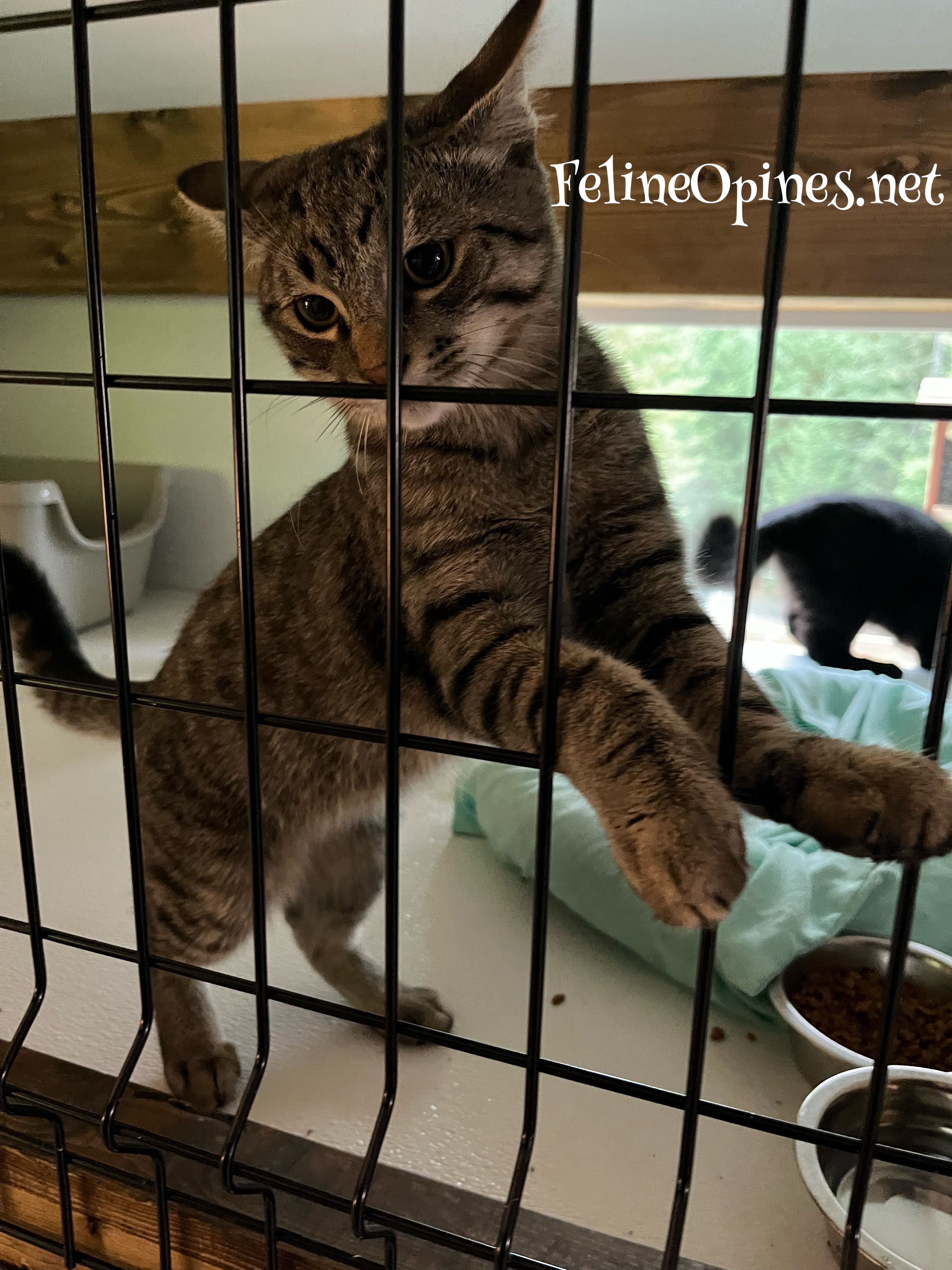
My spa experience was purrfect and didn’t make me nervous at all. As a matter of fact, I slept on the ride home. As I noted, there is a lovely cat hotel there and The Human went to say hello to some of the guests there. Three kittens were staying in the same room and they were very cute, as were all the guests. Every room was immaculate, had a big window view and a bird feeder hanging in front of the window. And all the guests have the opportunity to leave their rooms, stretch their legs and explore the Catnip Getaway guest area. Nice amenities!
Kittens..…kittens……kittens……kittens……and another guest.
So, would I recommend the Catnip Getaway? I enjoyed it and will be happy to go again. Aside from The Humans over fascination with the kittens staying there, I’d give it a two paws up. And The Human said the results were everything she hoped it would be and more and she’s ready to get some of her black items out of the closet and try to wear them again!
Do yourself (and your humans) a favor and book a spa day at The Catnip Getaway!
It’s getting a little nippy in our neck of the woods and the colors are so beautiful. Some humans are saying we’ll have snow later this week. We could care less, we’re pampered house cats but snow does mean a bit of work for The Human.
This week Oliver had a spa day and he’s working on his article about the experience. Below is a before and during photo. I can’t wait to see all the others and hear what this spa experience was all about (not that I want to go mind you).
I’m relaxing and mentally preparing for my spa day tomorrow.
The beginning of my spa experience with my mani pedi.
Meanwhile, LIly aka “Princess Stabby Toes” who will never see the inside of a cat spa, relaxes near the fire.
As the weather cools, we felines decide that banding together on the soft bedding is a good idea.
And Oliver has been busy doing his snoopervising.
Oliver has a very important purpose here.
What is Oliver’s purpose? It’s to keep us save from those falling leaves!
“I can see you leaves, and I can get over to that window to chase you away!”
Well, that’s the week in our neck of the woods. Don’t forget to check out Oliver’s article about his spa day and be sure and comment if you want to be in the Oct. 30 drawing for the signed copy of the beautiful book, Burt, the Airport Cat.
“He’s actually very comfortable with people, which is quite shocking to us and a lot of our customers love him,” Self Stor marketing manager Justin Morgan said. “He absolutely loves contact, which is quite weird to say for a working cat.”
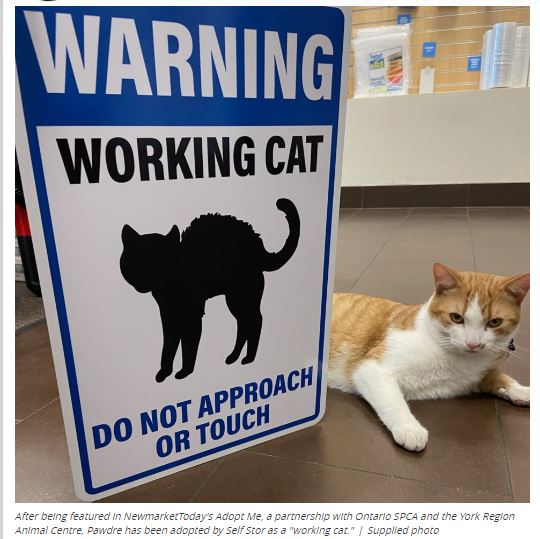
Pawdre was successfully adopted thanks to the Ontario SPCA’s working cat program. My regular readers know that I am a big fan of working cat programs!
Ontario SPCA shelter health and wellness manager Monica Seto said the program has had success over its five years. It is a way to help adopt cats assessed to not do as well in a traditional environment.
Pawdre has taken to the humans that care for him and the humans who come to his place of business. Although Pawdre will do his job roaming the storage halls, he said he will come to the office portion of the building every morning to greet people as they come in.
The friendliness of Padre has led to customers asking to adopt him if the mousing job does not work out or wraps up, Morgan said. He added that he has also considered adopting Pawdre in that instance.
“Now he’s almost at the point (that) he’s a lap cat,” he said. “Such a dramatic change in his life in only a few months.”
The moral to this story furiends, is never, never write off a kitty too soon!
“James Dean,” a dapper orange tabby cat, lives a star-studded life. He fills his days playing mischievously with his sister, “Audrey Hepburn,” and his brother, “Elvis,” while his nights are spent snuggled up with his owners, Kaci and Melvin Thomas, who live in Austin.
After a sudden onset of a chronic illness created a life-or-death situation for the James Dean, his humans consulted the Texas A&M Small Animal Teaching Hospital’s (SATH) cutting-edge Interventional Radiology Service. They saved his life with a surgery not commonly offered at other veterinary hospitals.
James Dean battled urinary tract-related health challenges and was diagnosed with chronic kidney disease in the spring of 2022. Kaci worked with a veterinarian in Austin to manage his disease with a specialized diet, and for a while, the new diet was successful. Our own Jasmine had kidney disease for many years.
But after a year, the Thomsases noticed James’ appetite was disappearing and he was quickly losing weight. So, they took him back to the vet for complete diagnostic testing from the clinic’s lab.
“The labs came back on a Saturday, and James’ veterinarian called me immediately,” Kaci recalled. “She said that his kidney function looked really bad and that we should take him to the local veterinary hospital. The hospital kept him comfortable and stable over the weekend. Then, on Monday, the specialist and surgeons evaluated him with an ultrasound.”
James’ ultrasound revealed stones that were causing severe blockages in both kidneys.
“The specialist and surgeon mentioned a few options in terms of care, but they kept coming back to, ‘His kidneys are so bad. We think that euthanasia would be appropriate,’” Kaci shared. “I didn’t like those options, so I called his veterinarian in Austin. She referred us to Texas A&M. We picked him up from the hospital and drove to Bryan-College Station the next day.”
At the SATH, James was placed under the care of Dr. Genna Atiee, a clinical assistant professor in the Department of Small Animal Clinical Sciences and specialist in the SATH’s Interventional Radiology Service.
Atiee explained that kidney disease limits the kidneys’ ability to filter blood, causing excess fluid and waste from the body to build up and create additional health problems overtime.
“Once you lose kidney cells, recovery is less likely, because the kidney doesn’t have very much regenerative capacity,” Atiee explained. “We don’t have a way to reliably remove or dissolve kidney stones in cats without some type of major intervention, so when James Dean came to us pretty sick, we recommended subcutaneous bypass devices be placed in his abdomen that allow urine to go from his kidney to his bladder and bypass the obstruction.”
Atiee and her colleague Dr. Audrey Cook, another specialist in the SATH’s Interventional Radiology Service, are two of the only veterinarians in Texas trained to surgically apply the subcutaneous bypass devices.
“We get referrals for this surgery regularly from the metro areas like Dallas, San Antonio and Austin because even though this surgery is highly effective, it’s not something every veterinarian or even every surgeon is trained to do right now,” Atiee said.
With Kaci’s approval, Atiee placed a device on one of James’ kidneys, and a couple of weeks later, on the other kidney.
“These devices require some maintenance in terms of flushing the tubes to ensure patency, and we’re happy to do that here or to work with a local specialist,” Atiee said. “The most important aspect of success post-surgery is for the family to work with us or their primary veterinarian to maintain the kidney disease.”
Kaci brought James back to Texas A&M for the early maintenance of his devices, but she now works with their local veterinarian to maintain his diet, fluid intake, and devices.
“Dr. Atiee was amazing. She called multiple times to explain the procedure, which was especially helpful because I was a little nervous in the beginning,” Kaci said. “We grew really close to James’ veterinary team at the SATH. Dr. Atiee and the students inher service were excellent to work with.”
Today, James is doing exceptionally well; he’s back to a healthy weight and playing with Audrey and Elvis again.
“Here we are many months later and he’s still kicking, doing very well, and is still happy and loving,” Kaci said. “I really like that the SATH’s veterinarians provide the most advanced care possible. Everyone’s up to date on all the newest and best evidence-based care. I’d recommend them to anyone and would encourage others to work with the Texas A&M veterinarians.”
“There are things that we are doing that are not available in a lot of places and a lot of people may not be aware of these options, particularly in the urinary tract,” Atiee said. “We also do virtual consultations, so even if you live far away, we’re happy to schedule an online appointment and discuss options. We want to help these animals. We will do everything we can to get a patient in who we can help.”
Our Human knows first-hand what a horrible thing kidney disease and we are all very happy to hear of this medical solution.
We are big fans of fostering, especially since Oliver and I are foster failures (The Human couldn’t bear to give us back after we were fostered and we’re very happy she made that decision.
Dunder is a rescue feline and he works with his human, Sara Bonner, of Washington, D.C., who fosters cats. Dunder has befriended 22 of these fosters, only to say goodbye when they find a home.
Funny enough, Bonner was not a fan of felines until she started a new job and found herself by cat people.
She said: “When one of my co-workers planned a weeklong vacation, they asked if I could take in their kitten while they traveled. Once she arrived at my home, I was instantly smitten. I’ll never forget shedding a tear on the day they came to pick her up. I applied to adopt Dunder from City Dogs and City Kitties Rescue five minutes after they left. I’m not totally sure how old he is, but my guess is 6 or 7.”
In a video posted to Bonner’s Instagram account, @dunderandfriends, Dunder can be seen cozying up an array of foster cats.
“I think that Dunder is so great with fosters because he has this innate ability to sense what the other cat needs,” Bonner said. “I’ve had fosters that hid for weeks before joining the apartment, whereas I’ve had others that instantly feel at home and are ready to play.
She continued: “Dunder does a good job of feeling out which cats need more time to warm up to him. We’ve had 22 fosters, and he’s befriended every single one. I also had my own little cat-sitting business for a while too, and we must have taken in 50-plus cats over the years. You’d be surprised—most cats do well with a buddy if you give them a chance.”
After five years living alone together, Dunder and Bonner moved in with Bonner’s boyfriend six months ago.
“It was a really exciting time, and we decided to take a break from fostering so we could settle into our new routine,” she said. “It was a well-needed pause. However, after a while it was clear that Dunder was lonely and needed a friend. I had always imagined adopting a second cat. However, I wanted to be a little further along in life and have a partner that could help me care for them, so once we were settled the moment had finally arrived.”
She went back to the City Kitties website and filtered by which cats had been there the longest. Mose had been stuck in foster care for eight-plus months.
“All of my fosters had gotten adopted within a month or two. It turns out that Mose kept getting passed over because of how shy she was. We don’t know exactly what happened to her, but it’s clear that she had some sort of traumatic experience with humans in her past before coming to City Kitties. She was incredibly skittish, and it took months before she allowed her foster mom to pet her,” Bonner said.
“But, wouldn’t you know it, Mose had a foster brother in her home who was super outgoing. Having a confident kitty friend around helped to put her at ease, and that’s exactly what we were looking for.”Bonner put a lot of work into making Mose feel comfortable, including working from the bathroom, where Mose decided to hide.
But it was Dunder who really made Mose feel at home. After moving into the loft where Mose was, Dunder stayed up there 24/7.
“He’d stay a few feet away, nap when she napped and [tried] to sneak in a sniff whenever she’d let him,” she said. “She was never alone up there. Dunder was determined to help her feel safe. Every day, I moved her food and a water bowl down a step so she’d have to come further into the living space.
“One night, after two weeks of hiding in the loft, Mose finally decided to join us in the living room. We were shocked! My boyfriend and I had to stop ourselves from jumping up and down so we wouldn’t scare her off, we were so excited.”
Today the cats are best furiends. They even spent a night alone when the humans went to a wedding and the two were cuddled up together, purring with contentment.
Your first question might be, why do cats mimic humans?
Well, \we’re very smart and we’re also capable of recognizing emotions and solving problems to achieve a goal. Various studies show cats are as intelligent as a two-year-old. Cats instinctively learn from their surroundings to provide them with the best chance of survival.
So why do we felines mimic you humans? There are a few reasons:
Familiarity and affection
Instinctive learning
Routine
Effective Communication
Indoor cats are basically adult kittens. Because we don’t need to hunt for food, we see our humans as surrogate parents. All children will adopt traits from their parents.
Imitating our owners is a sign we feel comfortable with our humans. We see you as someone to keep us safe and protect us like a parent would. By mimicking the traits and habits of our owners, we’re showing they we care deeply. Studies show cats replicate traits like extroversion, openness, neuroticism, and emotional stability.
We show love and we’re also animals of instinct. Starting from an early age, cats learn from our mothers how to groom, hunt, and cover our tracks after using the bathroom (or using a litter box). Mother cats teach their kittens the majority of their life skills in the first few weeks of life, so they may learn to fend for themselves in the wild.
Aside from expressing love for our parents, we indoor cats will also mimic actions, assuming it is how we should act. We’ll watch how our humans interact with objects around them and learn to do similar things.
We’ll even imitate our siblings as a means to get more attention. Videos online show cats making sounds similar to a crying baby because they recognize the infant gets attention and food when they make crying sounds. Humans are easy to train, after all!
We love having a consistent routine and schedule. We’re territorial animals and perform our hunting and protection duties better when we have routine exercise, hunting, grooming, and napping throughout the day.
You humans know that when a routine changes, your cats get flustered and upset. This was seen towards the end of the lock down when remote workers were forced to go back into the office. Their cats were annoyed by the sudden change in schedule.
Cats learn their owner’s routines and keep them on their schedule as a method of taking care of our humans. We follow our owner’s schedule and imitate you to feel close and share those moments together. This is why many cats follow their owners into the bathroom to use their litter box at the same time or follow them into the kitchen for a shared breakfast. When the routine is broken, like when someone is trying to sleep in, the cat will meow, paw, and jump on the bed to wake their owners. (Note, The Human is quite aware that we do not like late breakfast!)
Having a routine is good to keep the mind sharp and focused. Cats know this and want to ensure you humans are keeping to a regular schedule.
Cats are capable of making over 100 sounds with our vocal cords. This gives us dozens of ways to communicate our wants and needs. We learn to mimic the sounds of our owners while walking around the house, sitting on the couch, or responding to other people in the house.
Imitating sounds is a tactical skill kittens learn to catch birds in the wild. When a cat is sitting at a window and making chattering sounds at the birds, it’s a way of communicating to the birds it is safe to be around. With this adorable sound, they hope to lure the birds into striking distance. (Yes, I know it’s evil but it’s what we do).
We also adopt non-verbal cues to communicate with our owners. Some cats will learn to imitate hugging or holding hands by placing their paws on their owner to show love. In our house the “Al hug” is a famous family tradition.
We use a variety of methods to imitate our owners. It all depends on how our humans express themselves and communicate. In fact, studies show that cats will imitate emotional cues and extroversion dependent on their humans. For instance, if an owner is extroverted and loves being social, the cat may also enjoy being around others. Inversely, if an owner is anxious and paranoid, the cat will adopt the anxious and paranoid attitude.
What are some of the ways we imitate our humans? Here are a few:
Using the bathroom at the same time
Taking naps at the same time
Using vocal cues like meows, chirps, and chatters to imitate their owner’s inflections and tones
Willingness to socialize
Openness to other people in the house
Openness to go outside
Neurosis levels from mild to chronic
Curiosity of surroundings
Now you may be wondering if we felines mimic other animals too. We do this in some ways, for instance if we live with a dog, we may adopt dog-like traits as a method of bonding with our canine buddy. Some cats will act like dogs by getting messy, wanting to go outside for walks, or being as social as dogs.
Sometimes we may treat other animals like cats as a sign of affection. For example, a cat may groom their dog pal’s fur as a sign of affection.
Much to The Human’s horror, we learned that cats can also mimic snakes! Instinctively, cats know that snakes are frightening creatures and we’ve learned to adopt that trait as a self-defense mechanism. By pinning our ears back, showing tour fangs, and hissing, we think we look and sound remarkably similar to a hissing snake. The Human is terrified of snakes and hopes so NEVER sees an encounter like this!
To sum up, we felines imitate our owners because we love you. Some of you humans may think we treat you like servants, but deep down we love and admire you. Even when we act up by knocking things off the furniture, we’re are doing it as a means to communicate our needs.
My challenge to you humans is to watch for all the ways your felines show you that they love you.
Peaches the “fat cat” swims to a more svelte physique
Peaches, a diabetic cat in Edmonton, has been going viral with swimming workout videos on TikTok. I told Oliver that he should take up swimming. He wasn’t amused.
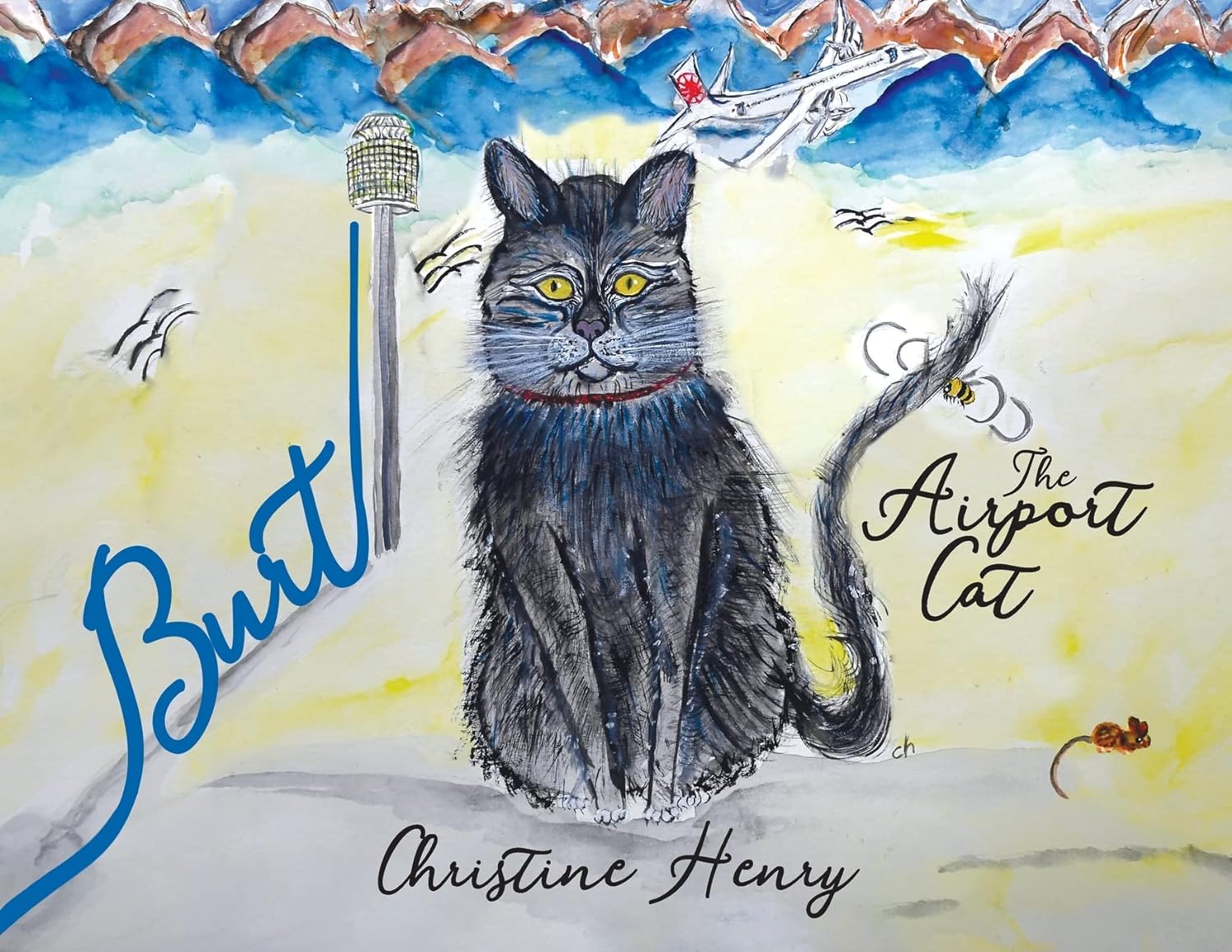
This week our feature has a theme…airports and flying. We received a pawsitively wonderful book to read and revue from Christine Henry. The book’s name is Burt the Airport Cat and is a wonderfully illustrated story about Burt, a black cat who escapes his carrier at the airport. Burt is a curious and friendly cat and decides to take advantage of his new surroundings and explore the airport. He meets new friends, Valkyrie, Scout, and the Padre, and samples local cuisine as well. Will he ever reunite with his family? Join him on his quest to learn more.
We loved the book and know you will like it too. We will be having a drawing for a signed copy of the book so just leave a comment to let us know you’d like to be entered. We will drawing on October 31st.
As I noted, this feline has a love of aviators and aviation so I decided to send my purrsonal assistant across the web to find stories of airports, airplanes and flight. Here are a few photos of me imagining myself as an aviator.
Please enjoy our aviation themed stories and don’t forget to enter the drawing for Burt’s book.
Can you imagine being a feline who is lost in an airport for more than a month?! This is the story about Ted, a black and white cat who went missing from his home, 6.4 kilometers ( about 4 miles) away from the Exeter airport. I wonder if this guy made as many friends as the hero in our book review, Burt did.
I won’t make you wait to find out Ted’s fate, BBC news reports that he was found in the roof of a kitchen area at the airport. The staff heard meowing coming from the ceiling and were able to coax him toward a place in the ceiling where they could get him out.
Evidently Ted climbed under the hood of a neighbors car to get away from the rain and the car had taken off. His family was delighted and amazed that he was found safe.
Ted was hungry and thirsty and the airport workers took care of him while attempting to find his family. They found a lost cat Facebook post about Ted by Cats Protection Exeter Axhayes Adoption Centre.
When Ted returned home he was skinny but he received a clean bill of health from his vet. Ted is back to his regular weight and now sports a tracker on his collar.
My readers know I’m not a feline that’s fond of “sciency” news but even I have to admit this is interesting. I’ll try to recap this article without too many scientific details.
You humans know that we felines are agile and graceful and sometimes, as we leap from one spot to another, it seems as though we are flying.
Feline jumps
When we jump or leap, we use a combination of muscular power, instinct, and physics to propel ourselves into the air. First we crouch down, using our hind legs like a coiled spring. We then use our powerful leg muscles to push off the ground, launching ourselves into the air. When we’re flying through the air, we stretch our legs out and tuck our heads and tails in to reduce air resistance and increase speed. When we’re at the peak of our jump we arch our backs helping our back legs to stretch even further so we can gain more height and distance. All these moves are made possible by our skeletal structure that’s designed for flexibility and mobility.
Balancing with whiskers and tails
Believe it or not, our whiskers help us maintain balance and control while we’re in the air. Our whiskers are incredibly sensitive to changes in air currents and can help us detect changes in speed and direction, while our tails act as rudders, allowing us to steer and adjust our trajectory mid-flight. All these things help us navigate with precision and accuracy.
Landing Safely
When we land we use a combination of muscular strength and instinct to absorb the impact and land safely on our feet. As we begin to approach the ground we use back legs to prepare for impact, tucking them under our body and extending our front legs. Then we land on our feet, now using our leg muscles to absorb the shock of impact and distribute it evenly throughout our body.
We felines are amazingly designed!
The History of Cats and Flight
Clearly we felines can’t fly like birds or bats, but mythology, folklore, literature, and popular culture have linked us with flight. This association can be traced back to ancient times when we cats were revered as sacred creatures with supernatural abilities.
In many cultures, cats are associated with magic and are believed to have supernatural powers, including the ability to fly. In ancient Egyptian mythology, the goddess Bastet was depicted with the head of a cat and was believed to be a protector of women and children, as well as a master of the skies, able to soar through the air at will.
The ancient Norse goddess Freyja was also associated with cats and was said to have a chariot pulled by two large cats. In Japanese folklore, the bakeneko is a cat that can transform into a human and fly through the air. These stories and beliefs have helped to cement the connection between cats and flight in popular culture.
Famous Flying Cats in Literature and Film
In literature and film, felines have been depicted as flying or gliding creatures, adding to our mystique and allure. One famous example is the character of Salem Saberhagen from the television show Sabrina the Teenage Witch, a black cat who was able to transform into a warlock and fly through the air.
The Cheshire Cat from Lewis Carroll’s Alice’s Adventures in Wonderland is another famous example of a flying cat. This mischievous feline disappears and reappears at will, often floating through the air with its signature grin.
True Stories of Cats Falling From Great Heights
There are many cats who survived long falls because of their ability to absorb shock and land safely on their feet. In fact, cats have been known to survive falls from heights of up to 32 stories without suffering serious injuries. Meowza!
This ability is due to our flexible spine and inner ear, which help us to quickly orient ourselves in mid-air and land on our feet. Additionally, we cats have a natural instinct to spread out our bodies and create a larger surface area to slow our descent.
One famous example of a cat surviving a fall from great heights is that of a cat named “Lucky” who fell 26 stories from a high-rise building in New York City in 2013. Lucky suffered only minor injuries and was reunited with her owner after being rescued by a local animal shelter.
There is also the story of our very own Oliver who tells the tale of The Amazing Flying Kitten. This was the day he almost gave The Human a heart attack.
So there you go, we felines are amazingly graceful creatures and some humans have even been able to capture us in flight as you’ll see in the next story.
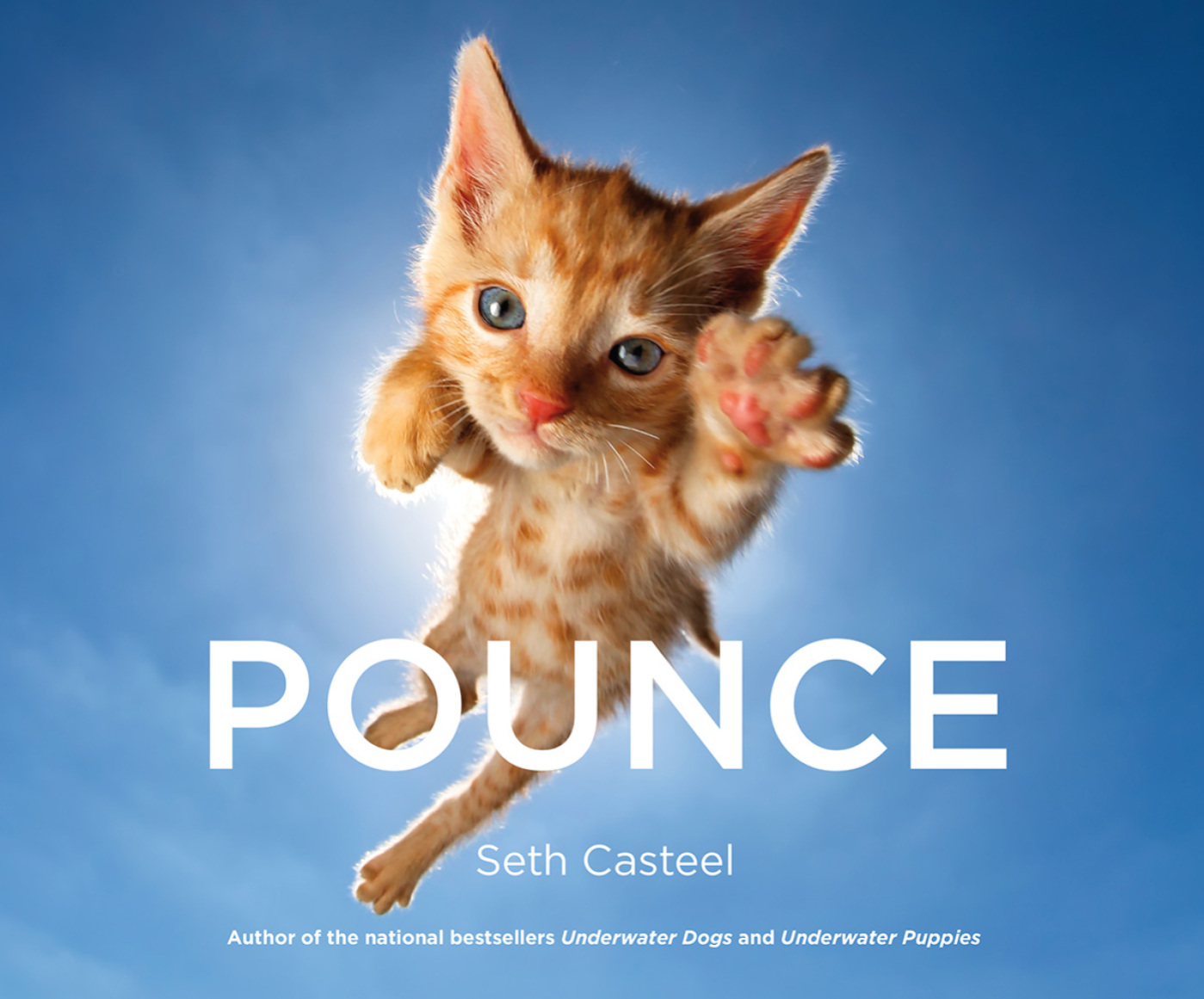
Seth Casteel’s POUNCE, a coffee table book, features gorgeous photos of adorable airborne cats in a variety of settings. POUNCE is an addition to Casteel’s other books which include Underwater Babies and Underwater Puppies.
The cats in the photos are all from animal shelters and rescue groups in the U.S. and Canada. Every cat who modeled for the book was available for adoption or already rescued during the photoshoots.
“At the heart of the book is Casteel’s commitment to showcasing animals who are in need of human love, attention, and care yet who sadly have not always received it,” reads the the book’s press release.
This is a delightful, funny book, with more than 80 previously unpublished photographs that reveal adorable cats and kittens as they pounce and jump through the air, legs outstretched—all in Casteel’s signature up-close, mid-action style. We love this book and think it would be a great Christmas gift for the cat lover on your list.
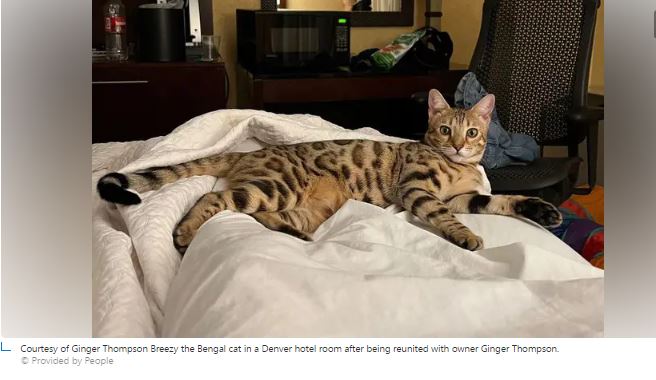
Oh Meowza, I have reported on too many cats who escaped the confines of their carriers to wander around airports. And here’s yet another one. Breezy, the Bengal cat escaped her carrier at the Denver International Airport.
Her human, Ginger Thompson from Washington explained what happened to FOX31. “They were getting me on the plane rushing me, and I set her down to get ready to put her under the seat, put my backpack up into the overhead bin, and was sort of jostled,” After escaping her carrier, the show cat fell between the plane door and jet bridge, landing on the tarmac below. Oh Meowza!!!
“I saw her fall, and she sort of tried to claw to stay up, but the momentum just took her down,” her human said. “And it wasn’t a jump or anything, it was more like just falling.”
Thompson shared news of Breezy’s scary situation on Facebook and included a heartfelt message in the update. “Breezy is more [than] a show kitty,” she wrote. “She and my other 2 are what keep me going.”
A friend of Thompson’s started a GoFundMe to help cover the cost of a hotel, so the distraught owner could stay near the airport while staff members searched for her missing cat.
After checking into the hotel, Thompson shared a screenshot of her text conversation with a Southwest ramp agent, who told her that “about a dozen” agents were actively searching for Breezy.
At the time, the Bengal cat had last been spotted “near some vents by [gate] C24” by the overnight crew, the agent said.
Two hours later, the worried owner shared another update. “It’s been a little over 24 hours [since] I lost Breezy. I’m going out of my mind worrying. Trying to be patient but laying here in the hotel waiting is killing me, and I’m losing any hope as each hour passes.”
“What has kept me going is all the support that is being offered and shown to get Breezy home,” she added.
A day into the search, Southwest employees found the show cat hiding in a ramp area at the airport.
“Breezy has been rescued,” Thompson wrote on Facebook. She went on to thank the entire Southwest crew for their “diligent efforts” to rescue her beloved cat “with care” — and shared that she would be offering them a reward for their hard work.
The owner also shared a photo of her text conversation with one of the crew members, who sent her a picture of the feline after she was discovered.
“Southwest ramp loves Breezy,” the employee texted Thompson, sharing a group selfie of the cat and the team that found her.
Thompson shared photos of Southwest employees’ successful search for Breezy, including a shot of the team holding flashlights.
“Southwest ramp crew are the best,” she wrote alongside the photos.
Thompson also shared snapshots from when Breezy was returned to her — including a selfie with the police officer who reunited them — and a photo of the show kitty licking her paw in the hotel room.
“Her chin is no [longer] bright white,” the owner wrote, adding that Breezy was “oily and greasy but safe.”
According to Thompson’s Facebook, she and Breezy are staying in Denver until the feline visits a veterinarian. Once the Bengal cat gets a clean bill of health, she and Thompson will return to Washington, where the owner’s other two kitties, Sammy and Beemer, await their return.
“They’re more than just show animals or pets,” Thompson told FOX31 of her furry friends. “They’re my family. They’re all I have.”
Two paws up to the good feline loving folks at Southwest!
Ah, nothing like first class and a catnip martini.
The good folks at Pets that Travel published information for 2023 of airlines that warmly welcome felines inside the cabin. This is the best way for felines to travel, not in the luggage/cargo hold. The Human worked in the travel industry and she saw first-hand that this wasn’t the best option for kitties.
First, let me make clear that no matter how warmly an airline might welcome us felines in the cabin area, we are still supposed to stay in our carriers and the last time I checked, none of the airlines serve catnip martinis.
Here are the 15 airlines noted in the article as being in-cabin feline friendly.
Aegean Airlines
Air Canada
Air Europa
Air France
Alaska Air
American Airlines
Delta
French Bee
JetBlue
Lufthansa
Southwest
TUI Fly
Turkish Airlines
United Airlines
Vueling
Some airlines allow humans to take two of their felines, some international carriers require the cat be microchipped and have an EU pet passport, that the cats must be no more than 11 inches tall and 18 inches long with most weight limits are 20 pounds and cats must be “well behaved” (no scratching, excessive whining or meowing, growling, biting or lunging)
Meowza some of these restrictions leave Oliver and I out of running as cat passengers. We’d each have to shave off 1 1/2 pounds and the no meowing and whining part would be a bit difficult too!
But, if your human thinks you’re in the running to be an inside-cabin passenger, check out the article to see what you need to do.
The Human was recently interviewed for the Cat Writer’s Association blog. As it is our policy to limit the exposure she gets on our blog (it’s about cats not humans) we relented in this case as she does talk about us quite a bit.
Happy Furiends! It’s a beautiful fall day in our neck of the woods and hope you’re enjoying the weather (whatever it is) in your neck of the woods.
This week The Human is giving a talk about judging and she decided to use Oliver as an example because he is one of the judgiest creatures she knows (Lily and I would agree)
I mean, look at that face and tell me he’s not judgy!
Oliver judges everyone and finds them wanting.
And of course, Oliver had something to say about my comment about his being judgy.
Okay, maybe he made his point. Lily has a tendency to be judgy too. She doesn’t sit in on the window sill just because she loves the view.
“I am not happy with this.”
And what is she judging and unhappy about? Can you tell?
Do you see what is making Lily unhappy ?
As for me, well I’m a go along to get along kind of guy and I really don’t understand why Lily and Oliver get their whiskers in such a twist.
“Really you two, you should just chill like me.”
Do I have any judgy furiends out there? Meow at me in the comments and let me know what you feel compelled to judge.
Ah, I love how fascinated the scientific community is with felines. This feline says that part of our allure is our mystery but still, humans continually try to figure us out.
Now there is new research suggesting our purr comes from a pad embedded in our vocal cords. This is a new theory. The old theory said that purring happens when (to quote the sciency humans), “through a special mechanism, with cyclical contraction and relaxation of the muscles in the vocal folds within the larynx that requires constant control from the brain.”
The new sciency take is, “Anatomical investigations revealed a unique ‘pad’ within the cats’ vocal folds that may explain how such a small animal, weighing only a few kilograms, can regularly produce sounds at those incredibly low frequencies [20 to 30 Hz, or cycles per second] — far below even than lowest bass sounds produced by human voices,” researcher Christian Herbst, a voice scientist from the University of Vienna, said in a university news release.
The findings were published online Oct. 3 in the journal Current Biology and are said to be not an outright contradiction of the previous theory, but a clear indicator that the understanding of cat purring is incomplete. Translation=we felines are still mysterious and you humans can’t completely figure us out.
A recent study concluded that millions of cat owners prefer their feline friend’s company to their partner’s. The study polled over 1,000 humans who lived with cats and found 49 percent would rather spend time with their furry friend, and 53 percent choose to do so most of the time.And what activities do these humans purrfers to do with their felines? The winners were taking a nap, sharing a cuddle, and watching TV. Then there was the 31 percent said they’d even rather share their duvet with their cat.
And a quarter of all respondents enjoy a snuggle more with their feline friend, while 47 percent also revealed they find their pet less irritating.
Another interesting factoid from the study was that three-quarters of owners speak to their cat more than once a day – with 23 percent confiding in their pet with information they’d never share with anyone else. Well DUH! The Human always says hello when she comes home and she says we are the best confidants in her life. I can’t tell you the traumas we’ve purred her through!
More than half the humans (51 percent) believe their own personality matches that of their cat – with affection, character, and friendliness the top traits desired.
And 31 percent said they look for the same type of traits in a pet as they do in a partner.
A third (33 percent) even think there are moments their other half gets jealous of the attention their pet receives over them.
The top reasons these humans would recommend getting a feline friend were companionship, improved mental health, and the unconditional love they give you.
And the main advice they’d provide would be to keep the litter box clean, adopt from a rescue, and keep them regularly checked over by the vet.
So there you go humans. If you’re feeling the lack of love in your life, maybe a visit to the shelter to find a feline soul mate will do the trick!
My regular readers know how fascinating I find stories of traveling cats. Now, TikToker @wifiadventure shows the adventures of a cat named Wi-Fi, and his human’s travels even on plane trips.
In her latest video, she shows how she brought a litter box for the cat to use on a flight to Japan.
The video, has 1 million views and 109,300 likes as of last week, and was titled, “Challenge #1: ‘Use the litter box on the flight to Japan.’” She reported his adventure this way; “It took some time for Wi-Fi to stretch and get adjusted to how loud the bathrooms are. The changing table was helpful because the ground is the loudest part & he felt trapped (cats like high places). We had our portable litter box, bag, scoop, crate, and of course the litter. Who knew learning how to take my cat to Japan could be so simple.”Many people commented in praise of the use of the litter box, in addition to how well her feline friend behaved on the plane. But there were others who weren’t so enamored of the plane litter box. “really cool to use the bathroom afterwards if you’re allergic,” someone snarked.
If you’re wondering about how WiFi was allowed on the plane, there are different policies regarding cats on aircraft. Most require a health certificate from a veterinarian. There are more rules for international flights and some carriers refuse to allow felines to travel internationally in the cabin.
Whether your feline would make a good flying partner will depend on the cat’s personality, how nervous he is and his health. You should always take your feline for a vet visit before you consider an in-cabin trip.
Aaaaaaand, here’s some more feline positive research. This research is from the University of Texas who have suggested that cat lovers show more mental prowess than dog lovers — and get this, it’s a result that has been reported by other researchers.
“One source characterized ‘the canine person’ as loyal, direct, kind, faithful, utilitarian, helpful, and a team player and ‘the feline person’ as graceful, subtle, independent, intelligent, thoughtful, and mysterious,” the Texas research stated. (Note, The Human purrticularily liked the graceful, intelligent and mysterious descriptions). She was less fond of the finding from the research that cat lovers were especially prone to neuroticism as well.
A Turkish documentarian, Ceyda Torun, observed a similar phenomenon with the psyche of owners while making a film on cats — pinpointing one particular trait in kitty parents.
“Their capacity for philosophical thought and introspection,” she told The Guardian. “It didn’t matter where they were from, or what level of education they had. You could see it in their eyes. They had that flicker of light. The light was on.”
Torun also said that loving cats often coincides with a person’s creativity and impression of beauty.
“There is something very aesthetically pleasing about a cat,” she added. “That’s why most artists are drawn to cats. Painters and poets tend to have relationships with cats, rather than dogs. Any feline of any size has this graceful athleticism, this prowess, this physical superiority that you can sense.”
As Robert de Niro saidin “Meet the Parents”: “A dog is very easy to break, but cats make you work for their affection.”
And that sentiment is corroborated by the editor-in-chief of “Your Cat“magazine, James Buzzel.
“They aren’t desperate to please you,” he told The Guardian. “So when they do come and sit on your lap, it’s an absolute honor.”
Despite the many positive findings, this feline still feels that the study continued to perpetrate some of the bogus ideas that people have about cats including coldness, shallowness of attachment…all a bunch of hooey!
Ah, I love the working cat and now there is a photo exhibition in Hong Kong that captures the whimsical life of shop cats in Sheung Wan and Sai Ying Pun, telling heartwarming stories about local merchants and their beloved feline shop assistants.
The Shop Cats of Sheung Wan and Sai Ying Pun Photography Exhibition can be seen at the hotel Mini Central until October 16. The exhibit features 18 photographs – paired with playful captions in English and Chinese – of cat shopkeepers taken by Erica, a Hong Kong photographer. Twelve of these photos can be found on postcards available for purchase.
“The theme of this exhibition is my favourite shop cats … a personal selection of those that hold a special place in my heart,” said the photographer, who started the well-liked Instagram page Sheung Wan Cats in 2020. The page has amassed over 23,600 followers and has around 1,200 posts featuring stray and shop cats in the two western district neighborhoods.
One of the photos features Fei Zai, a tabby reclining on a paper box at a dried seafood shop. Fei Zai made his first modeling appearance in the book Shop Cats of Hong Kong. He is a former stray that was abandoned in a park and then adopted by the dried seafood shop owner who hired him to keep the premises rat free. Fei Zai became a local celebrity and garnered quite a fan base.
The photo exhibit is a way to capture Hong Kong’s market culture and the wonderful felines that are an integral part of that culture.
The photo exhibition will run until October 16 from 11am to 9pm at Mini Central, 38 Ice House Street, Central. Entry is free.
Hello There Furiends! Alberto here. I hope you are enjoying fall as much as we are. Fall is our (and The Human’s) favorite season. We’ve been all been hard at work, purrticularly Lily who never is late reminding The Human of our various treat times during the work day. She gets an A+ as our food coordinator.
“Pardon me Human, sorry to interrupt but it’s early afternoon treat time.”
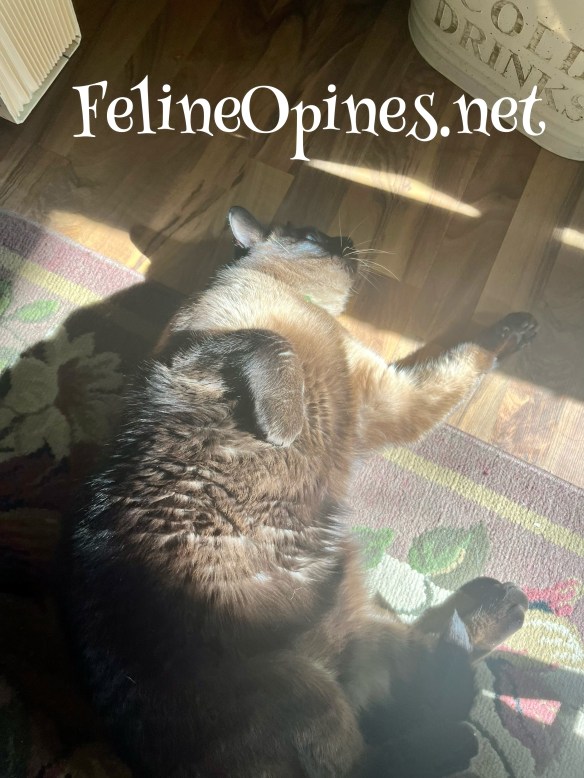
I am was busy putting together a tutorial for felines on how to thoroughly enjoy a sun puddle (especially important during these cooler days).
“You must position purrfectly in the sun puddle.”
I also have to schedule an “Al hug” in my busy work schedule.
“Phase one, jump on The Human’s lap and instruct her to prepare for her Al hug.”Step two is hard to capture on camera but this is one perspective of the completion of the Al hug.”
Oliver is spending his work time searching for the best bed on the cat tree. Unfortunately, today he commandeered my bed!
“So Al, gotta’ problem with this?”
That’s the past work week in our neck of the woods. How are things in your neck of the woods?
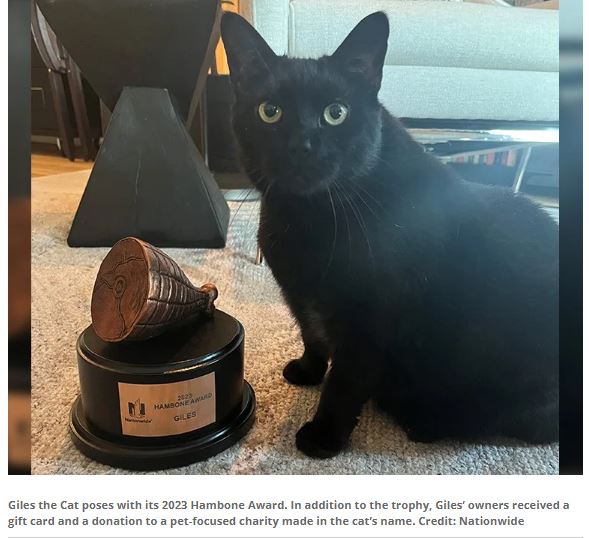
I have reported about this reward in the past and this year’s winner’s story bears v covering in my newsfeed. Nationwide is presenting its 15th annual Hambone Award to New York City’s Giles the Cat, who was injured in a sleeper sofa incident.
According to Giles humans, Reid and Kaitlyn, the debacle started with a visit from Reid’s parents and a night spent on a hide-a-bed.
Reid noted that it was a regular practice to make sure Giles wasn’t under the couch when the sofa was open as he would always race under it. “
In an early morning rush to the airport, the family neglected to check for Giles before folding up the bed, according to Reid, who added: “When they put the couch away, they didn’t realize that he was under there and … the mechanism or whatever bopped him in the face pretty good.”
After rescuing Giles from his sofa prison, they rushed to the vet. Giles ended up with some stitches and hopefully, an aversion to hide-a-beds.
The Hambone Award is given to bring awareness to the unique situations pets can cause and how pet insurance can help their owners manage the costs when an animal companion has a mishap, according to Nationwide. In addition to this award, Giles’ owners received a gift card and a donation made in the cat’s name to a pet charity of the family’s choice.
“Giles’ predicament shows just how easily an ordinary situation can become precarious for a pet,” Dr. Jules Benson, vice president of pet health and chief veterinary officer for Nationwide, said in a release. “We’re so glad that the quick actions of Giles’ family and their veterinary care team set him up for a speedy recovery.”
Nationwide reported that all of the nominated pets made full recoveries and their owners were reimbursed for the veterinary expenses covered by the company’s pet policies.
A Northwest Austin man has been reunited with his cat after he the Lyft driver drove off with the cat still inside. The man had taken Lyft to take his cat to the vet. When they arrived at their destination, the man got out of the car to come to the other side of the vehicle and get his cat who was in her carrier on the floor. Before he reached the door, the Lyft driver took off and the poor man ran after him. He notified everyone he could , contacted Lyft, put up posters and everything he could think of to do to get his beloved cat, Tux back. After about 36 hours Tux was found without her carrier, hiding under some stairs. Dear Lyft driver….I hiss in your general direction!
Philippine security guards adopt stray cats
A street cat named Conan found a new home and a job as a security guard. He now not only does his own job but motivates his human co-workers to do their job as well. Two paws up for working cats!!
I’ve reported on sailing felines before and am always fascinated when I come upon a new story. These two cats ended up traveling from Boston to the Bahamas on a 48-foot aluminum sailboat. Meowza! In September 2021, the Weiss family made this trip with their two “boat” cats. The family was living on the sailboat when they decided to sail to the Bahamas. Alex and Joy set sail with their daughter Kinsley and their two rescue cats. Peter is a 13-year-old black domestic short-hair and Pumpkin is a 3-year-old orange Maine Coon.
During the voyage, Peter and Pumpkin would often curl up beside or on a family member below deck. But they also enjoyed spending time on deck. “They slept in the sun and watched the sea birds. But it wasn’t always smooth sailing for these felines like the time Pumpkin insisted on being on deck even during rough weather.
The family arrived in the Bahamas in January 2022, and spent four months on the island. When they docked, the cats were a big hit. “They kind of served as ambassadors as we went everywhere. People would stop and start a conversation.’” Joy said.
The family spent four months in the Bahamas and described their trip with cats as a success. They now live in an East Boothbay home, but they do not expect to take any long sailing trips with their cats. “They both did really well sailing. They get along, but Peter is a little older and stiff, so he’s not as adept for long travels. So, I don’t think we will be taking another long trip with him,” Joy said.
Okay, this non-sciency cat has some reservations about this but then again, who am I to argue with human scientists? Evidently veterinary researchers have discovered that cats “glow” in the dark, according to a new study published in the journal Royal Society Open Science.
Evidently, we felines shine bright under UV light.
Scientists in Australia analyzed a museum’s collection of mammals to see how many glow in the dark with a UV light turned on. They also tested the glow to see if it was actually fluorescence and not a different phenomenon.
Lead author Kenny Travouillon, a paleontologist and acting curator of ornithology at Western Australian Museum, tested frozen and preserved mammal specimens. The findings were then sent to Curtin University in Perth for analysis under a range of UV lights.
They found that 125 species had the fluorescent properties that allow them to glow in the dark under a UV light, including the domestic species of cat (Felis catus).
“We report fluorescence for 125 mammal species, from half of all mammalian families and representing almost all clades in the mammalian phylogeny,” the scientists wrote.
Other mammals that were found to illuminate under UV lights include bats, platypus, koalas, polar bears, zebras, dolphins and humans.
While there are various forms of fluorescence, all include the absorption of light and a low-level emission, which often results in a glow.
“Fluorescence was most common and most intense among nocturnal species and those with terrestrial, arboreal and fossorial habits, with more of their body being more fluorescent,” the authors wrote.
Photographs showed that 125 species — 54 nocturnal and 71 diurnal — glowed under some sort of UV light, and the most fluorescent animals were typically white or pale yellow in color.
“While the amount and location of fluorescence varied between species, all exhibited some form of apparent fluorescence. Areas of fluorescence included white and light fur, quills, whiskers, claws, teeth and some naked skin,” the scientists said.
“It remains unclear if fluorescence has any specific biological role for mammals. It appears to be a ubiquitous property of unpigmented fur and skin but may function to make these areas appear brighter therefore enhance visual signaling, especially for nocturnal species,” study authors said.
And of course, The Human is now bent on purchasing a UV light to test this theory herself. We will publish her un-scientific results in an upcoming blog post.


























 Home | felineopines