
Oh Meowza, it’s November already! We love the colors of fall and Oliver spends a great amount of time watching the falling leaves. Too bad this will all be gone soon and we’ll have all the white stuff to deal with.
As we move toward winter, we really apurreciate finding sun puddles and like to take full advantage of them.

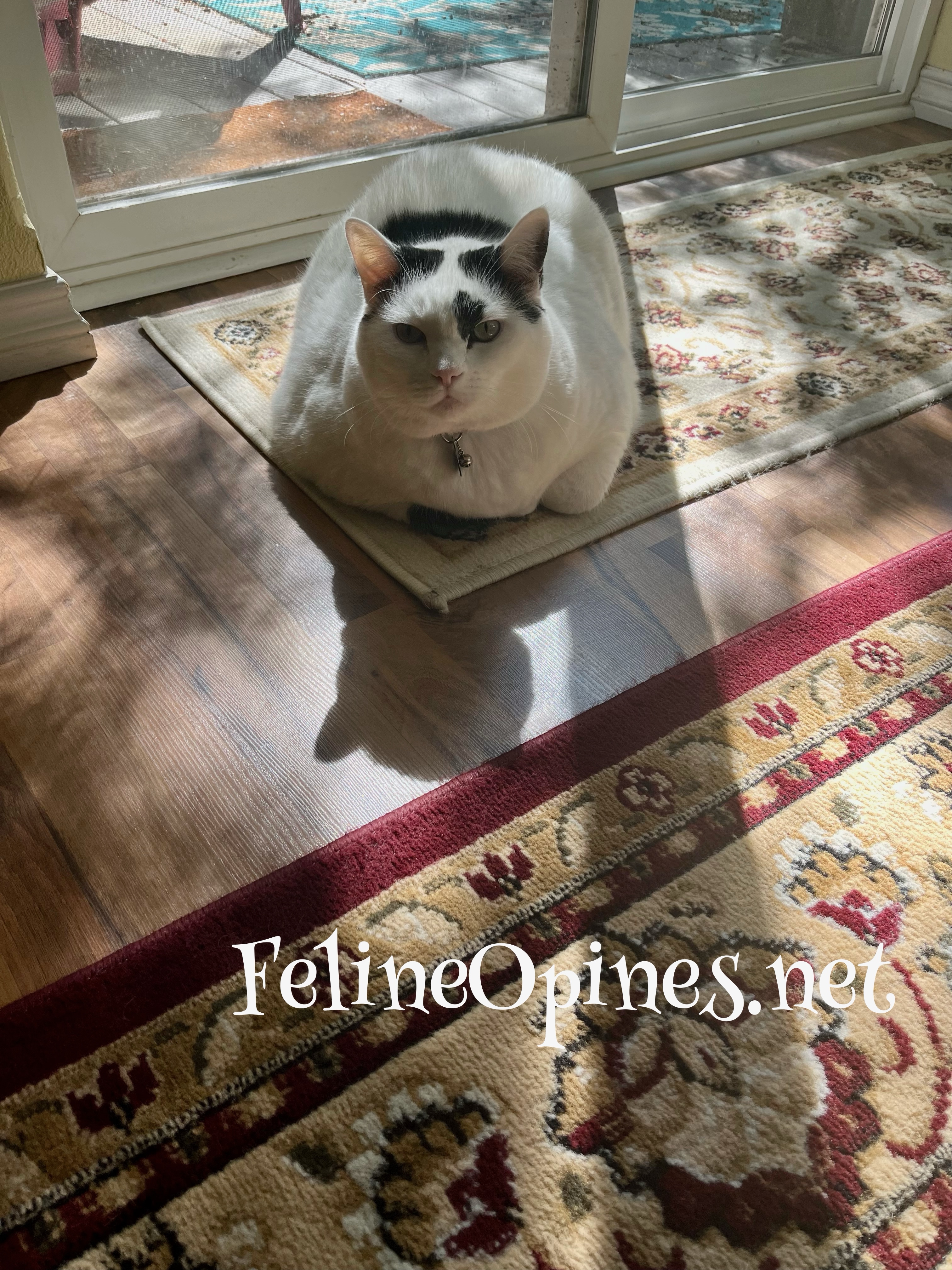
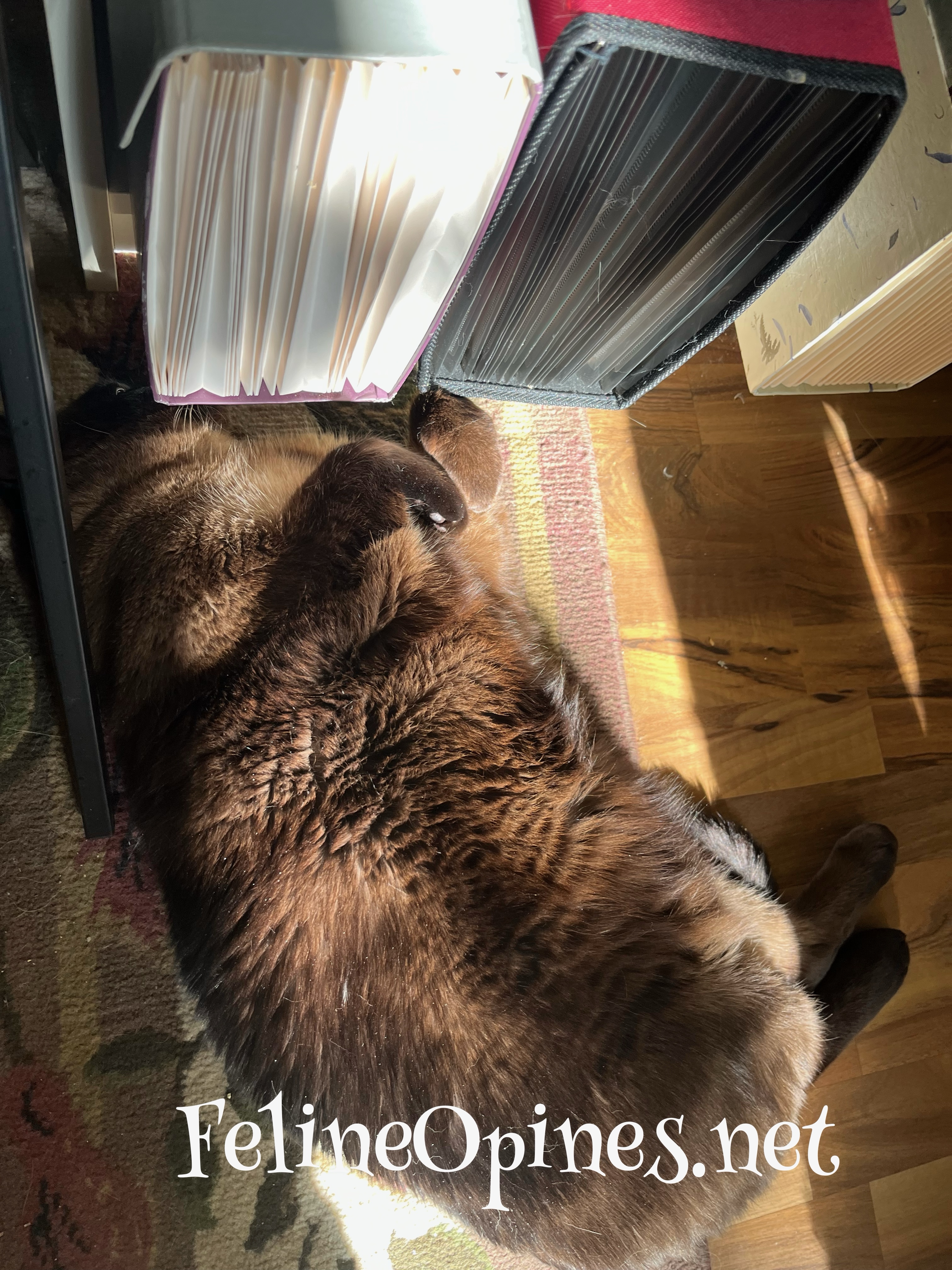
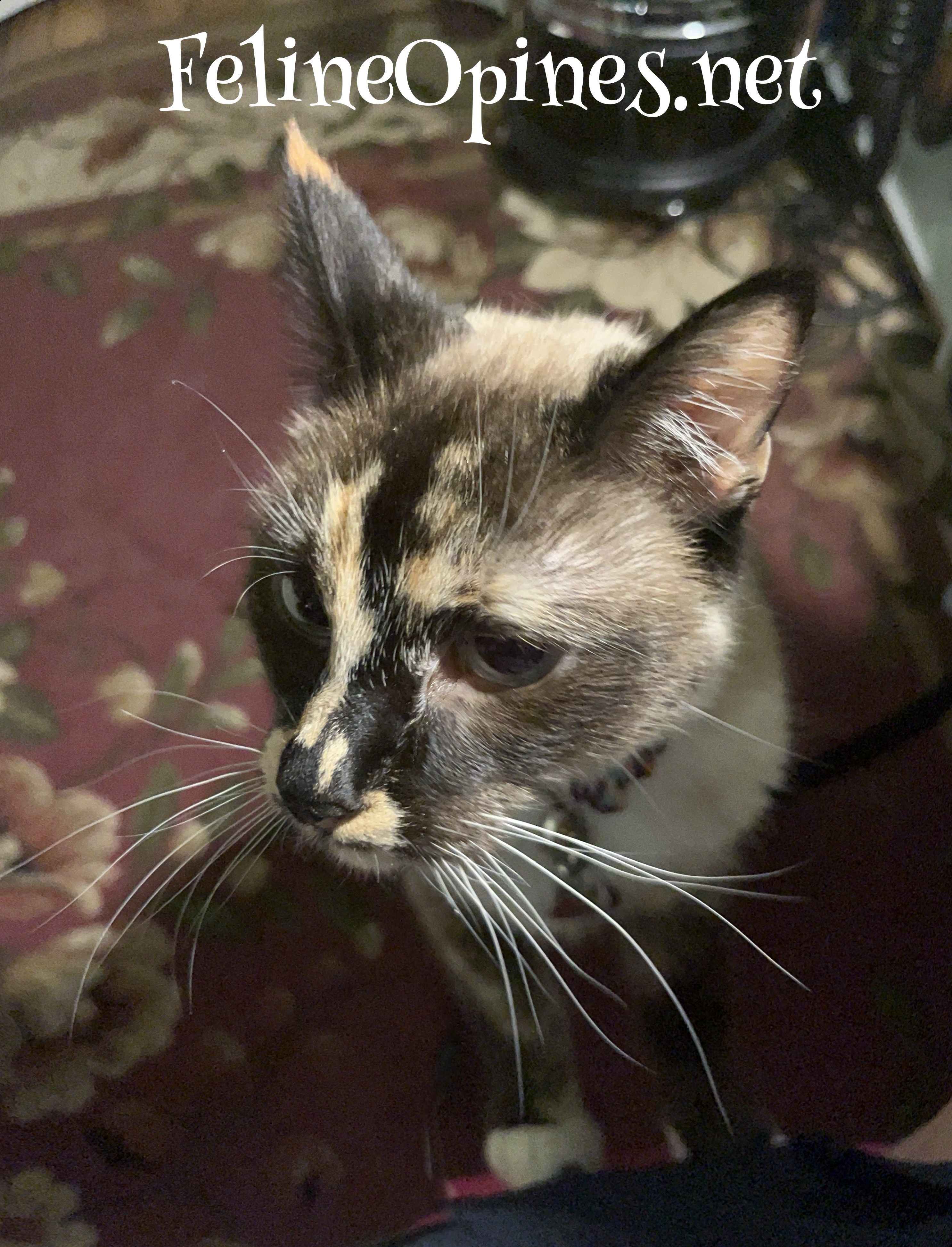
And speaking of fall, it’s a lot easier to spot visitors in the downstairs garden. Can you spot our visitor?

Can you see him now?
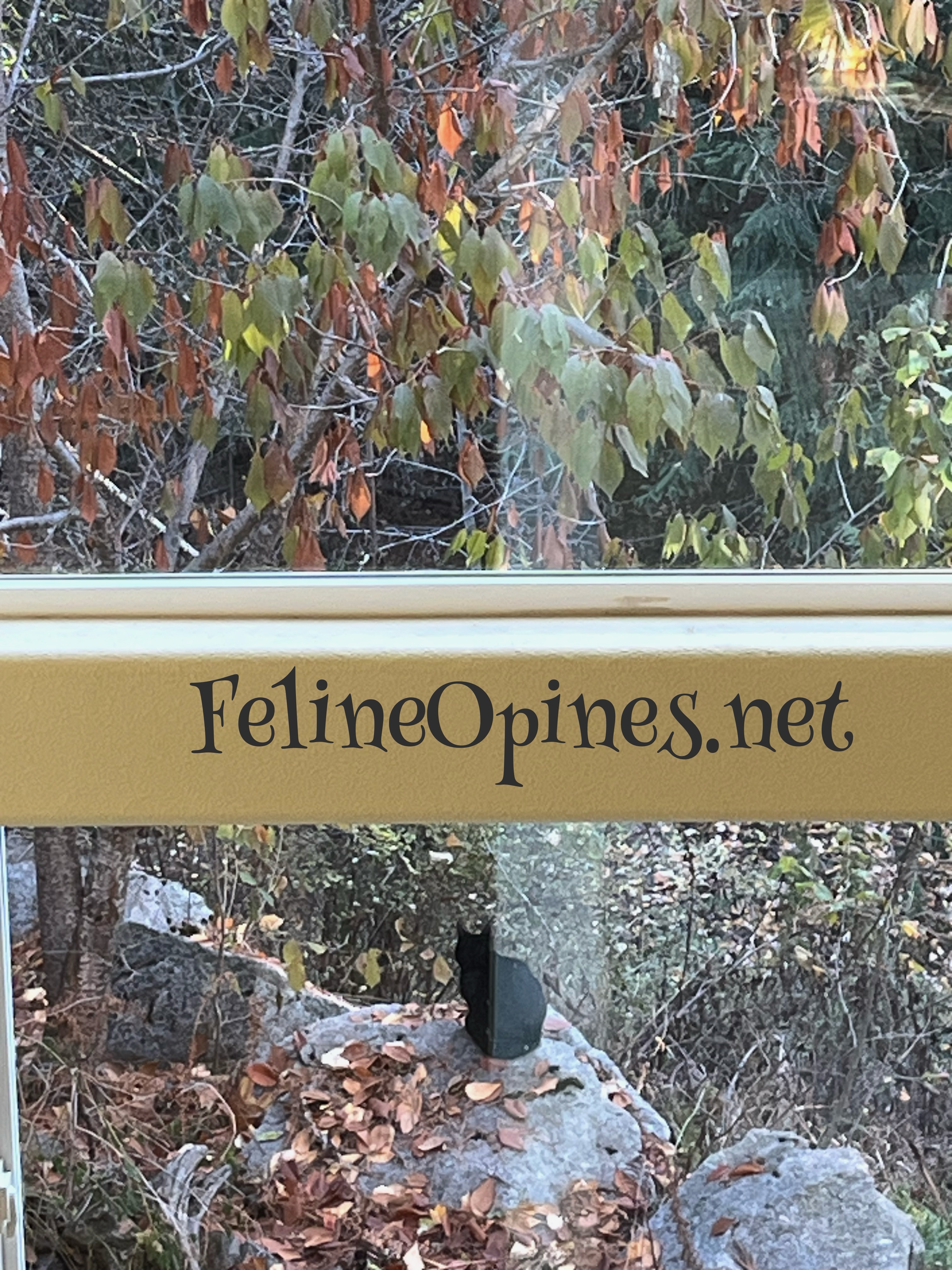
We get all kinds of visitors, sometimes they are much bigger and meaner than this one.
I hope you are enjoying your fall weather (if it is fall in your neck of the woods, some of our furiends in Australia and New Zealand are having spring now. I also hope you enjoy our feline news items this week.
Cats have 276 different facial expressions, study finds

And once again this feline is compelled to say, “Humans, cats are different, our purrsonalities are different and we react differently to things!”
In a study published in the journal Behavioural Processes last month, two US scientists counted 276 different facial expressions when domesticated cats interacted with one another.
“Our study demonstrates that cat communication is more complex than previously assumed,” study co-author Brittany Florkiewicz, an evolutionary psychologist at Lyon College in Arkansas, told CNN Wednesday, adding that their findings suggest that domestication has a significant impact on the development of facial signaling.
Florkiewicz explained that domesticated cats are typically more socially tolerant than their wildcat counterparts because of the way they live in proximity to humans, so the researchers were expecting to see expression in both positive and negative contexts—but they were surprised to “observe 276 morphologically distinct facial expressions.”
According to Florkiewicz and lead author Lauren Scott, a medical student from the University of Kansas Medical Center with a personal interest in cats, domestication allows more cat-to-cat social interactions, which is why the pair believed they would show more expression.
To collect data, Scott filmed 53 cats at a local cat café when both were based at University of California, Los Angeles, between August 2021 and June 2022. From the 194 minutes of video footage gathered, she recorded 186 feline interactions. The cats were adult domestic shorthairs of both sexes, all neutered or spayed.
Both researchers assessed the differences in expression with a coding system designed specifically for cats, called the cat Facial Action Coding System, and looking at the number and types of facial muscle movements. The study added that muscle movements associated with biological processes such as breathing and yawning were not included.
While they were not able to attribute a meaning to each expression they recorded, Florkiewicz and Scott found that 45.7% of coded expressions were friendly, while 37% were aggressive.
The paper detailed that a friendly expression is shown when the ears and whiskers move forward while the eyes close, and an aggressive cat has constricted pupils, ears flattened against the head and a tongue-swipe of the lip.
“Our hope is to expand our sample size to include cats living in other locations…looking at the facial expressions of cats living in multi-cat homes, feral colonies” and so on, Florkiewicz said.
Again I say humans, we felines are waaaay more complex than you give us credit for.
A cat’s tongue looks ‘terrifying’ up close — but there’s a reason why
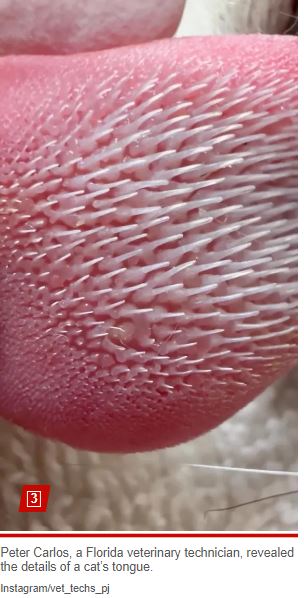
Does your human cringe when you lick them on the face? Here’s why
Peter Carlos, a Florida veterinary technician, revealed an up-close look at a cat’s tongue that has left many people speechless.
In the 12-second clip, posted on Carlos’ Instagram account, he films a feline that appears to be sedated, zooming into the cat’s tongue to show backward-facing spines called papillae.
The video has more than 35,000 views, who knew a cat tongue would interest so many people.
Papillae have tiny keratin protein spines that transfer large amounts of saliva from mouth to fur, explains National Geographic. Keratin is the same material that is made of cat’s claws and human fingernails.
The spines on cat tongues are curved and hollow-tipped, which help them groom themselves and pick up water.
SEE ALSO
Hook-like papillae covering the entire tongue make it easier for the cats to “remove meat from bones,.
We felines can take care of themselves for extended periods because our papillae help us feed and groom ourselves.
“Our study shows that [cats] are in fact, much more independent than canine companions,” Daniel Mills, professor at Lincoln’s School of Life Sciences, told Economic Times. “Many see a cat as an ideal pet for owners who work long hours.”
So there you go humans, everything you wanted to know about our tongues!
Crimes could soon be solved using cat DNA found at crime scenes with new method

The Human loved this story and she’s saving the info for her cozy mystery that features Oliver and I and some bad guys that get caught due to cat DNA.
Since a quarter of UK households own a cat, and the statically charged hairs of their felines easily cling to owners’ clothes criminal cat owners need to invest in a large supply of cat hair removal products because they could be placed at the scene of crime by the cat hairs they leave .
Still, cat hairs are not as good as the criminal’s own DNA, which contains telltale repeated stretches of genetic code called ‘short tandem repeats’ (STRs) – found in a type of DNA called nuclear DNA.
There is not enough nuclear DNA to detect these STRs in cat hair, because the root of the cat’s hair which contains this type of DNA has usually dried up.
Cat hair is, however, a better source of a type of DNA called mitochondrial DNA, passed down through females.
But this is usually broken into fragments within the hair, providing an incomplete DNA reading.
Because pet cats all share the same small number of ancestors, a typical sample could belong to thousands of different cats.
However scientists now have a breakthrough which could revolutionize cold cases such as unsolved murders by matching cat hairs to a particular cat.
Researchers can now take fragments of mitochondrial DNA and make billions more of them, using a PCR test rather like those used for Covid.
The fragments each spell out the same genetic code from the cat’s mitochondrial DNA – but each is like an incomplete photocopy.
When these are multiplied by billions, however, technology which might struggle with only a few copies can identify the genetic code the fragments have in common.
That recreates the full mitochondrial DNA of the cat – which was never possible before.
It was proven to work to identify the remains of a lost cat, using DNA from its hair verified using the cat’s son.
Dr Jon Wetton, a member of the team behind the breakthrough, from the University of Leicester, said: ‘Cat hair at crime scenes was disregarded until now, because cats have such similar DNA.
‘But this method can identify individual cats, even decades after they have died, so could be invaluable in cold cases.
‘In a previous murder case we applied the earlier technique but were fortunate that the suspect’s cat had an uncommon mitochondrial variant, as most cat lineages couldn’t be distinguished from each other.
‘But with our new approach virtually every cat has a rare DNA type and so the test will almost certainly be informative if hairs are found.’
The research is published in the journal Forensic Science International: Genetics.
The new technique is said to be around ten times more discriminating than a previously used technique which looked at only a short fragment of cat hair DNA.
Professor Mark Jobling, a co-author of the study from the University of Leicester, said: ‘In criminal cases where there is no human DNA available to test, pet hair is a valuable source of linking evidence, and our method makes it much more powerful. The Human is geeking out about this information but she’s a bit weird.
Online platform reunites lost cats with their owners

PetRadar (previously CatRadar), an online platform designed to help reconnect pet owners with lost pets, has expanded its offerings so that it now serves both missing cats and dogs. This makes The Human happy as she and her sister run a local lost pet group in our neck of the woods.
“After finding our 8000th missing cat, I knew we needed to start saving dogs, too!” expressed David Olthaar, founder and CEO of PetRadar, in a company release.
At least 15% of cat owners lose their pet in a 5-year period and some are never found, according to research published in Animals.3 Additionally, the American Humane states that approximately 10 million pets are lost in the United States each year.
To address this problem, 2 years ago, Olthaar “saw yet another blurry missing cat poster on a dark rainy night”2 and figured there must be a more effective way to reunite lost cats with their owners by leveraging the digital world. With the help of his best friend, they used sponsored posts on social media to advertise a missing cat in a 1km (~0.6 mi) radius surrounding the last seen address. “We wanted to use social media ads for good. And what’s better than reuniting lost pets with their owners?” expressed Olthaar, in the release.
Quickly, the duo found their first cat. “I remember when the first sighting of a lost cat came in. I couldn’t believe it. Reuniting them was a beautiful moment. I was even invited for dinner as a thank you!” added Olthaar.
This small project among friends became a successful online system worldwide to help find missing pets. This inspired Olthaar to change the name of the platform from CatRadar to PetRadar. The first dog has been found, and Olthaar is positive there are many more to come.
PetRadar features both free and premium services on its website. The free services include a printable poster, personal support & guidance, and a listing on PetRadar’s website. The premium features include all of those along with sponsored posts on social media, a personal dashboard, and notifications via text messages.
Stevenage railway cat Nala ‘breaks down barriers’ at rush hour
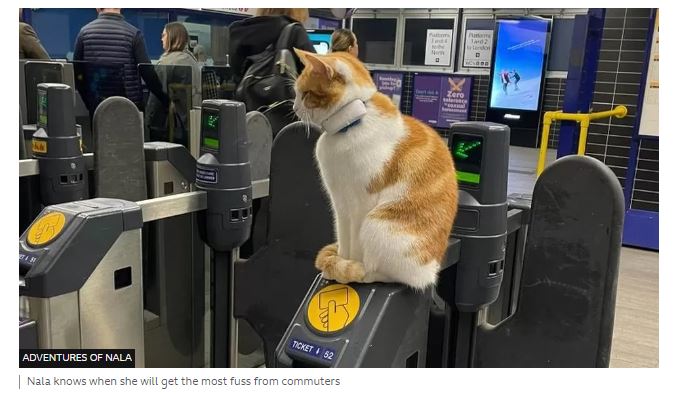
What would my Wednesday feline news segment be without a working car? Nala fits the bill purrfectly.
Nala, a ginger cat has been photographed hundreds of times at Stevenage station, usually perched on a ticket gate.
Owner Natasha Ambler set up a Facebook group where hundreds of people have posted photos of their encounters.
She said Nala loved the attention and headed for the station both morning and evening as “she knows what time the commuters will be there”.
The station manager said she was “breaking down barriers” and creating a community for local passengers.
The cat is four years old and although she lives close to the station – and has a loving home – she is very much an outdoors cat, Miss Ambler said.
Nala has always been adventurous, and is fitted with a GPS tracking device, so her humans have been able to see how widely she travels.
Miss Ambler told how she “mainly visits the railway station and the next door leisure park”.
“Once she spent most of the night in a cinema and a friend had to go and bring her home,” Miss Ambler said.
Nala wears a collar bearing her name and the details of her owners, but Miss Ambler said at one point she was receiving “about 20 calls a day from people asking if our cat was lost”.
“We had to get a second tag made up to tell people ‘she’s not lost’.”
Asked if she was concerned about her cat’s escapades, Miss Ambler said: “Not at all, she’s obviously well-loved and she’s very happy doing what she does – I just hope one day she doesn’t actually try to get on a train.”
Shaun Smith, Great Northern’s station manager at Stevenage, is also enamoured with their resident cat.
He commented: “She’s breaking down barriers by making people smile and starting cheerful conversations between staff and customers – helping our team and our tenants at the station feel part of the local community, which is rewarding for everyone.”
 Home | felineopines