
Happy Wednesday Furiends,
It’s getting a little nippy in our neck of the woods and the colors are so beautiful. Some humans are saying we’ll have snow later this week. We could care less, we’re pampered house cats but snow does mean a bit of work for The Human.
This week Oliver had a spa day and he’s working on his article about the experience. Below is a before and during photo. I can’t wait to see all the others and hear what this spa experience was all about (not that I want to go mind you).


Meanwhile, LIly aka “Princess Stabby Toes” who will never see the inside of a cat spa, relaxes near the fire.

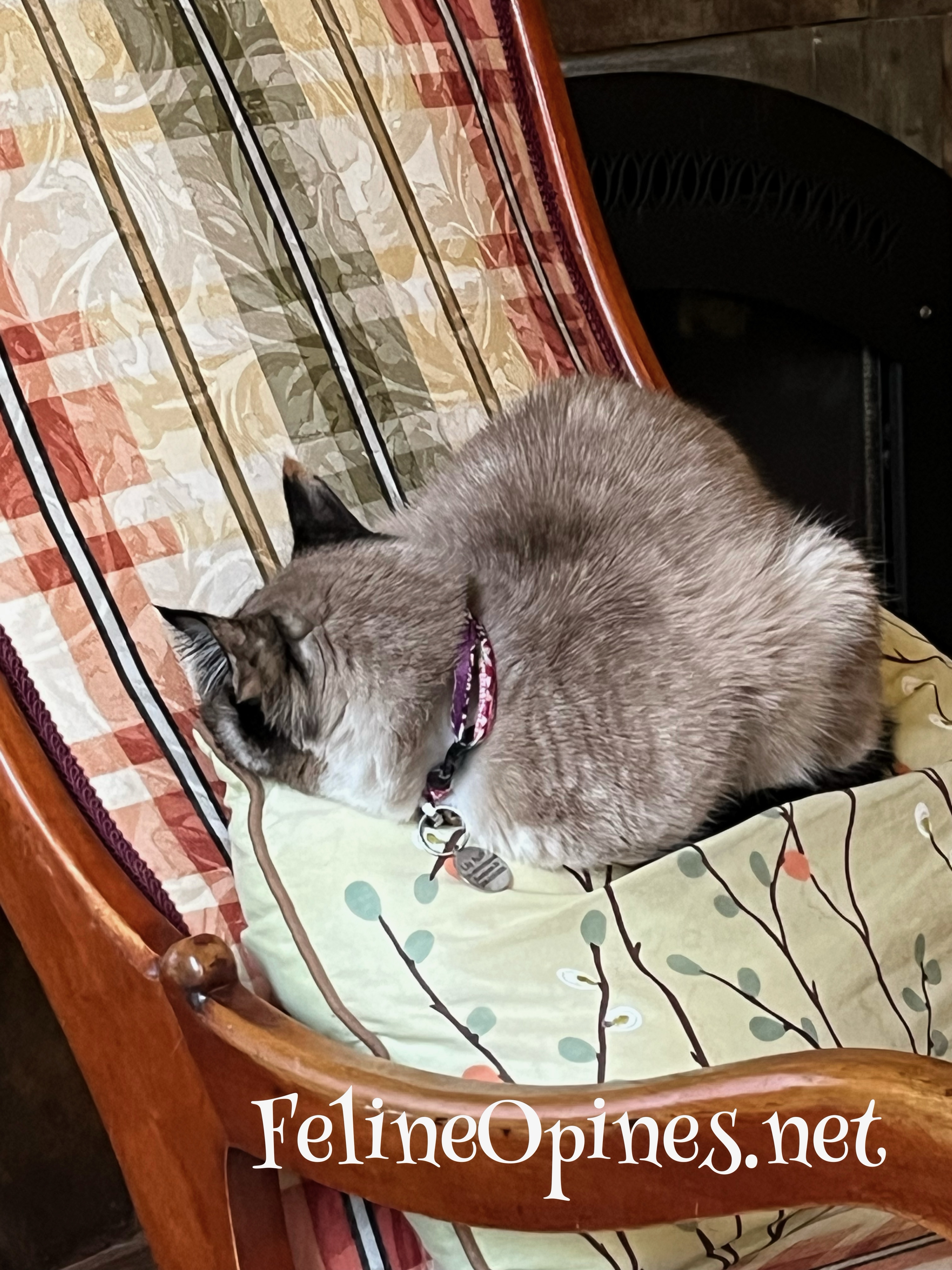
As the weather cools, we felines decide that banding together on the soft bedding is a good idea.

And Oliver has been busy doing his snoopervising.

What is Oliver’s purpose? It’s to keep us save from those falling leaves!

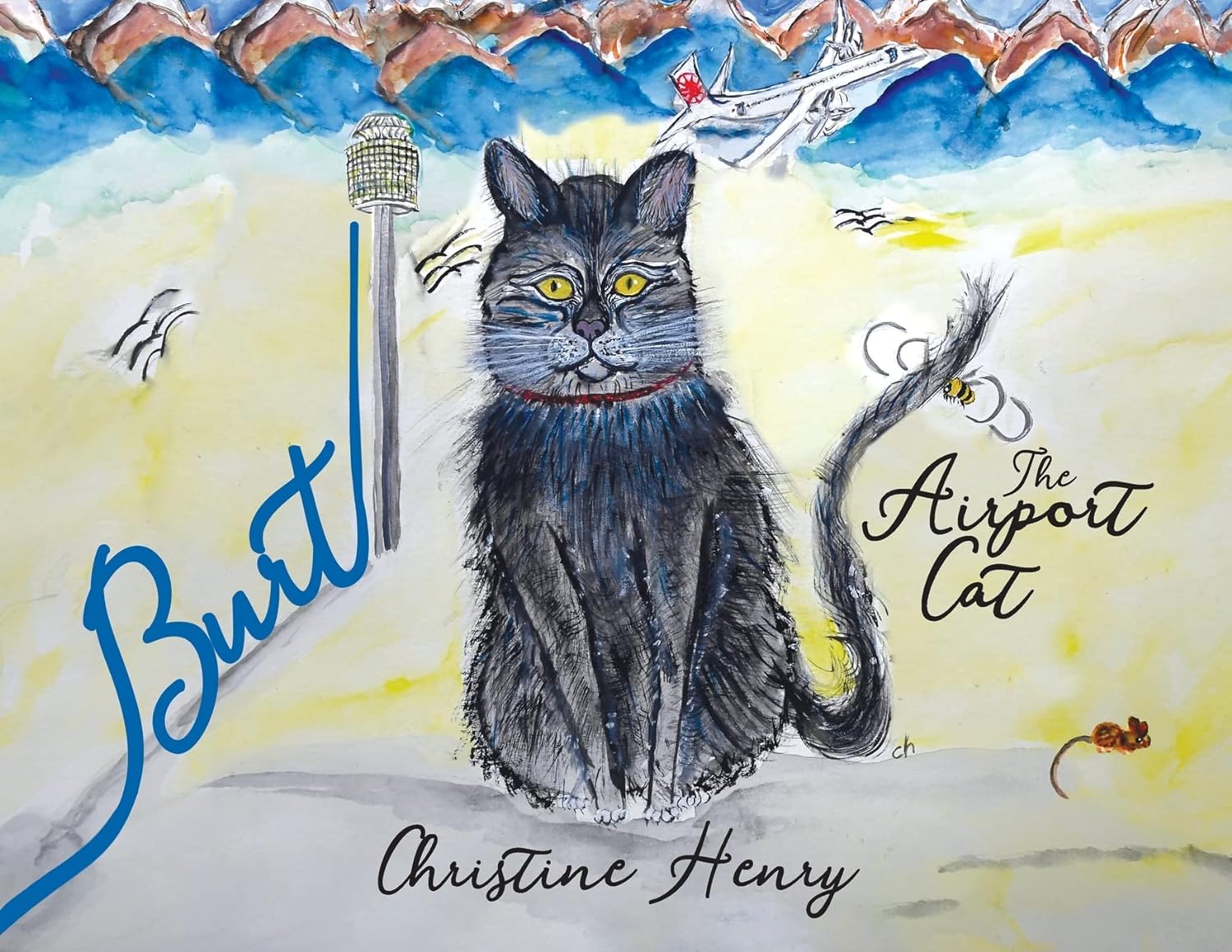
Well, that’s the week in our neck of the woods. Don’t forget to check out Oliver’s article about his spa day and be sure and comment if you want to be in the Oct. 30 drawing for the signed copy of the beautiful book, Burt, the Airport Cat.
‘Unadoptable’ feline now a ‘working cat’ in happy new home
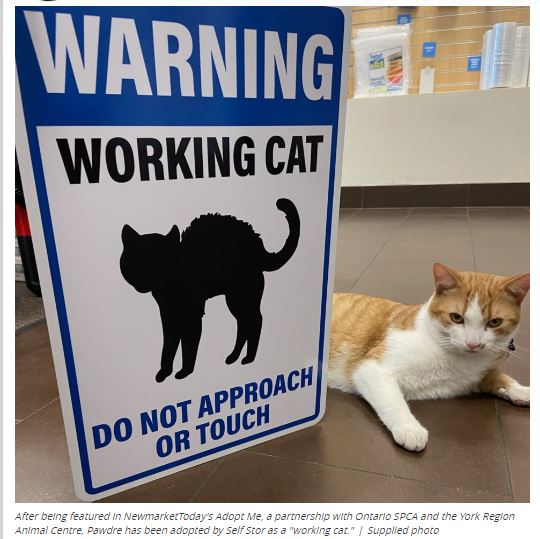
Pawdre was a cat in need of a home. He was taken in by the Ontario SPCA York Region Animal Centre after he was found wandering around the community.
After some time waiting for adoption, including being featured in NewmarketToday’s bi-weekly Adopt Me column, Pawdre has found a new home and even better,a new job doing what cats have long meant to do — mouse hunting, for Self Stor Storage in North York.
“He’s actually very comfortable with people, which is quite shocking to us and a lot of our customers love him,” Self Stor marketing manager Justin Morgan said. “He absolutely loves contact, which is quite weird to say for a working cat.”
Pawdre was successfully adopted thanks to the Ontario SPCA’s working cat program. My regular readers know that I am a big fan of working cat programs!
Ontario SPCA shelter health and wellness manager Monica Seto said the program has had success over its five years. It is a way to help adopt cats assessed to not do as well in a traditional environment.
Pawdre has taken to the humans that care for him and the humans who come to his place of business. Although Pawdre will do his job roaming the storage halls, he said he will come to the office portion of the building every morning to greet people as they come in.
The friendliness of Padre has led to customers asking to adopt him if the mousing job does not work out or wraps up, Morgan said. He added that he has also considered adopting Pawdre in that instance.
“Now he’s almost at the point (that) he’s a lap cat,” he said. “Such a dramatic change in his life in only a few months.”
The moral to this story furiends, is never, never write off a kitty too soon!
Veterinarians Use Little Devices To Make Giant Impact On Cat’s Life
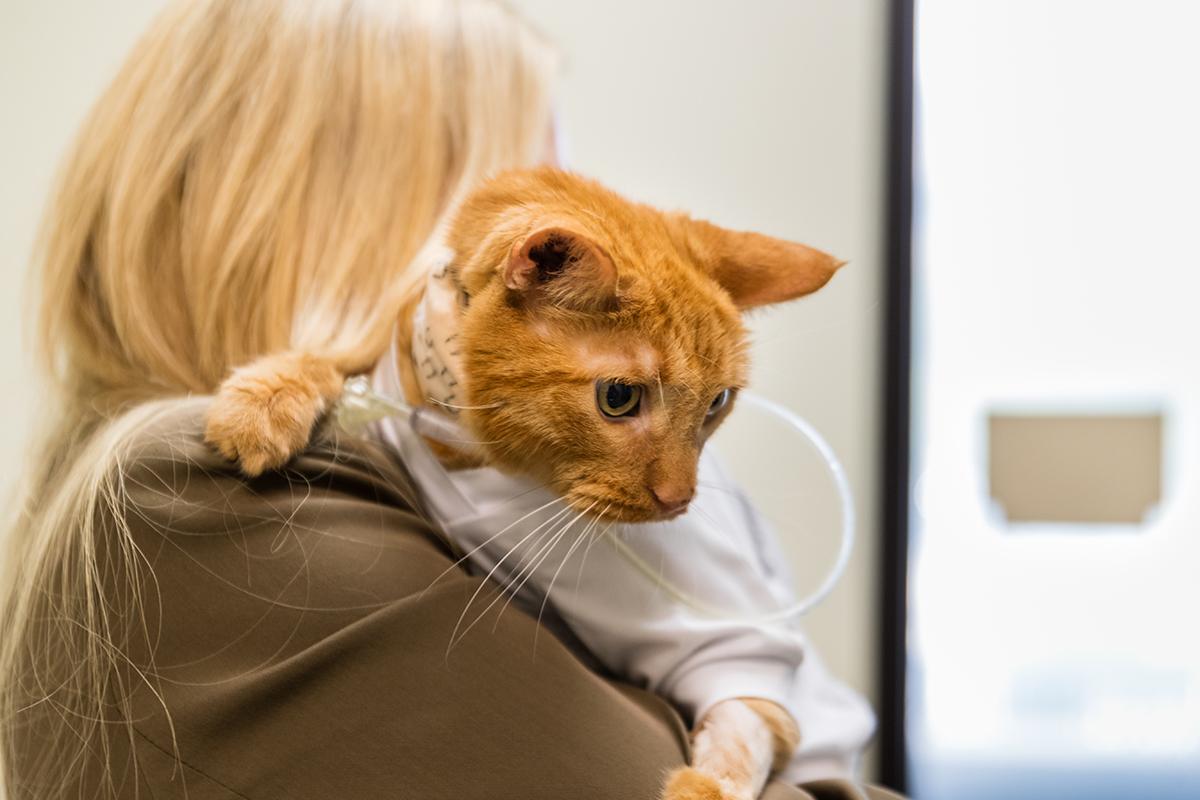
“James Dean,” a dapper orange tabby cat, lives a star-studded life. He fills his days playing mischievously with his sister, “Audrey Hepburn,” and his brother, “Elvis,” while his nights are spent snuggled up with his owners, Kaci and Melvin Thomas, who live in Austin.
After a sudden onset of a chronic illness created a life-or-death situation for the James Dean, his humans consulted the Texas A&M Small Animal Teaching Hospital’s (SATH) cutting-edge Interventional Radiology Service. They saved his life with a surgery not commonly offered at other veterinary hospitals.
James Dean battled urinary tract-related health challenges and was diagnosed with chronic kidney disease in the spring of 2022. Kaci worked with a veterinarian in Austin to manage his disease with a specialized diet, and for a while, the new diet was successful. Our own Jasmine had kidney disease for many years.
But after a year, the Thomsases noticed James’ appetite was disappearing and he was quickly losing weight. So, they took him back to the vet for complete diagnostic testing from the clinic’s lab.
“The labs came back on a Saturday, and James’ veterinarian called me immediately,” Kaci recalled. “She said that his kidney function looked really bad and that we should take him to the local veterinary hospital. The hospital kept him comfortable and stable over the weekend. Then, on Monday, the specialist and surgeons evaluated him with an ultrasound.”
James’ ultrasound revealed stones that were causing severe blockages in both kidneys.
“The specialist and surgeon mentioned a few options in terms of care, but they kept coming back to, ‘His kidneys are so bad. We think that euthanasia would be appropriate,’” Kaci shared. “I didn’t like those options, so I called his veterinarian in Austin. She referred us to Texas A&M. We picked him up from the hospital and drove to Bryan-College Station the next day.”
At the SATH, James was placed under the care of Dr. Genna Atiee, a clinical assistant professor in the Department of Small Animal Clinical Sciences and specialist in the SATH’s Interventional Radiology Service.
Atiee explained that kidney disease limits the kidneys’ ability to filter blood, causing excess fluid and waste from the body to build up and create additional health problems overtime.
“Once you lose kidney cells, recovery is less likely, because the kidney doesn’t have very much regenerative capacity,” Atiee explained. “We don’t have a way to reliably remove or dissolve kidney stones in cats without some type of major intervention, so when James Dean came to us pretty sick, we recommended subcutaneous bypass devices be placed in his abdomen that allow urine to go from his kidney to his bladder and bypass the obstruction.”
Atiee and her colleague Dr. Audrey Cook, another specialist in the SATH’s Interventional Radiology Service, are two of the only veterinarians in Texas trained to surgically apply the subcutaneous bypass devices.
“We get referrals for this surgery regularly from the metro areas like Dallas, San Antonio and Austin because even though this surgery is highly effective, it’s not something every veterinarian or even every surgeon is trained to do right now,” Atiee said.
With Kaci’s approval, Atiee placed a device on one of James’ kidneys, and a couple of weeks later, on the other kidney.
“These devices require some maintenance in terms of flushing the tubes to ensure patency, and we’re happy to do that here or to work with a local specialist,” Atiee said. “The most important aspect of success post-surgery is for the family to work with us or their primary veterinarian to maintain the kidney disease.”
Kaci brought James back to Texas A&M for the early maintenance of his devices, but she now works with their local veterinarian to maintain his diet, fluid intake, and devices.
“Dr. Atiee was amazing. She called multiple times to explain the procedure, which was especially helpful because I was a little nervous in the beginning,” Kaci said. “We grew really close to James’ veterinary team at the SATH. Dr. Atiee and the students inher service were excellent to work with.”
Today, James is doing exceptionally well; he’s back to a healthy weight and playing with Audrey and Elvis again.
“Here we are many months later and he’s still kicking, doing very well, and is still happy and loving,” Kaci said. “I really like that the SATH’s veterinarians provide the most advanced care possible. Everyone’s up to date on all the newest and best evidence-based care. I’d recommend them to anyone and would encourage others to work with the Texas A&M veterinarians.”
“There are things that we are doing that are not available in a lot of places and a lot of people may not be aware of these options, particularly in the urinary tract,” Atiee said. “We also do virtual consultations, so even if you live far away, we’re happy to schedule an online appointment and discuss options. We want to help these animals. We will do everything we can to get a patient in who we can help.”
Our Human knows first-hand what a horrible thing kidney disease and we are all very happy to hear of this medical solution.
‘Lonely’ Cat Who Fostered Dozens of Others Finally Gets Forever Friend

We are big fans of fostering, especially since Oliver and I are foster failures (The Human couldn’t bear to give us back after we were fostered and we’re very happy she made that decision.
Dunder is a rescue feline and he works with his human, Sara Bonner, of Washington, D.C., who fosters cats. Dunder has befriended 22 of these fosters, only to say goodbye when they find a home.
Funny enough, Bonner was not a fan of felines until she started a new job and found herself by cat people.
She said: “When one of my co-workers planned a weeklong vacation, they asked if I could take in their kitten while they traveled. Once she arrived at my home, I was instantly smitten. I’ll never forget shedding a tear on the day they came to pick her up. I applied to adopt Dunder from City Dogs and City Kitties Rescue five minutes after they left. I’m not totally sure how old he is, but my guess is 6 or 7.”
In a video posted to Bonner’s Instagram account, @dunderandfriends, Dunder can be seen cozying up an array of foster cats.
“I think that Dunder is so great with fosters because he has this innate ability to sense what the other cat needs,” Bonner said. “I’ve had fosters that hid for weeks before joining the apartment, whereas I’ve had others that instantly feel at home and are ready to play.
She continued: “Dunder does a good job of feeling out which cats need more time to warm up to him. We’ve had 22 fosters, and he’s befriended every single one. I also had my own little cat-sitting business for a while too, and we must have taken in 50-plus cats over the years. You’d be surprised—most cats do well with a buddy if you give them a chance.”
After five years living alone together, Dunder and Bonner moved in with Bonner’s boyfriend six months ago.
“It was a really exciting time, and we decided to take a break from fostering so we could settle into our new routine,” she said. “It was a well-needed pause. However, after a while it was clear that Dunder was lonely and needed a friend. I had always imagined adopting a second cat. However, I wanted to be a little further along in life and have a partner that could help me care for them, so once we were settled the moment had finally arrived.”
She went back to the City Kitties website and filtered by which cats had been there the longest. Mose had been stuck in foster care for eight-plus months.
“All of my fosters had gotten adopted within a month or two. It turns out that Mose kept getting passed over because of how shy she was. We don’t know exactly what happened to her, but it’s clear that she had some sort of traumatic experience with humans in her past before coming to City Kitties. She was incredibly skittish, and it took months before she allowed her foster mom to pet her,” Bonner said.
“But, wouldn’t you know it, Mose had a foster brother in her home who was super outgoing. Having a confident kitty friend around helped to put her at ease, and that’s exactly what we were looking for.”Bonner put a lot of work into making Mose feel comfortable, including working from the bathroom, where Mose decided to hide.
But it was Dunder who really made Mose feel at home. After moving into the loft where Mose was, Dunder stayed up there 24/7.
“He’d stay a few feet away, nap when she napped and [tried] to sneak in a sniff whenever she’d let him,” she said. “She was never alone up there. Dunder was determined to help her feel safe. Every day, I moved her food and a water bowl down a step so she’d have to come further into the living space.
“One night, after two weeks of hiding in the loft, Mose finally decided to join us in the living room. We were shocked! My boyfriend and I had to stop ourselves from jumping up and down so we wouldn’t scare her off, we were so excited.”
Today the cats are best furiends. They even spent a night alone when the humans went to a wedding and the two were cuddled up together, purring with contentment.
Ah, I love a happy ending!
Discover Why Cats Mimic Their Owners

Your first question might be, why do cats mimic humans?
Well, \we’re very smart and we’re also capable of recognizing emotions and solving problems to achieve a goal. Various studies show cats are as intelligent as a two-year-old. Cats instinctively learn from their surroundings to provide them with the best chance of survival.
So why do we felines mimic you humans? There are a few reasons:
- Familiarity and affection
- Instinctive learning
- Routine
- Effective Communication
Indoor cats are basically adult kittens. Because we don’t need to hunt for food, we see our humans as surrogate parents. All children will adopt traits from their parents.
Imitating our owners is a sign we feel comfortable with our humans. We see you as someone to keep us safe and protect us like a parent would. By mimicking the traits and habits of our owners, we’re showing they we care deeply. Studies show cats replicate traits like extroversion, openness, neuroticism, and emotional stability.
We show love and we’re also animals of instinct. Starting from an early age, cats learn from our mothers how to groom, hunt, and cover our tracks after using the bathroom (or using a litter box). Mother cats teach their kittens the majority of their life skills in the first few weeks of life, so they may learn to fend for themselves in the wild.
Aside from expressing love for our parents, we indoor cats will also mimic actions, assuming it is how we should act. We’ll watch how our humans interact with objects around them and learn to do similar things.
We’ll even imitate our siblings as a means to get more attention. Videos online show cats making sounds similar to a crying baby because they recognize the infant gets attention and food when they make crying sounds. Humans are easy to train, after all!
We love having a consistent routine and schedule. We’re territorial animals and perform our hunting and protection duties better when we have routine exercise, hunting, grooming, and napping throughout the day.
You humans know that when a routine changes, your cats get flustered and upset. This was seen towards the end of the lock down when remote workers were forced to go back into the office. Their cats were annoyed by the sudden change in schedule.
Cats learn their owner’s routines and keep them on their schedule as a method of taking care of our humans. We follow our owner’s schedule and imitate you to feel close and share those moments together. This is why many cats follow their owners into the bathroom to use their litter box at the same time or follow them into the kitchen for a shared breakfast. When the routine is broken, like when someone is trying to sleep in, the cat will meow, paw, and jump on the bed to wake their owners. (Note, The Human is quite aware that we do not like late breakfast!)
Having a routine is good to keep the mind sharp and focused. Cats know this and want to ensure you humans are keeping to a regular schedule.
Cats are capable of making over 100 sounds with our vocal cords. This gives us dozens of ways to communicate our wants and needs. We learn to mimic the sounds of our owners while walking around the house, sitting on the couch, or responding to other people in the house.
Imitating sounds is a tactical skill kittens learn to catch birds in the wild. When a cat is sitting at a window and making chattering sounds at the birds, it’s a way of communicating to the birds it is safe to be around. With this adorable sound, they hope to lure the birds into striking distance. (Yes, I know it’s evil but it’s what we do).
We also adopt non-verbal cues to communicate with our owners. Some cats will learn to imitate hugging or holding hands by placing their paws on their owner to show love. In our house the “Al hug” is a famous family tradition.
We use a variety of methods to imitate our owners. It all depends on how our humans express themselves and communicate. In fact, studies show that cats will imitate emotional cues and extroversion dependent on their humans. For instance, if an owner is extroverted and loves being social, the cat may also enjoy being around others. Inversely, if an owner is anxious and paranoid, the cat will adopt the anxious and paranoid attitude.
What are some of the ways we imitate our humans? Here are a few:
- Using the bathroom at the same time
- Taking naps at the same time
- Using vocal cues like meows, chirps, and chatters to imitate their owner’s inflections and tones
- Willingness to socialize
- Openness to other people in the house
- Openness to go outside
- Neurosis levels from mild to chronic
- Curiosity of surroundings
Now you may be wondering if we felines mimic other animals too. We do this in some ways, for instance if we live with a dog, we may adopt dog-like traits as a method of bonding with our canine buddy. Some cats will act like dogs by getting messy, wanting to go outside for walks, or being as social as dogs.
Sometimes we may treat other animals like cats as a sign of affection. For example, a cat may groom their dog pal’s fur as a sign of affection.
Much to The Human’s horror, we learned that cats can also mimic snakes! Instinctively, cats know that snakes are frightening creatures and we’ve learned to adopt that trait as a self-defense mechanism. By pinning our ears back, showing tour fangs, and hissing, we think we look and sound remarkably similar to a hissing snake. The Human is terrified of snakes and hopes so NEVER sees an encounter like this!
To sum up, we felines imitate our owners because we love you. Some of you humans may think we treat you like servants, but deep down we love and admire you. Even when we act up by knocking things off the furniture, we’re are doing it as a means to communicate our needs.
My challenge to you humans is to watch for all the ways your felines show you that they love you.
Peaches the “fat cat” swims to a more svelte physique
Peaches, a diabetic cat in Edmonton, has been going viral with swimming workout videos on TikTok. I told Oliver that he should take up swimming. He wasn’t amused.


 Home | felineopines